Digital Family Archive vs Photo Albums
Your family photos are fading, your stories are unrecorded, and your kids can't find anything. Here's why a digital family archive does what photo albums never could — and how to build one without losing what makes physical keepsakes special.
Patrick Moore, Founder • April 3, 2026
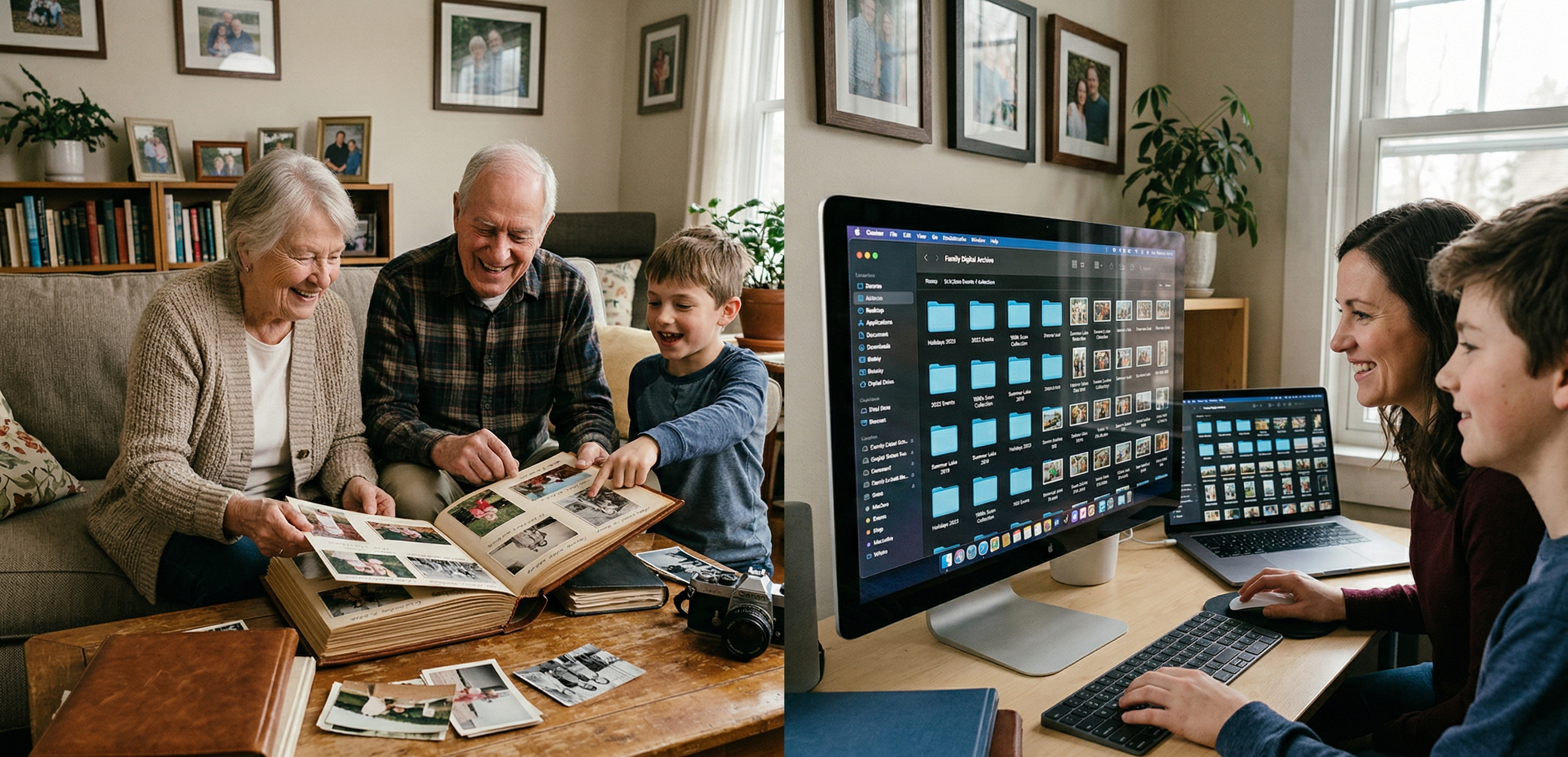
There's a photo album in your parents' house right now. You know the one — heavy, leather-bound, with sticky pages that tore every time you tried to move a picture. Maybe it's in a closet. Maybe it's in the basement. Maybe nobody's opened it in years.
Inside? Decades of your family's life. Unlabeled. Unorganized. Slowly yellowing.
And then there are the 2,000 photos from last year's vacation sitting in your camera roll, wedged between screenshots of parking spots and accidental shots of the inside of your pocket.
Neither system works. One's decaying. The other's drowning.
This isn't really about photo albums vs digital storage. It's about the difference between collecting memories and preserving them. Most families aren't doing either well. (If you're not sure where to begin, our guide on 5 gentle ways to start a family archive is a good starting point.)
What This Post Covers
This isn't a "digital good, physical bad" argument. Both have a place. But if your family preservation strategy consists entirely of photo albums and a camera roll, you're missing the most important part of the story — the actual stories.
The Case for Physical Photo Albums
Credit where it's due. Photo albums do something no digital system has fully replicated: they make memories tangible.
There's a reason your grandmother's photo album hits different than her iCloud library. You can hold it. Smell it. Sit on the couch with her and turn pages while she tells you who everyone is and why that particular Christmas was the one nobody talks about.
What photo albums do well:
- Emotional weight. A physical album feels important. It has presence.
- Curated by default. You only printed the good ones. Natural quality control.
- Prompts storytelling. Flipping through an album with a parent creates conversation.
- Doesn't require Wi-Fi, batteries, or a password.
But here's the part nobody likes to talk about:
70%
Photos Deteriorating
of family photos show visible degradation within 20 years without proper storage
0
Stories Captured
Most photo albums contain zero written context about what's actually happening in the photos
1 Copy
Single Point of Failure
If the album is lost in a flood, fire, or move, those memories are gone forever
The real problem with photo albums
Photo albums capture moments. They don't capture meaning.
You can look at a photo of your parents at their wedding and feel something. But unless someone wrote down why your dad was wearing that ridiculous tie, or that your mom almost didn't show up because she was terrified, that photo is just an image. The story dies when the storyteller does. (This is exactly why we wrote about the stories you'll never hear again — the window closes faster than most people think.)
That's the gap. Not between digital and physical — between image and context.
Beyond the Camera Roll: What a Digital Archive Does Differently
A digital family archive isn't just "photos on a computer." That's a digital version of the same shoebox.
A real digital family archive is a structured, searchable, shareable collection of your family's memories — photos, voice recordings, videos, written stories, and the relationships between them.
Here's what makes it fundamentally different from a photo album:
| Feature | Physical | Digital |
|---|---|---|
| Content types | Photos only | Photos, voice, video, and written stories |
| Organization | Chronological (if at all) | By person, date, event, or theme |
| Copies | One copy in one location | Backed up in the cloud — accessible anywhere |
| Finding memories | Flip through every page | Search by person, place, or keyword |
| Sharing | Must be in the same room | Shareable with family instantly |
| People connections | No link between photos and people | Tagged — see every memory with Grandma |
| Longevity | Degrades over time | Preserved indefinitely with proper backup |
Content types
- PhysicalPhotos only
- DigitalPhotos, voice, video, and written stories
Organization
- PhysicalChronological (if at all)
- DigitalBy person, date, event, or theme
Copies
- PhysicalOne copy in one location
- DigitalBacked up in the cloud — accessible anywhere
Finding memories
- PhysicalFlip through every page
- DigitalSearch by person, place, or keyword
Sharing
- PhysicalMust be in the same room
- DigitalShareable with family instantly
People connections
- PhysicalNo link between photos and people
- DigitalTagged — see every memory with Grandma
Longevity
- PhysicalDegrades over time
- DigitalPreserved indefinitely with proper backup
The killer feature: voice and story
This is what photo albums simply can't do.
Your dad's voice telling the story of how he met your mom. Your grandmother describing what her childhood home looked like. Your uncle's version of the fishing trip that's become family legend. (There's a reason we believe the sound of a loved one's voice is one of the most undervalued family heirlooms.)
A photo of that fishing trip is nice. Your uncle telling the story while you hear him laugh — that's irreplaceable.
Digital family archives let you attach voice recordings, written notes, and video to any memory. A flat image becomes a living, breathing moment.
Try This Today
Pick up your phone, call a parent or grandparent, and ask them one question: "What's your earliest memory?" Record the call (with their permission). You now have something no photo album will ever contain — their voice telling their story. That's the beginning of a digital family archive.
Where Digital Archives Win — Decisively
1. Search and discovery
In a photo album, finding a specific photo means flipping through every page. In a digital archive, you search "Grandma's 80th birthday" and it's there. Click "Dad" and see every memory he's in, across decades.
2. Voice preservation
By the time most people think about recording a parent's voice, it's too late. A digital archive makes voice recording as easy as pressing a button — and those recordings live alongside the photos and stories they belong to. Not sure what to ask? Start with our 25 questions to ask your mom or learn how to get a reluctant parent to share.
3. Family collaboration
A photo album sits in one house. A digital archive can be shared with family members across the country. Your sister in Seattle and your cousin in Miami can both add their photos from the reunion — and see each other's. (If you've struggled with shared albums, see how to make a shared album on iPhone — and why a dedicated archive goes further.)
4. Tagging and connections
Tag people in memories. Suddenly you can see every memory involving your grandmother, sorted by date, spanning 40 years. That's a life story told in moments — something no physical album can assemble. We call these Life Threads — the hidden connections between memories that reveal patterns across people and decades.
5. Protection from loss
Houses flood. Basements get water damage. Albums get lost in moves. A digital archive backed up to the cloud survives all of it. Your memories exist independently of any physical object. (We go deeper on this in the family backup plan — what happens when the only copy is gone.)
6. Stories behind the photos
This is the big one. Every photo has a story. Who was there. What happened before and after the shutter clicked. Why this moment mattered.
Photo albums give you the image. Digital archives give you the why.
The One Thing Photo Albums Do Better
Here's the honest truth: scrolling through photos on a screen doesn't feel the same as turning pages together on a couch.
There's an intimacy to physical albums. The shared experience. The weight of the book on your lap. The way older relatives naturally start narrating when they see a familiar face.
The answer isn't choosing one over the other. It's using both intentionally.
Keep the physical albums. They're irreplaceable artifacts. But don't rely on them as your preservation strategy.
Think of it this way:
- Photo albums are for experiencing memories together in person.
- Digital archives are for preserving memories so they survive beyond the people who lived them.
The album is the campfire. The archive is the library. You need both. (For more on longevity and format, see our comparison of digital vs physical memory books.)
80%
Lost in 3 Generations
of family knowledge disappears if not intentionally preserved and passed down
92%
Wish They Started Sooner
of people who've lost a parent say they wish they'd captured more stories
15 min
That's All It Takes
to record one voice memory that your grandchildren will treasure forever
Building Your Archive: A Practical Starting Point
You don't need to digitize 50 years of photos in a weekend. Start small:
Week 1: Record one story
Call a parent or grandparent. Ask one question. Record it. Save it. That's your first entry. Need inspiration? Try how to record your grandparents' stories — or explore the person you never knew your parents were.
Week 2: Upload 5 meaningful photos
Not 500. Just 5 that actually matter. Add a sentence or two about each one — who's in it, when it was, and why it matters.
Week 3: Tag your people
Create profiles for the key family members. Start connecting memories to people. This is where the archive becomes powerful — you can now see anyone's complete story.
Week 4: Invite one family member
Share access with a sibling, a parent, or a cousin. Now it's not just your archive — it's your family's.
Memory Murals Was Built for This
Memory Murals is a private digital family archive designed for exactly this workflow. Record voice memories with AI transcription, upload photos and videos, tag family members, and share it all with the people who matter — in a secure, invite-only space. No social media. No ads. Just your family's story, preserved for generations. See all features · View pricing · Start free today
Don't Wait for the Perfect System
The biggest mistake isn't choosing the wrong format. It's doing nothing.
Every day that passes without recording a story, capturing a voice, or adding context to a photo is a day closer to losing it permanently.
Photo albums are beautiful. Keep them. Cherish them. But don't confuse having a box of photos with having a preserved family legacy.
A digital family archive doesn't replace the album on the shelf. It captures everything the album can't — the voices, the stories, the connections, and the context that turns a collection of images into a living family history.
If unlimited photo backup is closer to your immediate need than a story archive, Memory Murals vs Capture walks through where the storage-volume tools fit versus where a story-shaped archive fits — useful before you pick which of the two you actually need.
Still weighing apps? Our broader roundup of the best memory sharing apps for families compares seven tools across the photo-album-vs-story-archive spectrum side by side, so you can see which one matches how your family actually shares.
And if you're planning to share the archive with extended family but don't want them editing what you've gathered, our view-only access guide covers the permission model that keeps the archive readable without making everyone an editor.
If you're the one person in your family doing the actual archival work — and most families have one — the solo archivists hub covers the editorial-control patterns specific to single-author archives.
Start with one story. One voice recording. One photo with a caption that explains why it matters.
The album can sit on the shelf. But the archive should be growing.
Keep reading:
Frequently asked questions
What's the difference between a digital family archive and a photo album?
A photo album shows what something looked like. A digital family archive captures what something meant — the photo plus the voice recording of who was there, the story behind the moment, the connections to other people and events in the family. Albums are static collections; archives are searchable, taggable, and grow with the family. Both have value, but they answer different questions: an album lets you flip; an archive lets you find.
Are physical photo albums still worth keeping in 2026?
Yes. Physical albums are durable artifacts that don't depend on electricity, accounts, or file formats — they survive moves, power outages, and tech generations. Keep the albums. The mistake is treating them as the family's complete record. Albums hold the photos; the digital archive holds the context. The album can sit on a shelf for fifty years; the archive is what your grandchildren will actually search through to learn who they came from.
What's the best way to organize family photos digitally?
Start with people, not folders. Tag every photo with who's in it, when it was taken, and one sentence about what's happening — that single sentence is the difference between an archive and a junk drawer. Avoid date-only folder structures; they make a photo searchable by year but not by person, story, or event. The most useful family archives are organized around relationships and stories, with date as a secondary filter rather than the primary one.
How do I create a digital family archive that will outlast me?
Use a tool that lets you export your data in standard formats (JPEG, MP4, plain text), share access with at least two trusted family members, and isn't tied to a single account or device that dies with you. Avoid platforms with no export path or proprietary formats. The longest-surviving archives are the ones where multiple family members can read and add to them — a single-owner archive disappears the moment that owner stops paying or stops logging in.
Can I keep both a photo album and a digital archive?
Absolutely, and most families that take preservation seriously do. The album is the campfire — the object you pull out when guests are over, when a grandchild visits, when you want to flip through pages with someone in the same room. The archive is the library — searchable, expandable, available across devices and continents. Use the album for moments; use the archive for memory. Neither one replaces the other.
About the author
Patrick Moore, Founder of Memory Murals
Patrick Moore is the founder of Memory Murals. He built it after realizing how much of his own family's history had quietly slipped away — to help families preserve their stories, voices, and photos while they still can.
Related Stories
Comparisons
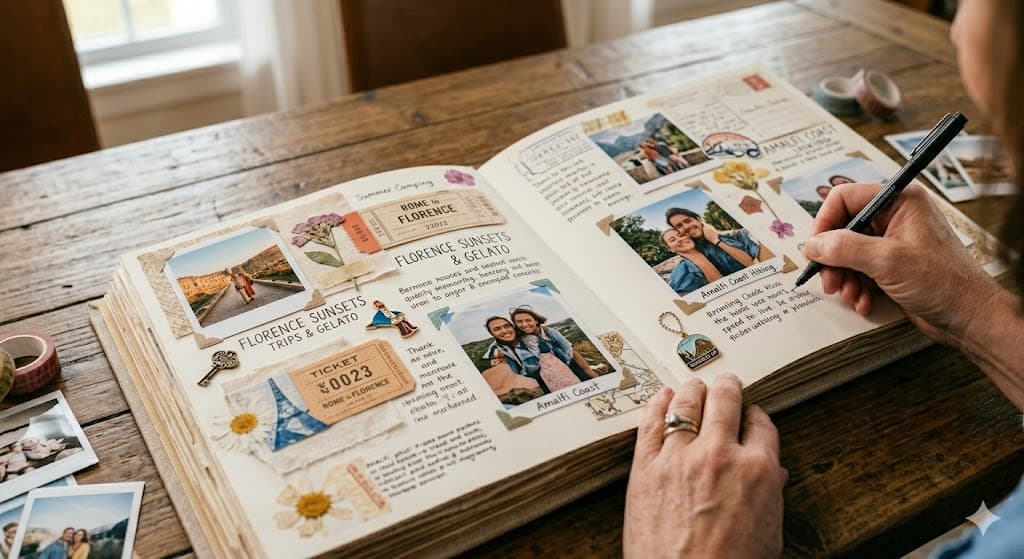
Digital vs Physical Memory Books: Which Preserves Your Family's Legacy Longer?
Deciding between digital and physical memory books for your family's stories? Explore which method offers greater longevity and preserves more of your precious moments.
Patrick Moore • March 27, 2026
Insights
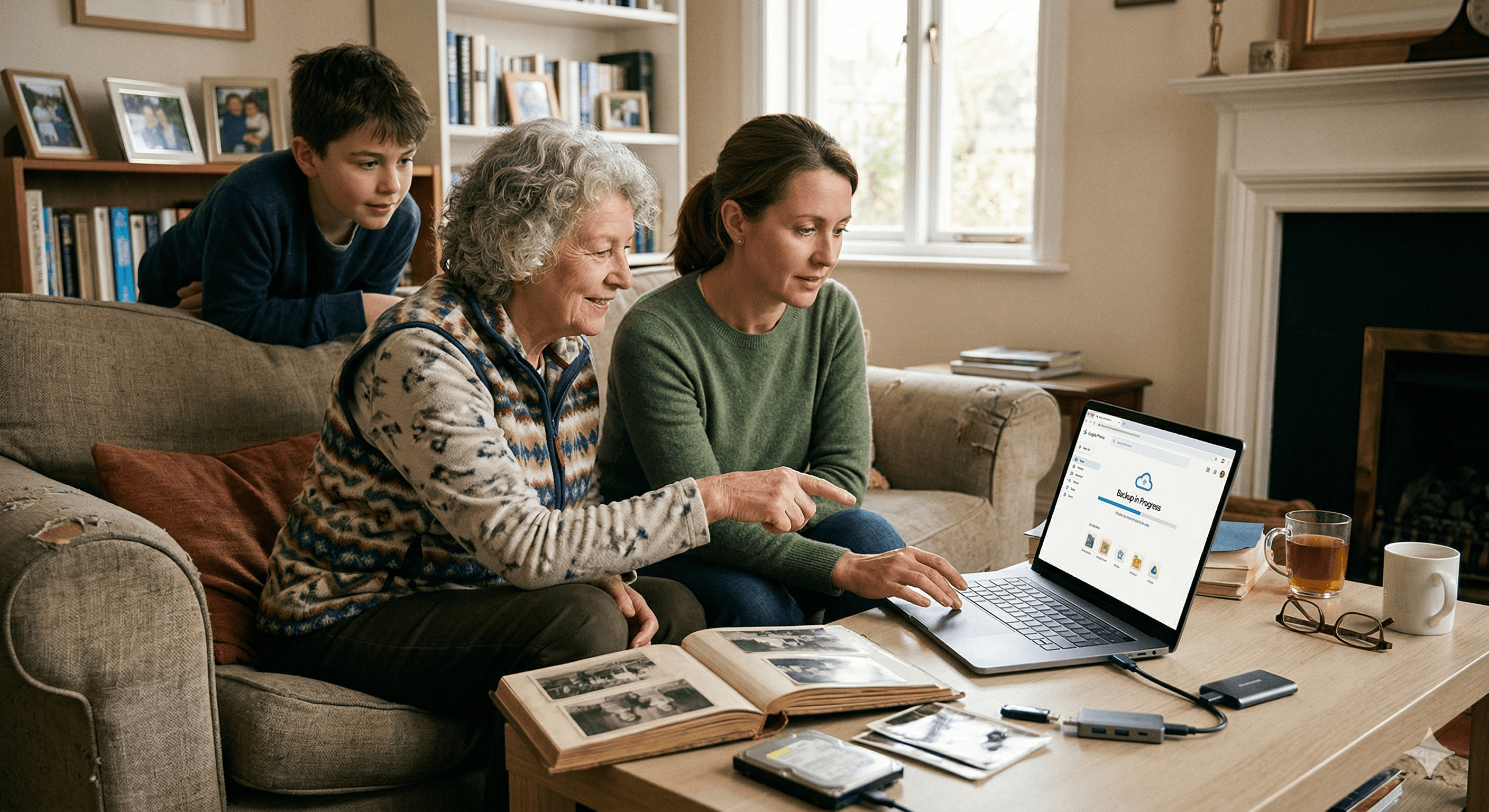
The Family Backup: Why the Most Important Data in Your Life Isn't on Your Phone
You back up your photos, your contacts, your passwords. But the most irreplaceable data in your life — your family's stories — has zero redundancy. Here's how to fix that.
Patrick Moore • March 31, 2026

Lists & Roundups
5 Gentle Ways to Start Your Family Archive
Preserving your family history can feel overwhelming — not because it's difficult, but because it matters. Here are five simple, meaningful ways to begin.
Patrick Moore • December 15, 2025