
You Have the Questions. Now Here's How to Save the Answers.
Every article gives you a list of questions to ask your grandparents. Almost none of them tell you what to do next. Here's the part nobody writes: how to actually capture the answers so they outlive the conversation.
Patrick Moore, Founder • April 11, 2026
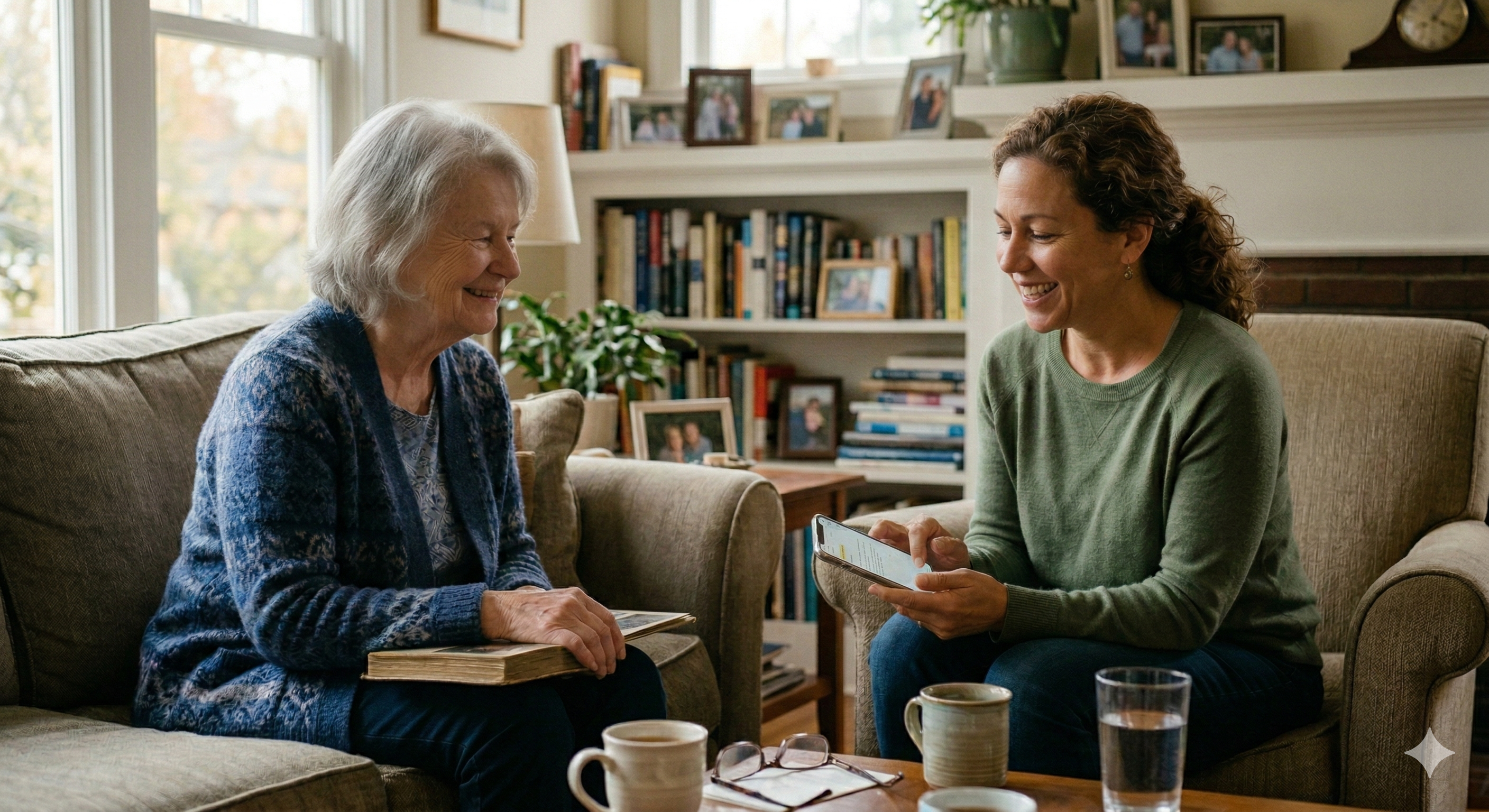
You've been here before.
You searched for "questions to ask my grandparents" or "family history interview questions," and a dozen listicles handed you lists of 50, 100, even 150 questions. You saved one. Maybe you even printed it. And then — for most people — life kept moving and the list got lost in a browser tab you eventually closed.
Here's the thing nobody writes about: the questions aren't the hard part.
The hard part is what happens after you ask them. You sit across from your grandfather on a Sunday afternoon, you ask him to tell you about his childhood, and he talks for forty-five minutes. He laughs at something he hasn't thought about in fifty years. His voice cracks when he mentions his brother. You feel the weight of it.
And then you drive home, and by Tuesday you can only remember the outline of what he said. By next month, you can't remember which stories were his and which ones your grandmother told you at Christmas. By next year, when you finally try to write it down, it's your version of his story — not his.
This post isn't another list of questions. It's the part that should have come next. Here's how to actually capture the answers so they outlive the conversation.
For the all-relationships version of this method — covering parents, grandparents, veterans, spouses, the question patterns, and the archival side — see our complete family interview method. This post is the grandparent-specific spoke.
If You Haven't Picked Your Questions Yet
Start with our companion list: 40 questions to ask your grandparents before it's too late — every question paired with why it matters, designed specifically for the conversations only grandparents can have. Then come back here for the part nobody writes about.
The Problem With Writing It Down
Your notes will capture what she said. They will never capture how she said it.
They won't capture the forty-year-old laugh that broke loose when she remembered her first dance. They won't capture the word she used for her father that you've never heard anyone else use. They won't capture the way she went quiet for a full second before the hardest sentence, and how that silence told you everything the sentence couldn't.
The voice is the memory. The words are just the summary.
What Notes Preserve
The facts. The names. The dates. The outline of what happened. Enough to write a family tree — not enough to recognize the person.
What Notes Lose
The voice itself. The pacing. The accent she dropped from her hometown. The laugh that sounded exactly like your mother's. The things she never would have said twice.
There's a reason we ache when we hear an old voicemail from someone we've lost. It's not the words. It's the sound of them being spoken by a specific person who used to be in the room. Written notes can't do that. Audio can.
The Real Cost of Waiting
Most people don't record their family's stories because they assume there will be another Sunday. Another holiday. Another easy moment. But the people we love don't usually announce the last conversation, and the stories that seemed safe at Thanksgiving can disappear in an instant. This is how fast a voice can go silent.
What "Recording" Really Means
When most people say they want to "record" their grandparents' stories, they picture a tape recorder on a kitchen table. But recording is actually four separate things, and doing just one of them isn't enough.
1. Capture
Save the audio of the actual conversation — in their voice, in full, without compressing it into your own words.
2. Transcribe
Turn the audio into searchable text, so you can find "the story about the train station" in five seconds instead of an hour.
3. Organize
Connect each story to the person it's about, the date it happened, and the other memories it's related to.
4. Share
Give the rest of your family — siblings, cousins, grandchildren yet to come — a way to hear what you heard.
If you only capture the audio, you'll have hours of recordings sitting in a folder you never open. If you only transcribe, you lose the voice. If you don't organize, you can't find anything. If you don't share, everything you collected lives and dies with you.
The goal is to do all four, as close to effortlessly as possible.
The Actual Step-by-Step
You don't need a studio. You don't need lighting. You don't need a list of 100 questions. Here's the format that actually works.
How to Run a Recording Session That Won't Feel Awkward
Pick three questions, not thirty
People freeze when they feel interviewed. Three good questions is enough to fill an hour. The fourth and fifth will come naturally once they're warmed up.
Start with a soft question
Not "tell me about your childhood." Start with something small and specific — "What did your kitchen smell like on Sunday mornings?" Concrete details unlock everything else.
Press record and forget about it
If they can see the recorder, they'll perform for it. Put the phone face-down on the table. After two minutes they'll stop noticing.
Don't interrupt
Every time you jump in with a follow-up question, you break the rhythm. Let them trail off. Let them pause. The best stories come out of the silence you thought was a dead end.
Stop before they're tired
Forty-five minutes, maximum. Less if they're over 80. You can always do another session next week. A tired storyteller remembers less and edits more.
Save it somewhere you'll actually find it
This is the step everyone skips. A file named "voice_memo_2026_04_11.m4a" buried in your phone isn't preservation. It's a time capsule you forgot to label.
That last step is where most family interview projects quietly die. You do the hard work of recording the conversation, and then the audio file sits on your phone until you lose your phone. Which brings us to the part most listicles leave out.
Your Three Realistic Options
Forget the gear reviews. Here's what actually works for families, ranked by how much the work each one leaves for you to do later.
Option 1 — Your phone's voice memo app
Good For: First Try, No Commitment
Open-and-record is fast. Every phone has it. You can start today with zero learning curve. The audio quality is surprisingly good.
The problem: Nothing happens to it after you record. You'll have 47 audio files with cryptic names and no idea which one is the story about your grandfather's first car. A year from now, you'll still be meaning to "organize them someday."
Option 2 — A written journal or notes app
Good For: Quiet Reflection, One-Person Projects
Easy to start, easy to share, doesn't feel intrusive. Useful if your loved one freezes up around recorders.
The problem: You're typing up your interpretation of what they said. The voice is gone. The specific phrases they used are gone. Your brain fills in the gaps with its own version, and that version slowly replaces the real one.
Option 3 — A tool built specifically for this
Good For: Actually Finishing the Project
A purpose-built family memory tool handles all four steps — capture, transcribe, organize, share — in one place. You record the conversation in the app, it transcribes the audio automatically, it tags the people mentioned, and it stores everything in a private family archive that your siblings and grandchildren can access.
The advantage: You do the asking. The tool does the remembering. And the finished archive is something your whole family can add to, not just you.
If You Want the Questions in One Place
Most listicles give you questions grouped by theme — childhood, love, work, regret — but scattered across ten different websites. Memory Murals has 50 guided prompts built in, organized by category, designed specifically to be answered out loud.
50
Guided Prompts
across 9 categories from early childhood to lifetime reflections
9
Life Chapters
from early life and family, through work and purpose, to wisdom and legacy
1 tap
To Start Recording
pick a prompt, hit record, let them talk
You pick a category — "Early Life & Childhood," "Love & Relationships," "Wisdom & Legacy" — and it hands you a question ready to be asked. You record the answer in the app, AI transcribes it, and it's saved to a private space only you and your family can access. No folders, no file names, no hunting for it later.
The Whole Flow, Without the Friction
Here's what it actually looks like to go from "I should record my grandmother's stories" to "my whole family has access to her voice forever."
From Question to Preserved Memory in Four Steps
Open a Legacy prompt
Pick a question from the 50 guided prompts, or write your own. Sit down with your loved one and start a conversation.
Record in their own voice
Tap the mic and let them talk. Their actual voice, their actual laugh, their actual pauses — all captured in full.
AI transcribes and titles it
The recording is automatically transcribed to text and given a title. You get both the audio heirloom and a searchable version you can read later.
Save to your private family archive
The memory is added to your timeline, tagged to the people it's about, and shared with the family members you've invited. It's searchable, it's permanent, and it's private.
What used to be a notebook full of summaries becomes a living archive in their own voice. And the next time a cousin asks "did Grandma ever tell you about the summer she moved to Toronto?" — you can play her answering that exact question, from a conversation you had on a Sunday afternoon three years ago.
Why Most Family Recording Projects Fail
It isn't because the questions are wrong. It isn't because people don't want to be recorded. It isn't because the technology is too complicated.
It's because there's a gap between "I should do this" and "I have a system that works." People get stuck in the gap. They record one voice memo, they take a few notes, they promise themselves they'll organize it later, and later never comes. The audio file gets lost when they upgrade their phone. The notes get lost when they close the browser tab. The conversation itself becomes a story about a conversation — fading a little more each year.
The Real Goal
You're not trying to produce a documentary. You're trying to make sure that one day, when your kids or grandkids ask what she was like, you have something to hand them that isn't just your memory of her. You have her — her voice, her words, her stories — in a place that won't disappear.
The hard part of family history isn't asking good questions. It's building a system where the answers don't get lost the moment you stand up from the table. Everything else flows from that.
Start with one session. Three questions. Forty-five minutes. A tool that handles the boring parts so you can focus on listening. Do that once, and you'll have something that your whole family will still be thanking you for in twenty years.
If a family reunion is coming up — usually the only time the elders are in the same room as the grandkids — the family-reunion memory archive guide covers how to set up an "elder corner" with a phone and a quiet chair so the stories you've been meaning to capture finally get on tape.
Start preserving their stories today. Try Memory Murals free →
Frequently asked questions
What's the easiest way to record my grandparents' stories?
Start with the phone in your pocket. Voice Memos on iPhone, Recorder on Android — both work for a first session. Once you've done one recording and proved to yourself the conversation will actually happen, move to a tool that transcribes and organizes for you. The hardest part of this whole project isn't the equipment; it's the system that prevents the recording from getting lost the moment you upgrade your phone or close the browser tab.
What's the best app to record my grandparents' stories?
Pick one that handles three jobs: capturing voice in good quality, transcribing it automatically, and storing it somewhere your whole family can access without an account-management headache. Memory Murals was built specifically for this — voice-first, AI transcription, family-sharable, private by default. Voice Memos works for the first recording. For the long-term archive, you want something that won't disappear when a phone is replaced or a Google Drive bill goes unpaid.
How do I get my grandparents to talk on camera or recorder?
Skip the camera. A microphone is much less performative than a lens, and most grandparents talk more naturally when they're not staring at one. Tell them you want to remember the way they tell a story, not record an interview for posterity. Pick a low-stakes location — kitchen table, porch, car — and ask one specific question. They almost always agree once they realize you're not making a documentary; you're just listening more carefully than usual.
What questions should I ask when recording my grandparents?
Specific and sensory questions outperform sweeping ones every time. "What did your kitchen smell like at age ten?" works far better than "tell me about your childhood." Pick two or three questions per session — never a long list. The first answer warms them up; the second goes deeper. Don't try to cover their whole life in one sitting; you'll get a better archive by doing six short sessions over six months than one marathon interview.
How long should a recording session be?
Aim for 30 to 45 minutes. Energy drops sharply past the hour mark and the stories get shorter and less detailed. End each session a little before they're tired so they're willing to do another one next month. Quality goes down fast at the end; your future self will be much happier with six 30-minute sessions than one 90-minute marathon where the last 30 minutes are everyone running out of steam.
About the author
Patrick Moore, Founder of Memory Murals
Patrick Moore is the founder of Memory Murals. He built it after realizing how much of his own family's history had quietly slipped away — to help families preserve their stories, voices, and photos while they still can.
Related Stories

Lists & Roundups
40 Questions to Ask Your Grandparents Before It's Too Late (And Why Each One Matters)
Your grandparents are the last living link to a world nobody else around you ever saw — your parent as a kid, the country you came from, the century before yours. These 40 questions unlock the stories that disappear when they do.
The Memory Murals Team • May 2, 2026

Lists & Roundups
25 Questions to Ask Your Mom Before It's Too Late (And Why Each One Matters)
Most of us think we know our mothers. But between the school pickups and the phone calls, there's an entire life you've never asked about. These 25 questions will change that.
Patrick Moore • March 31, 2026

Insights
The Sound of Home: Why a Loved One's Voice is the Ultimate Time Machine
We obsess over HD video but overlook our most powerful connection: the human voice. Here's why recording your family's voices might be the most important thing you ever do.
Patrick Moore • January 20, 2026