
40 Questions to Ask Your Grandparents Before It's Too Late
Your grandparents are the last living link to a world nobody else around you ever saw — your parent as a kid, the country you came from, the century before yours. These 40 questions unlock the stories that disappear when they do.
The Memory Murals Team • May 2, 2026

You know what they keep in the candy drawer. You know the chair they always sit in. You know the way they say your name when you walk in the door — slower than anyone else does, like the word is worth more on its way out.
But do you know what their childhood bedroom looked like? Do you know the friend they lost in their twenties? Do you know what they were doing the day a war started, or a wall fell, or a brother left for a country they never came back from?
Your grandparents are the only living people who knew your mom or dad as a kid. They're the only people alive who remember their own parents — your great-grandparents, who you'll never meet. They're the last ones holding a generation of family history that nobody around you ever saw.
When they go, two whole generations go quiet at the same time.
These aren't small-talk questions. These are the 40 questions that unlock the person behind the title — the man or woman who lived 60, 70, 80 years before you arrived. Each one comes with why it matters, because understanding the purpose behind the question turns a conversation into a legacy.
These 40 questions are the grandparent-specific entry into our master guide to recording family life stories, which covers the full method across every relationship and what to do with the recording afterward.
Before you start
Don't sit them down with a list. Pick 2 or 3 questions and ask them while you're doing something else — drying dishes, sorting through old photos, sitting on the porch. Grandparents open up sideways, not face-to-face. For more on creating the right environment, read our guide on how to actually record their answers.
The questions that reveal who they were
1. "What did the world feel like when you were a kid?"
Why it matters: Start with sensory. Not "what was it like" — what did it feel like. The smell of the kitchen. The sound of the street. What time it got dark in winter. You're not asking for facts. You're asking them to drop you into a moment, and that's where the real stories are.
2. "Where did you live, and what was the house like?"
Why it matters: Houses anchor memory. Whatever they describe — the apartment above the bakery, the farmhouse with no heating upstairs, the room they shared with three siblings — every other story they tell will get richer once you can picture where it happened.
3. "What was your relationship with your own mother like?"
Why it matters: This is the question that echoes through generations. Your grandmother had a mother. Your grandfather had a mother. They probably never talked about her with you. The patterns they repeated, the patterns they broke, the things they swore they'd never do — every one of those decisions is still shaping your family today.
4. "What's something you did as a kid that you've never told anyone?"
Why it matters: Grandparents soften with time. The mischief they hid from their own parents at 12 is something they can finally laugh about at 75. These stories are gold — they're funny, they're human, and they shatter the "wise old grandparent" image just enough to make them real.
5. "What was the first big change you ever lived through?"
Why it matters: A war. A move. A new technology. A parent losing a job. Whatever they name, that's the moment childhood ended for them — and it'll tell you more about the era they came up in than any history book.
80%
Lost in 3 Generations
of family knowledge disappears if not intentionally preserved
70%
Wish They'd Asked
of adults say they regret not recording their grandparents' stories before they died
The questions about what they built
6. "What was your first paying job, and what did it pay?"
Why it matters: Not the career — the first job. The paper route. The shop counter. The summer at the cannery. The dollar figure will sound impossible. The story of what they did with that first paycheck will probably be the funniest part.
7. "Did you choose your career, or did it choose you?"
Why it matters: Most of their generation didn't get a choice the way you did. Family expectations, the available work in their town, what they could afford to study — these decided it. Their answer reveals what doors were open and which ones quietly closed before they could try.
8. "What did you do for a living that I've never really understood?"
Why it matters: You know they were a teacher, an electrician, a nurse, a foreman. You don't know what the day actually looked like. What did the building smell like? Who did they eat lunch with? What was the hardest part nobody at home ever heard about? This question gives them permission to explain a life they've never been asked to describe.
9. "What did money mean in your house growing up?"
Why it matters: This is one of the most loaded questions on the list, and it's the one that reveals the most about how they raise — and got raised. Whether there was always enough, never enough, or the kind of "enough" that meant going without other things — that shaped everything about who they became.
10. "If you could have done a completely different career, what would it have been?"
Why it matters: Somewhere inside the person who ran the dry cleaner for 40 years is a person who wanted to be a pilot, a singer, a teacher, a sailor. Ask. The answer is rarely what you'd guess, and it'll tell you which dreams they swallowed to give your parent the life they had.
The questions about the love story you've only heard pieces of
11. "How did you meet Grandma/Grandpa?"
Why it matters: You've heard a version of this. Ask again anyway. The story they tell at 75 has more honesty in it than the one they told at 40. They've stopped editing for the kids. They've stopped pretending it was simpler than it was. That's where the real love story lives.
12. "What was your wedding day actually like — not the photos, the day?"
Why it matters: Wedding photos are stiff and posed. The day itself was chaotic — somebody got too drunk, somebody cried in the bathroom, somebody nearly didn't make it. Those are the stories that survive in family memory. The photos lie. The day didn't.
13. "What was the hardest year of your marriage, and how did you survive it?"
Why it matters: Every marriage has a year that almost ended it. Ask them about that year. Not to dig — but because the way they got through it is the lesson your kids will need someday. Long marriages aren't survived by luck. They're survived by something specific, and only the people who lived it can tell you what.
What you think you know
They've been together forever. They retired in the same house. The story of how they met has been told a hundred times. The family love story is settled.
What you've never asked
The fight that almost ended it. The year one of them slept on the couch. The person each of them almost picked instead. The version of love they grew into that nobody at the wedding could have predicted.
14. "What's something about love you only learned by being married for decades?"
Why it matters: They've been married longer than you've been alive. There are things they know about partnership that you can't learn any other way except by surviving it. Ask, and write down whatever they say verbatim. You'll come back to it for the rest of your life.
15. "Was there anyone before Grandma/Grandpa that you almost married?"
Why it matters: Risky question. Don't ask if the spouse is in the room. But every long marriage has a "what if" person — the one before the right one. Hearing about that almost-life makes the chosen life make a different kind of sense.
The questions about who your mom or dad was before they were yours
16. "What was [my mom or dad] like as a kid?"
Why it matters: Your parent edits their own childhood when they tell it to you. Your grandparent doesn't. You'll hear about the tantrums, the obsessions, the weird habits, the friend who was a bad influence, the school year that nearly broke them. The version of your parent you grew up with starts to make a different kind of sense.
17. "What's something about raising kids that nobody warned you about?"
Why it matters: They raised your parent in a different era — different rules, different fears, different help. Ask what they wish they'd known. The answer will tell you what was hardest for them in a way they probably never told your parent directly.
18. "Is there anything you wish you'd done differently as a parent?"
Why it matters: This one requires trust. They probably won't answer it the first time you ask. Don't push. But if they trust you enough to give you a real answer, you'll learn something about your own childhood — and your parent's — that explains things neither of you could have figured out on your own.
19. "What was the hardest thing about being a parent in your generation?"
Why it matters: No internet. No support groups. Often no money. Often no partner home during the day. Their generation parented under conditions you can't fully imagine. Whatever they name will reframe how you think about every story you ever heard about your own childhood.
20. "What did you hope for my mom/dad that you never told them?"
Why it matters: Parents of that generation didn't talk about hopes. They talked about expectations, results, decisions. But underneath the practical conversations, they were carrying a private hope for their kid. Ask what it was. Then tell your parent. It might be the most meaningful thing you ever pass along.
The questions about the world they witnessed
21. "What's a moment in history you remember exactly where you were?"
Why it matters: A war ending. A president shot. A wall coming down. A man on the moon. Your grandparent watched the world change in real time, and they remember the room they were standing in. That memory is going to disappear with them — unless you ask now.
22. "What's the biggest change you've seen in the world that nobody talks about?"
Why it matters: The big history-book moments get all the attention. But the changes that actually shaped daily life — the way people spoke to each other, the way kids walked to school, the things you used to be able to do without thinking — those quieter shifts are invisible unless someone old enough to remember points them out.
23. "Did you ever live somewhere that doesn't exist anymore — a town, a country, a way of life?"
Why it matters: Borders moved. Towns shrank. Whole industries disappeared. There may be a version of "home" your grandparent carries inside them that nobody alive can visit anymore. Ask them to describe it before that place exists only in their head.
Why this conversation does more than you think
There's now solid neuroscience behind the idea that knowing your family's stories changes how your brain develops — kids who grow up hearing them have higher resilience, better mental health, and stronger identity. We wrote about it here: their stories literally rewire your kids' brains. When you ask your grandparents these questions, you're not just preserving the past. You're shaping the next generation's nervous system.
24. "What did you sacrifice to be here, and was it worth it?"
Why it matters: If they immigrated, if they moved cross-country, if they left a community to follow a job — there's a version of their life they walked away from. Ask them what they gave up, and whether they'd do it again. The answer is one of the most honest things a grandparent can give you.
25. "What's something everyone took for granted then that you can't believe now?"
Why it matters: Every generation has invisible assumptions that look insane to the next one. Hearing them name those assumptions is how you understand the era they came from — not the headlines, but the wallpaper. The stuff that seemed normal until it wasn't.
26. "Were you ever scared for your country in a way the news didn't capture?"
Why it matters: Public history records what got reported. Private history remembers what people whispered about at the dinner table. There's almost certainly a moment when your grandparents were genuinely afraid for the country, and the news that year said something completely different. That gap between the public story and the private feeling is family history.
The questions most people never get around to asking
27. "Is there something you've carried for years that you've never told anyone?"
Why it matters: Tread carefully. But people in their 70s and 80s often have something they've held for 50 years without ever speaking it aloud. If they trust you, you may be the first person who ever heard it. Don't fill the silence after you ask. Let them decide.
28. "What's the closest you ever came to a completely different life?"
Why it matters: A job offer in another country. A relationship that almost happened. A choice that came down to a coin flip. There's a parallel-life version of your grandparent that almost was — and the story of why it didn't happen is the story of how your family ended up existing at all.
29. "Was there someone you lost too soon?"
Why it matters: A sibling who died young. A friend in the war. A parent before they were ready. Grief that old has settled into something they can finally talk about — and the person they name is usually someone you've never even heard of. That person's whole existence depends on whether you ask.
30. "What do you believe about what happens after we die?"
Why it matters: This one cuts deep. Some grandparents will deflect. Some will tell you something they've never said out loud — about faith, about doubt, about what they hope is waiting. Whatever they say, you'll think about it for the rest of your life.
31. "Is there anyone you wish you'd forgiven — or anyone you wish would forgive you?"
Why it matters: Eight decades is a long time to carry a grudge or a guilt. Some of the people on either side of those feelings are already gone. Asking gives them permission to put it down, even if it's only out loud, even if it's only with you.
32. "What's the loneliest you've ever been?"
Why it matters: They've outlived friends, siblings, sometimes a spouse. They've watched a world change while their reference points stayed the same age in their heads. The loneliness of getting old is something most grandparents won't bring up. But if you ask gently, what they tell you will change how you see them every time you visit afterward.
The questions that make them laugh
33. "What's the most trouble you ever got in growing up?"
Why it matters: Every grandparent has a story that ends with "and your great-grandfather nearly killed me." The discipline, the rules, the punishments of their era are so different from anything you experienced that the story alone is half the entertainment.
34. "What's the dumbest thing you spent money on that you still don't regret?"
Why it matters: A car they couldn't afford. A dress they wore once. A trip that wiped them out. Behind every "stupid" purchase is a story about who they were trying to be at the time, and that's the part worth hearing.
35. "What's something everyone wore or listened to or believed in your day that you still secretly love?"
Why it matters: They grew up in an era they're now supposed to laugh at. But there's always something — the music, a fashion, a kind of car, a way of writing letters — that they still genuinely love. Watching them defend it is the best kind of family entertainment.
36. "What's the funniest thing one of your kids ever did?"
Why it matters: They've got a hundred of these, and most of them you've never heard. The story your parent has been hiding from you since they were eight is sitting in your grandparent's memory waiting for someone to ask.
The questions about what stays after they're gone
37. "What do you want my kids — your great-grandkids — to know about you?"
Why it matters: This is the legacy question. Not what they want on a tombstone — what they want whispered to a child who won't remember meeting them. The answer is almost always simpler and more beautiful than you'd expect, and it's one of the most worth-recording questions on this entire list.
38. "What family story do you want to make sure doesn't die with you?"
Why it matters: Every family has a story that only one person still knows in full — the version with all the names, all the dates, all the side details. Your grandparent is probably the last person who knows one of yours. Ask them to tell it. Then write down every detail.
39. "What's the one thing you've learned that you wish I'd take seriously?"
Why it matters: Hard-won wisdom, delivered without a lecture. You're inviting them to give you the lesson it took them seventy years to figure out — and they'll choose carefully, because they only get to give you one. Whatever it is, write it down word for word.
40. "If today were the last conversation we ever had, what would you want me to know?"
Why it matters: It sounds heavy. It is. But this is the question that cuts through everything else. Whatever they say in answer to this — that's the message. Some grandparents will say "you already know." Some will surprise you. Either way, you asked. And someday, that will matter more than you can possibly understand right now.
Don't just ask — record
Here's the part most people get wrong. You'll remember the feeling of these conversations. You'll remember sitting at the kitchen table or driving them home from the doctor or standing in the garden while they talked. But you won't remember the exact words.
And the exact words are the part that matters. The way they said it. The pause before the answer. The thing they almost didn't say but then did. The sound of their voice saying your name one more time.
Save their voice while you can
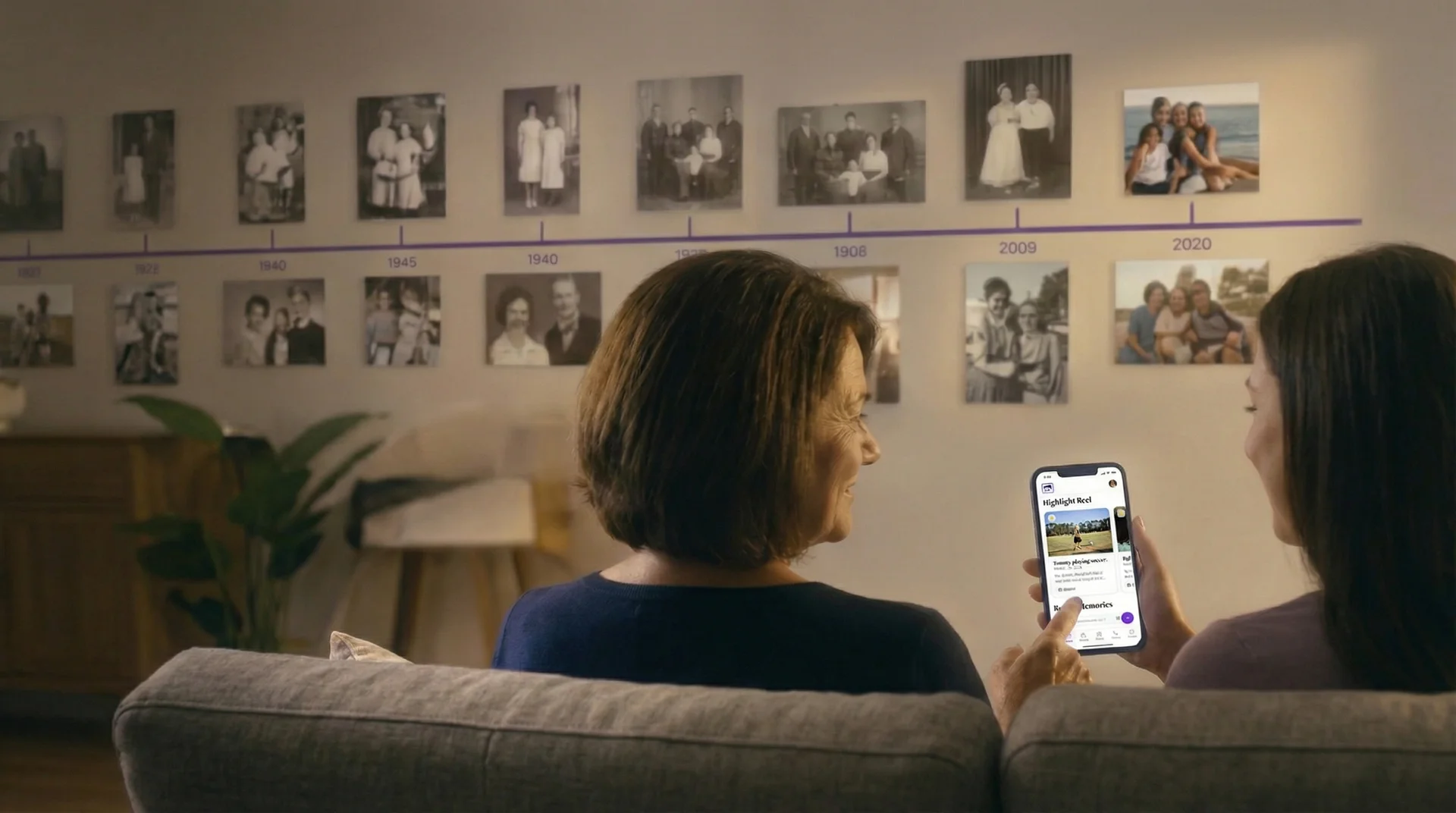
Memory Murals lets you record conversations, transcribe them automatically, and save them alongside photos on a family timeline. Tap, talk, done — the rest is handled for you. Their voice. Their exact words. Preserved for your kids, and your kids' kids, and everyone after. Free to try, no credit card required. Start here → — and read more about why the voice itself becomes the time machine.
The questions are just the beginning. The recording is what makes it permanent. Someday your kids — or their kids — will ask what Grandma or Grandpa was like. And instead of trying to remember, you'll be able to let them hear it. The actual voice. The actual laugh. The actual silence before the answer they almost didn't give.
That's not a memory. That's a legacy.
Start preserving your grandparents' stories today. Try Memory Murals free →
Frequently asked questions
What questions should I ask my grandparents before it's too late?
The questions that surface the stories nobody else in the family has heard tend to be specific and sensory rather than sweeping. Ask about a kitchen, a teacher, a song, a job they hated. The 40 prompts on this list are sequenced so the harder, more legacy-shaped questions come once they've warmed up. Treat them as a long menu — pick two or three for any given conversation, not the whole list at once.
How do I get my grandparents to open up and tell stories?
Don't sit them down with a recorder and announce an interview. Grandparents open up sideways — while drying dishes, sorting through old photos, driving home from a doctor's appointment. Ask one specific question, let the silence do the work, and don't rush to fill the gap. The best stories almost always arrive in the second pause, not the first. Specificity beats open-ended every time: "What did your kitchen smell like growing up?" works better than "tell me about your childhood."
What's the single best question to ask my grandparents?
If you only get to ask one, ask: "What family story do you want to make sure doesn't die with you?" Every family has a story that only one person still knows in full — with all the names, all the dates, all the side details. Your grandparent is probably the last person who knows one of yours. The question gives them permission to choose what to hand down, which is almost always more meaningful than what you'd have asked for directly.
Should I record my grandparents' stories or just write them down?
Record audio. The voice is the part you'll lose first and miss most — the cadence, the laugh, the way they say your name. Notes are useful as backup but a transcript can't recreate the sound of someone you love. Your phone is enough; turn on Voice Memos or use a tool that records and transcribes automatically while you focus on listening. The recording is the artifact your kids will thank you for in 30 years.
How long should a grandparent interview session be?
Forty-five minutes to an hour, max. Energy drops sharply after that and the answers get shorter. It's better to do six 30-minute sessions over three months than one marathon. The shorter session also feels less like an examination and more like a conversation. End each session before they're tired; you'll get them back next time without resistance.
Related Stories

Lists & Roundups
25 Questions to Ask Your Mom Before It's Too Late (And Why Each One Matters)
Most of us think we know our mothers. But between the school pickups and the phone calls, there's an entire life you've never asked about. These 25 questions will change that.
Patrick Moore • March 31, 2026

Lists & Roundups
50 Questions to Ask Your Dad Before It's Too Late (And Why Each One Matters)
He taught you to ride a bike and pretended the burnt pancakes were fine. But do you know what scared him? What he almost did differently? What he wishes he'd said? These 50 questions unlock the man behind 'Dad.'
Patrick Moore • April 18, 2026
How-To Guides
How to Save a Deceased Loved One's Voicemail Before It's Gone Forever
Your phone carrier is counting down to the day your loved one's last voicemail disappears forever. Most families don't know this until it's too late. Here's exactly how to save it — on iPhone and Android — before the clock runs out.
The Memory Murals Team • April 19, 2026