
The Grandparenting Buffer: How Legacy Sharing Protects the Brain
A 2026 APA study links legacy-sharing with grandchildren to slower cognitive decline. Here's why preserving family stories may be the brain's best defense.
Patrick Moore, Founder • February 3, 2026

My grandmother used to tell the same story about walking to school through the snow in Poland. Every time, she'd add a new detail I hadn't heard before. I thought she was just reminiscing. Turns out, she was protecting her own brain.
A 2026 study highlighted by the American Psychological Association (APA) confirms what a lot of grandparents seem to feel instinctively: sharing your family's stories with the younger generation doesn't just help them -- it actively slows cognitive decline in you. The researchers are calling it the "Grandparenting Buffer," and the data behind it is surprisingly strong.
The Invisible Cognitive Shield in Your Living Room
We've always celebrated the grandparent-grandchild bond. But mostly through an emotional lens -- it feels good, it's important, the kids love it. Now science has caught up with what that bond actually does to the brain.
In January 2026, the APA published a landmark study in Psychology and Aging identifying this "Grandparenting Buffer." The bottom line: actively sharing family stories, explaining old photos, and discussing history with grandchildren isn't just heartwarming. It functions as a real cognitive shield for the elder brain.
This isn't about generic social interaction. It aligns with what the Emory University Family Narratives Lab has shown for years -- family narratives are protective infrastructure for identity and resilience. And as The New York Times explored in "The Family Stories That Bind Us," a rich family narrative acts as a scaffold for who you are. If you've read our piece on "The "Do You Know" Scale," you already know how much family history affects a child's sense of self. What's new is that it protects the teller's brain too.
The Science: What the 2026 APA Study Actually Found
The research was led by Flavia Chereches of Tilburg University. Her team analyzed longitudinal data from nearly 2,900 grandparents with an average age of 67, drawn from the English Longitudinal Study of Ageing (ELSA) -- a well-established, long-running study tracking health, social, and economic factors among older adults in England.
The results were clear. Grandparents who regularly provided childcare or engaged in legacy-focused activities -- telling family stories, explaining old photos, talking about historical events -- scored significantly higher on tests measuring verbal fluency and episodic memory.
Verbal fluency is your ability to find words and articulate thoughts smoothly. Episodic memory is remembering specific personal events -- what you did last Tuesday, where you were when something happened. It's often one of the first things to decline with age.
"The magic isn't just in the babysitting. It's in the active transmission of culture and history. When a grandparent explains where they came from, they are exercising parts of the brain that passive entertainment simply cannot reach," explains lead researcher Flavia Chereches in the APA press release.
It's not about being present. It's about being mentally engaged.
Key Findings: The Numbers
35%
Slower Decline
Seniors who actively engaged in storytelling and educational play showed a significantly slower rate of cognitive aging.
Verbal Spark
Word Retrieval
Consistent, active communication with grandchildren directly improved word retrieval skills, keeping speech sharp and fluid.
Gender Buffer
Grandmothers
Both grandfathers and grandmothers benefited, but grandmothers showed a particularly strong protective effect when involved in educational play and legacy sharing.
Here's why it works. When grandparents tell stories, they're not just remembering facts. They're retrieving complex narratives, organizing them in sequence, finding the right words, and adjusting their delivery for a younger audience. That process fires up the hippocampus (memory formation), the prefrontal cortex (planning and decision-making), and language centers all at once. It's a full brain workout that watching TV simply can't replicate.
And there's a social layer too. The interaction itself combats loneliness and isolation -- both recognized risk factors for cognitive decline. The sense of purpose that comes from passing down knowledge adds another protective dimension. Cognitive stimulation, social connection, and emotional fulfillment working together -- that's the Grandparenting Buffer.
Why Memory Murals Are the Ultimate "Brain Food"
Knowing the science is one thing. Actually using it is another.
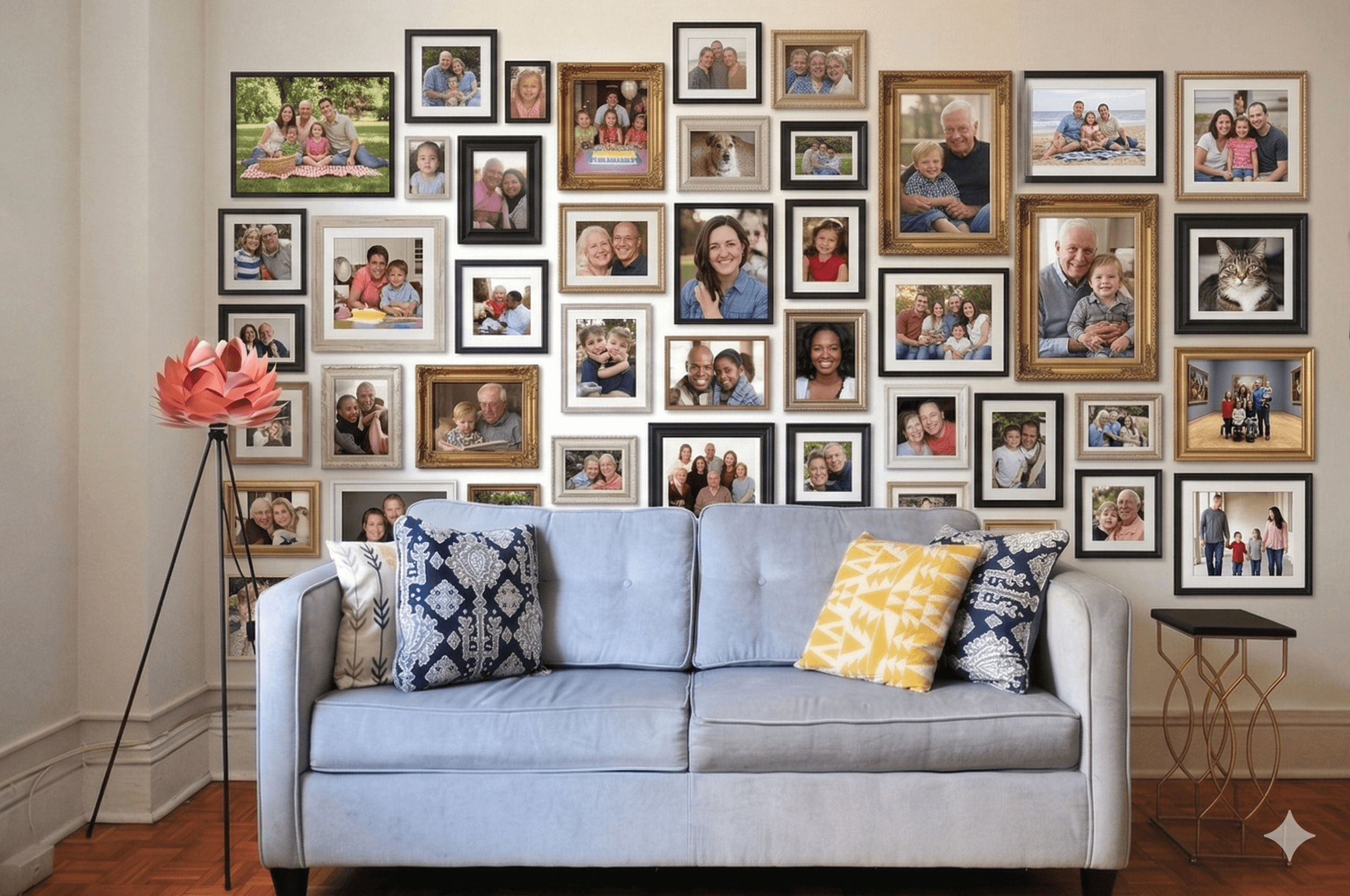
This is where Memory Murals comes in. It takes the theoretical Grandparenting Buffer and turns it into something you can do every day. A Memory Mural isn't a photo album or a wall decoration. It's a cognitive playground -- built to naturally trigger the exact activities the APA study identified as protective.
1. Stimulating Verbal Fluency
2. Episodic Memory Reinforcement
3. The Voluntary Advantage
Beyond the direct brain benefits, there's something deeper happening. Curating your own life story is an affirmation of your journey. That sense of purpose and continuity contributes to mental well-being, which feeds right back into cognitive resilience.
This isn't just about keeping photos safe. It's about preserving a lived experience in a way that actively sharpens your mind while you do it.
For those who've struggled to get detailed stories from loved ones -- the "I don't remember" conversations -- our guide "From 'I Don't Remember' to 'Unforgettable'" has practical tips for turning hesitant moments into rich narratives. And the full arc of a family story, including the hard chapters, contributes to this protective effect too. Difficult experiences become usable strength when they're told and preserved -- something we explore in "The Invisible Inheritance."
Your living space plays a role as well. We wrote about this in "The Science of an Enriched Home: How Your Walls Reshape Your Brain" -- turning your environment into a source of cognitive stimulation. And for a deeper look at what's happening neurologically, "The Biological Glue: How Your Brain Builds Your Legacy" goes into the brain science behind it.
Memory Murals doesn't just store photos. It transforms them into conversation prompts, chronological timelines, and themed Life Threads that make sharing your history as natural as reliving it. Start your free 7-day trial and see how easily your family's story can become a source of cognitive vitality.
Safeguard Your Legacy and Your Mind
The stories you carry are medicine for your brain and a cornerstone for future generations. Memory Murals helps you activate the Grandparenting Buffer by turning family interactions into brain-boosting sessions. Start your free 7-day trial before another story is lost.
Start Activating the Grandparenting Buffer Today
Choose One Story
Pick a single family memory -- a holiday tradition, a childhood adventure, how you met your spouse
Share It Aloud
Tell the story to a grandchild or young family member in your own words, with all the details you remember
Preserve It
Record the story using Memory Murals so it becomes a permanent, accessible part of your family legacy
Repeat Weekly
Make it a habit -- each session exercises your brain and deepens family bonds
FAQ: Your Questions Answered
What is the "Grandparenting Buffer" and why is it important for brain health?
It's the cognitive protection older adults gain from staying mentally active through grandchild care and legacy sharing. The 2026 APA study by Flavia Chereches found that this active engagement leads to slower cognitive aging, better verbal fluency, and stronger episodic memory. It's a natural, enjoyable way to fight age-related decline by harnessing intergenerational connection.
How do Memory Murals specifically help with memory preservation and cognitive health?
Memory Murals act as visual, interactive anchors for storytelling. By organizing personal history into something you can see and navigate, they become natural conversation starters. Your brain has to retrieve names, dates, and detailed narratives -- which strengthens episodic memory. The verbal articulation required to share those stories exercises verbal fluency. And because building a mural is collaborative and enjoyable, it taps into the "voluntary advantage" the research identified -- positive emotional engagement amplifies the cognitive benefits.
Does the type of interaction with grandchildren matter more than just how often I see them?
Yes. The 2026 APA reporting is clear that quality matters more than quantity. As Chereches put it, "the magic isn't just in the babysitting." Passive entertainment or simple presence helps some, but active engagement -- educational play, reading together, sharing family stories -- shows the strongest results. Activities that require you to retrieve, organize, and verbalize memories are especially powerful.
Any Level of Engagement Helps
The 2026 APA reporting suggests any level of caregiving involvement provides a benefit, though active engagement in leisure and learning activities showed the strongest results. Even occasional interactions centered on family history contribute meaningfully.
About the author
Patrick Moore, Founder of Memory Murals
Patrick Moore is the founder of Memory Murals. He built it after realizing how much of his own family's history had quietly slipped away — to help families preserve their stories, voices, and photos while they still can.
Related Stories
Insights
The 85-Year Secret to Longevity: Is Your Living Room Wall a Medical Asset?
Harvard's 85-year study links relationships to long-term health. Here's why a family legacy wall can become a daily catalyst for social fitness.
Patrick Moore • February 4, 2026

Insights
The "Do You Know" Scale: Why Your Mother's Stories Are Your Child's Secret Superpower
Decades of psychological research show family stories are the foundation of a child's emotional resilience and self-esteem. Here's what the research reveals.
Patrick Moore • January 26, 2026

Pillar Articles
The Biological Glue: How Your Brain Builds Your Legacy
New research shows memory can be stabilized by physical structures in the brain. Here's what functional amyloids reveal about why some moments last a lifetime.
Patrick Moore • February 22, 2026