
The Invisible Inheritance: Your Family's Hardest Moments
The inheritance of resilience doesn't show up on a bank statement. Learn why your family's hardest moments may be its most valuable legacy.
Patrick Moore, Founder • January 18, 2026

My grandmother never talked about the year she lost everything. The house, the savings, the business my grandfather had spent a decade building -- all of it, gone in a single bad season. I only found out about it from my aunt, almost by accident, at a family dinner when I was 27.
And I remember thinking: Why didn't anyone tell me this?
Not because I wanted the gory details. But because I'd spent my entire twenties feeling like I was failing every time something went wrong. Like struggle was proof that I wasn't cut out for whatever I was trying to do. And here was my grandmother -- this woman I admired more than anyone -- who had faced something far worse and just... kept going.
That story changed something in me. It didn't fix anything. But it gave me a floor to stand on.
That's the invisible inheritance. It doesn't show up on a bank statement or in a will. It lives in the stories your family has been too afraid to tell.
Why We Hide the Hard Stories
Every family carries a "hardest moment." A bankruptcy. An unexpected death. A cross-country move with nothing but a suitcase. A dream that didn't work out. And most families bury these stories. They're too heavy, too sad, too messy for the dinner table.
We do it out of love, mostly. We want to protect our kids from pain.
But here's the thing -- cutting-edge research in developmental psychology says these are exactly the stories our kids need to hear. When we shield them from the hard parts, we accidentally rob them of something crucial: the knowledge that their family has faced terrible things and survived. That struggle isn't a sign of failure. It's the family business.
The "Oscillating Narrative" -- and Why It Matters
Researchers have a name for this: the "oscillating narrative". Kids who score highest on resilience measures don't come from families with perfect track records. They come from families who tell stories that go up and down. Good times and bad. Wins and losses.
When parents and grandparents share how they navigated hard times, they're not just recounting events. They're handing over a blueprint: "In this family, we hit walls. We feel the weight of it. And we find a way through."
The Intergenerational Self
When children learn their ancestors overcame real challenges, their own problems feel more manageable. Researchers call this the "intergenerational self" -- a deep sense of belonging to a lineage that endures.
This isn't just intellectual knowledge. It's something you feel in your bones. For more on how these deep connections build inner strength, check out "The Grandparenting Buffer: Why Your Legacy is Their Brain's Best Defense".
The Problem with Only Telling the Good Parts
If you only share the highlight reel -- graduations, weddings, promotions -- you accidentally send a dangerous message: life is supposed to be a constant upward climb.
Then your kid hits their first real obstacle and thinks something is wrong with them.
Bruce Feiler made this point in his New York Times piece "The Stories That Bind Us" -- keeping hard stories secret is often more damaging than sharing them honestly. Secrecy creates voids. Kids fill those voids with anxiety and guilt that doesn't belong to them.
Authentic legacy demands the full picture. The mess, the complexity, the eventual redemption.
The Mistakes
The Close Calls
The Grit
Why Family Inspiration Hits Different
When a young person faces a crisis of confidence, their first instinct is to scroll. Motivational quotes from celebrities. Influencer advice. And look, sometimes that helps. For about five minutes.
But hearing your own grandmother describe how she navigated a moment of total uncertainty? That's not just information. It's identity.
External Inspiration
Family Resilience
And this isn't just poetic. Research shows that hearing a parent's voice -- even over the phone -- lowers cortisol and raises oxytocin. Your stress goes down. Your sense of safety goes up. Even when the topic is something hard.
Advice from an ancestor gets processed differently than advice from a stranger. It's not a suggestion. It's proof that you're built for this.
For more on the science of voice, read "The Sound of Home: Why a Loved One's Voice is the Ultimate Time Machine".
Turning Pain into a Toolkit
We spend so much time and money preparing our kids for the world -- education, technology, opportunities. But the most important tool we can give them is often the one we overlook: an honest understanding of where they come from.
Narrative psychologist Dan McAdams calls these "redemptive narratives" -- stories where someone moves from a negative situation to a positive outcome. They don't deny the pain. They show how pain got transformed into something useful.
When kids hear these stories, they absorb real lessons:
Problem-Solving
Emotional Regulation
Moral Frameworks
Perseverance
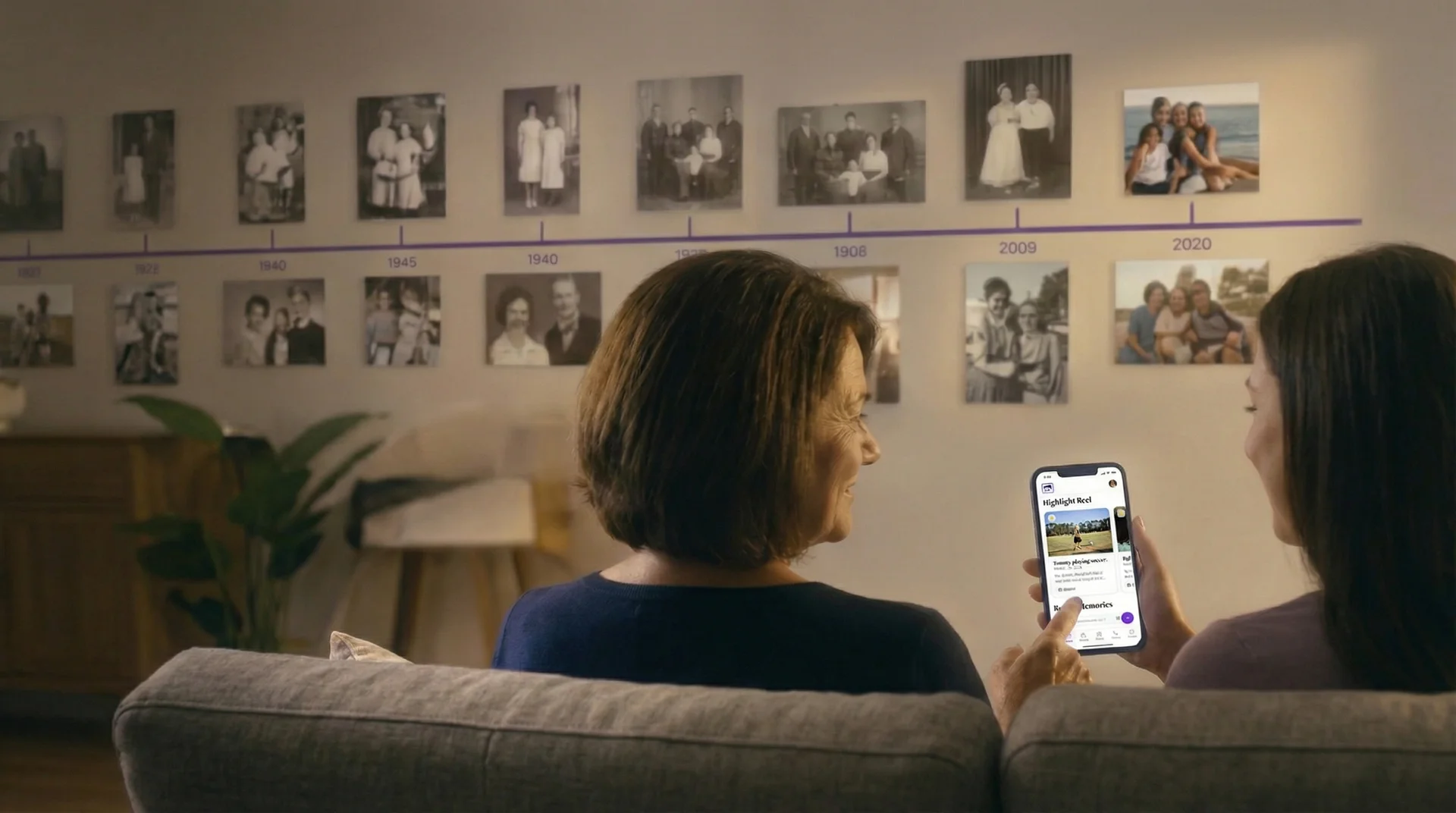
This is why Memory Murals includes Legacy prompts and Audio Memories -- so families can record, organize, and preserve these stories, including the hardest moments. Your family's struggles aren't just pain. They're a survival kit for the next generation. Start your free 7-day trial to begin building it.
Building Your Family's Resilience Archive
Identify a Defining Moment
Think of a time your family faced real adversity -- financial hardship, loss, a major life change
Frame It as Growth
Focus not just on the pain, but on what was learned, how you adapted, and what strength emerged
Record It in Your Own Voice
Speak the story aloud -- your voice carries emotional truth that written words can't
Share It with Purpose
Let your children and grandchildren know they come from people who do hard things
From Unspoken Legacy to Living Wisdom
The greatest gift you can leave isn't just what you had, but who you were and how you overcame. By turning unspoken struggles into honest stories, you give your kids something better than a shield against difficulty. You give them a compass. And the unshakable knowledge that they're built of sturdy stuff.
Build Your Family's Survival Kit Today
Every day is an opportunity to share the hard stories. Memory Murals helps you record the moments where you were brave, where you learned, where you grew. These become a survival kit for future generations. Start your free 7-day trial.
FAQ: Understanding Your Family's Invisible Inheritance
What is an "invisible inheritance," and why are difficult family stories considered assets?
It's the non-material legacy passed down through generations -- the resilience, problem-solving skills, and emotional strength that come from a family's history of overcoming hard things. Research shows that kids who understand their family history as an "oscillating narrative" -- with both triumphs and struggles -- develop higher resilience and self-confidence. These stories don't burden kids. They ground them.
How does sharing "shadow stories" prevent children from feeling like failures?
When families only share success stories, kids internalize the idea that life should be a constant upward climb. Then when they hit an obstacle, they think something's wrong with them. Sharing mistakes, close calls, and moments of grit provides a realistic view. Bruce Feiler's "The Stories That Bind Us" makes the case that keeping difficult stories secret can be more harmful than sharing them honestly. Kids need to know that struggle is normal, not a sign of personal failure.
What is the "intergenerational self"?
It's the psychological sense that you belong to a lineage capable of enduring. When kids learn about their family's hard moments and how those were navigated, they develop a deep belief in their own capacity for resilience. It's not just knowing your grandmother survived hard times -- it's feeling like that strength lives in you too.
Can hearing a parent's voice truly make a difference in confidence?
Yes. Studies show hearing a parent's voice can lower cortisol and increase oxytocin -- measurable physiological effects. When a child hears a parent recount their struggles and how they got through, it provides a deep, almost biological reassurance: you come from people who handle hard things. That's a different kind of confidence than anything a motivational poster can offer.
About the author
Patrick Moore, Founder of Memory Murals
Patrick Moore is the founder of Memory Murals. He built it after realizing how much of his own family's history had quietly slipped away — to help families preserve their stories, voices, and photos while they still can.
Related Stories

Insights
The "Do You Know" Scale: Why Your Mother's Stories Are Your Child's Secret Superpower
Decades of psychological research show family stories are the foundation of a child's emotional resilience and self-esteem. Here's what the research reveals.
Patrick Moore • January 26, 2026

Insights
The Person You Never Knew: Why We Often Miss the True Story of Our Parents
Most of us think we know our parents — but there's a Legacy Gap between who raised us and who they were before. Here's how to uncover their full story.
Patrick Moore • January 15, 2026
Insights
The Stories You'll Never Hear Again: Why Every Unrecorded Day Is a Permanent Loss
Your family is losing stories every single day. Not to tragedy or disaster, but to the quiet, ordinary passage of time. Here's why the window is closing faster than you think.
The Memory Murals Team • March 29, 2026