
The Stories You'll Never Hear Again
Your family is losing stories every single day. Not to tragedy or disaster, but to the quiet, ordinary passage of time. Here's why the window is closing faster than you think.
The Memory Murals Team • March 29, 2026
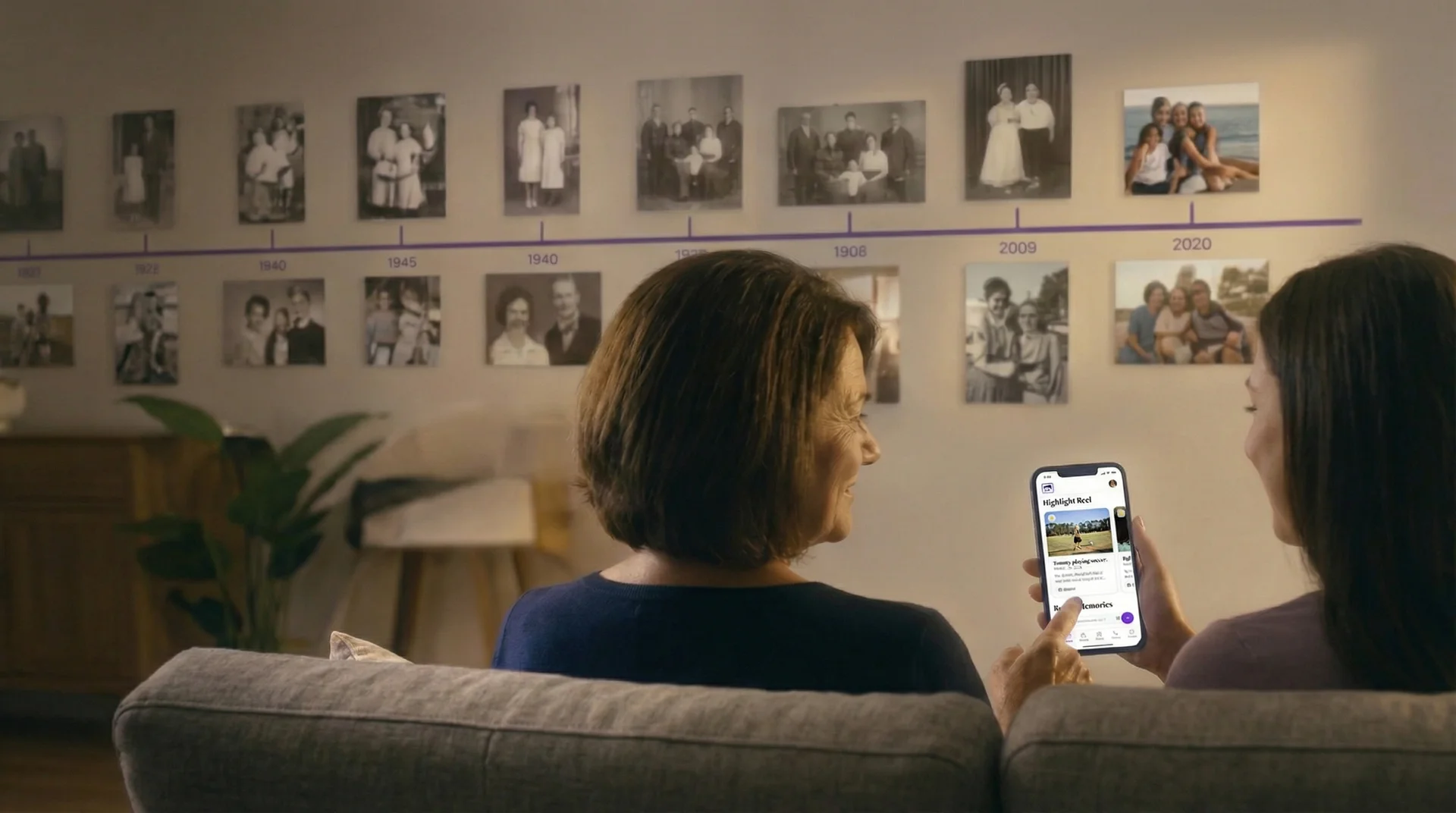
Right now, somewhere in your family, a conversation is happening that won't ever happen again. Nobody's sick. Nothing dramatic is going on. The moment will just pass, the details will blur, and the person who lived it will eventually forget they ever told it.
That's the emergency nobody talks about. Not the big losses we brace for — the slow, invisible erosion of thousands of small stories that make up who we are.
The Uncomfortable Math
The average person loses about 50% of new information within one hour. By the next day, 70% is gone. For older adults, episodic memory declines roughly 1-2% per year after 60. Every year that passes, your family's stories get less complete, less vivid, and harder to recover.
Your Family's Memory Is Disappearing Right Now
Here's something nobody brings up at family dinners: the person across the table from you is carrying stories that exist nowhere else on earth. Not in any book. Not in any database. Not on any server. Just in one human brain.
And that brain is forgetting. Every single day.
It's not a flaw — it's biology. Hermann Ebbinghaus documented this back in the 1880s. He called it the "forgetting curve," and it's brutal: memory retention drops off a cliff the moment an experience ends.
50%
Gone in 1 Hour
Half of new information fades within 60 minutes
70%
Gone in 24 Hours
Most details vanish by the next day
90%
Gone in 1 Week
Without reinforcement, almost everything disappears
But here's the part that should bother you: it's not just facts that fade. It's texture. The way your grandfather described the sound of his first car. The specific joke your mother tells about the day you were born — the one she tells a little differently each time. The name of the street your great-grandmother grew up on, the one nobody thought to write down.
These aren't trivial details. They're the connective tissue of your family's identity. And as we explored in The Sound of Home, it's not just the words that matter — it's the voice itself, that biological comfort signal no written transcript can replicate.
The Extinction Event Nobody Mourns
When a language dies, linguists call it an extinction event. Entire ways of understanding the world, gone. But the same thing happens inside families every day, and nobody calls it what it is.
Every family has an oral tradition, whether they know it or not. The stories told at Thanksgiving. The warnings passed from mother to daughter. The explanation of why your family left one country for another — told a particular way, with particular emphasis, carrying particular lessons.
The Stories You Think You Know
The Stories Nobody Asked For
A 2018 study from Emory University found that kids who know their family's stories — the struggles, migrations, triumphs, failures — show higher self-esteem, stronger identity, and greater resilience. The researchers called it "intergenerational narrative," and it turned out to be one of the strongest predictors of emotional well-being in young people.
But here's the catch: those stories have to actually be told. And then preserved. Because knowing your grandmother "had a hard childhood" isn't the same as hearing her describe, in her own words, what it felt like to leave home at sixteen.
The Emory University Finding
Children who know their family's intergenerational stories show measurably higher self-esteem, stronger sense of identity, and greater resilience. Family narrative isn't a luxury. It's psychological infrastructure.
The Cruel Arithmetic of Time
Let's do some math nobody wants to do.
If your parents are in their sixties, you probably have somewhere between 15 and 25 years left with them. Sounds like a lot. But how much of that time will you actually spend in real conversation?
If your parent is 65, you might have 20 years left together. If you live apart, maybe you visit 5 to 10 times a year. Each visit might include 2 or 3 hours of genuine conversation. Add it up and you're looking at roughly 200 to 600 hours of conversation. Total. For the rest of your life.
Two hundred hours. That's less than most people spend watching TV in a single month. And in those two hundred hours, you need to capture decades of lived experience, wisdom earned through suffering, joy that shaped a personality, and the thousand small stories that explain why your family is the way it is.
And not every conversation will be meaningful. Some will be about logistics. Some about the weather. Some will get interrupted by grandchildren or phone calls or fatigue.
The actual window for capturing your family's stories isn't years. It's hours. And it's shrinking every day.
The Three Types of Memory Loss Families Experience
When we think about losing family stories, we think about death. But death is only one of three ways families lose their history — and it's not the most common.
The first is gradual forgetting. It's happening right now, to everyone in your family, including you. Details soften. Dates blur. Names slip away. Your father's story about his first day of school has already lost details since the last time he told it.
The second is cognitive decline. About 10% of people over 65 develop dementia. By 85, that number is nearly one in three. When cognitive decline starts, the window for recording stories doesn't just narrow — it slams shut. The stories might still be in there somewhere, but the ability to retrieve and articulate them is gone.
The third — and the most common — is generational drift. Stories are told but never recorded. We wrote about this in The Digital Orphan Crisis: entire family histories vanish not through tragedy, but through simple neglect. Your grandmother told your mother. Your mother told you. You told your kids a simplified version. Your kids will tell their children almost nothing, because by then the story's been diluted beyond recognition.
The Three-Generation Rule
Without deliberate preservation, family stories rarely survive more than three generations. Your great-grandchildren will know almost nothing about you unless you take action now.
"I'll Do It Later" Is the Most Expensive Sentence in Every Family
Every family has said some version of this:
"We should really sit down with Grandma and record her stories."
And then nobody does. Not because they don't care — because there's always tomorrow. Because it feels awkward to sit someone down with a microphone. Because everyone's busy, and the holidays are coming, and there'll be time later.
Until there isn't.
The Regret Study
The Awkwardness Barrier
The Technology Excuse
The cruelest part? This kind of procrastination is irreversible. You can always earn more money. You can always take another vacation. You can't go back and record a conversation with someone who's gone.
Start With One Story. Today.
The fix isn't a massive project. It's not a weekend filming session or a professionally produced documentary. It's one story. Recorded today.
Here's what that looks like:
The 5-Minute Family Archive
Pick One Person
A parent, grandparent, aunt, uncle. Someone whose stories you want to keep.
Ask One Question
"What's your earliest memory?" or "Tell me about the day I was born." Keep it simple.
Press Record
Use your phone, a voice memo app, or Memory Murals. Let them talk. Don't interrupt.
Save It Somewhere Permanent
Not your camera roll. Not a text thread. Somewhere designed to last — where your family can find it in 20 years.
That's it. Five minutes. One question. One recording. You've just preserved something that would've been lost to time.
And here's what happens next: it gets easier. The awkwardness fades. The person being recorded starts to enjoy it. They remember things they haven't thought about in decades. They tell you stories you've never heard. And suddenly, what started as a five-minute experiment becomes a living archive of your family's history. If you need more ideas, we put together 5 Gentle Ways to Start a Family Archive that makes the whole process feel effortless.
50 Questions to Get You Started
Memory Murals includes 50 guided Legacy prompts designed to surface the stories that matter most — from childhood memories to life lessons to the things your family will want to know someday. You don't have to figure out what to ask. Just pick a prompt and press record.
This Isn't About an App. It's About a Decision.
Every family hits a point where the window for preservation is still open. The stories are still there. The people are still here. The memories are still vivid enough to capture.
You're at that point right now.
The question isn't whether your family's stories are worth preserving. Of course they are. As the research behind Your Brain's Biological Glue shows, preserving stories literally strengthens the neural pathways that bind families together. The real question is whether you'll do something about it before the quiet, ordinary passage of time makes the decision for you.
You don't need to preserve everything. You don't need to be a filmmaker or a writer or a historian. You just need to start. One story. One voice. One moment that your grandchildren will someday be grateful someone thought to save.
The stories your family carries are irreplaceable. And every day they go unrecorded, they drift a little further away.
Don't let "someday" become "too late."
Start Preserving Your Family's Stories
Memory Murals gives you a private, secure space to record your family's stories with text, photos, and voice recordings. Start free with a 7-day premium trial, no credit card required. Get started today.
Related Stories

How-To Guides
You Have the Questions. Here's How to Actually Record the Answers.
Every article gives you a list of questions to ask your grandparents. Almost none of them tell you what to do next. Here's the part nobody writes: how to actually capture the answers so they outlive the conversation.
Patrick Moore • April 11, 2026

Lists & Roundups
25 Questions to Ask Your Mom Before It's Too Late (And Why Each One Matters)
Most of us think we know our mothers. But between the school pickups and the phone calls, there's an entire life you've never asked about. These 25 questions will change that.
Patrick Moore • March 31, 2026

Insights
The Sound of Home: Why a Loved One's Voice is the Ultimate Time Machine
We obsess over HD video but overlook our most powerful connection: the human voice. Here's why recording your family's voices might be the most important thing you ever do.
Patrick Moore • January 20, 2026