5 Gentle Ways to Start Preserving Your Family History
Preserving your family history can feel overwhelming — not because it's difficult, but because it matters. Here are five simple, meaningful ways to begin.
Patrick Moore, Founder • December 15, 2025

Last year I found a box of old photos at my parents' house. Black-and-white prints, curled at the edges. I recognized my grandmother's face in one of them. But the rest? No names. No dates. No stories. Just strangers who were probably family.
That's the thing about family history. It doesn't disappear in some dramatic event. It just quietly slips away, one forgotten detail at a time. And by the time you notice, you can't get it back.
The good news? Starting to preserve your family's story isn't as hard as it feels. You don't need months of free time or a genealogy degree. You just need to begin.
1. Begin With One Moment: The Power of the Small Start
The biggest obstacle to preserving family history isn't laziness or lack of time. It's the sheer scale of the thing. You look at a lifetime of memories and think, "Where do I even start?" So you don't start at all.
Psychologists call this decision paralysis. Barry Schwartz wrote a whole book about it — too many options, too much pressure, and the result is... nothing.
Here's what actually works: pick one thing. One photo. One video clip. One memory that already feels complete in your mind. Upload it, and write a sentence or two about why it matters to you. That's it. You're not writing a memoir. You're making a single deposit into your family's future.
And there's real brain science behind why this works. Finishing even a tiny task gives you a hit of dopamine — the same chemical that makes you want to do it again. One memory leads to the next. Before you know it, you've got momentum.
Dr. B.J. Fogg at Stanford built his entire research career around this idea: start absurdly small, and the habit builds itself.
The Overwhelm Trap
You tell yourself you'll do it when you have a free weekend. That weekend never comes. Meanwhile, photos pile up on your phone with no context, and the stories behind them keep fading.
The Momentum Method
Start with one memory. Just one. The act of beginning — even something tiny — creates a positive feedback loop that makes the next step feel natural. Don't wait for perfect conditions.
Internal Link: Learn why even the most organized digital lives can lead to a "digital orphan crisis" and how to avoid it: /journal/digital-orphan-crisis
2. Remember the Ordinary: The Real Fabric of Life
We tend to think of "history" as big events. Graduations. Weddings. Births. And those moments matter, obviously. But they're not the whole story.
The stuff that really defines a family? It's smaller than that. It's the way your dad made eggs on Saturday mornings. The phrase your mom used when she was annoyed but trying not to show it. The game you played in the car on long drives that nobody outside the family would understand.
Dr. Dan McAdams' research on narrative identity backs this up — our personal stories aren't built from highlight reels. They're woven from thousands of ordinary moments that add up to something meaningful.
Years from now, your grandkids won't just want to know that you got married. They'll want to hear about the ridiculous thing that went wrong at the reception. The inside joke from the rehearsal dinner. The small, weird, human stuff.
A Psychology Today piece on this topic put it well: ordinary memories are often the most treasured ones. They're what make a family feel real, not just documented.
The Contextual Power of the Everyday
Memory Murals is purpose-built to capture the texture of everyday life -- routines, interactions, and quiet moments that provide true context. These are the "invisible inheritances" that shape us most.
Internal Link: Discover how even unexpected moments hold profound value in "The Invisible Inheritance: Why Your Family's Hardest Moments Are Your Greatest Assets" → /journal/invisible-inheritance-hardest-moments
3. Let Questions Do the Work: Gently Unlocking Your Past
Here's a secret: the hardest part of preserving memories isn't the technology. It's staring at a blank screen and having no idea what to say.
That blank-page paralysis is real. But there's an easy fix — questions.
In psychology, they're called retrieval cues: external prompts that help your brain pull up specific memories. A good question doesn't interrogate you. It opens a door. And suddenly you're remembering things you didn't even know you still carried.
This is exactly why Memory Murals' "Legacy" feature includes guided prompts. Things like "What was your childhood home like?" or "What advice shaped you most?" They're designed to bypass that blank-page feeling and get you talking. Or writing. Or recording.
It works because of what cognitive psychologists call schema theory — questions activate mental frameworks you already have, making stored information easier to access and put into words.
The result? The impossible task of "document your entire life" becomes a series of manageable, even enjoyable conversations with yourself.
The Most Valuable Inheritance
The most valuable inheritance is understanding -- a narrative that allows future generations to know who you were and why it mattered. Questions are the keys to unlocking this legacy.
Internal Link: Learn more about how to engage others in sharing their stories and move "From 'I Don't Remember' to 'Unforgettable': How to Get Your Loved Ones to Share Their Best Stories" → /journal/how-to-get-your-mom-to-share-stories
How Guided Questions Unlock Hidden Memories
Encounter a Prompt
A thoughtful question like "What was your childhood home like?" activates retrieval cues in your brain
Activate Schema
The question triggers existing mental frameworks, making stored information more accessible
Recall Rich Details
Sensory memories, emotions, and forgotten stories surface naturally without forcing
Capture the Story
Record the narrative in your own words -- written, spoken, or both -- preserving authentic detail
This approach -- guided prompts, voice recordings, and a focus on the everyday -- is at the core of Memory Murals. Start your free 7-day trial to see how simple it is to begin building your family's living archive.
4. Capture Your Voice: The Echo That Outlasts Everything
Photos show what life looked like. But your voice? That shows what it felt like.
We don't think about this enough. A person's voice — the way they laugh, the pauses they take, the way they say your name — carries something a photograph never can.
And the brain agrees. Research published in Nature Neuroscience by Pascal Belin and Robert Zatorre found that our brains have specialized regions dedicated to processing familiar voices. A Stanford study by Dr. Daniel Abrams showed that hearing a loved one's voice triggers deep emotional responses and vivid memories — even decades later.
So record something. It doesn't have to be polished. Read a favorite passage out loud. Tell a story. Laugh at a memory. Just let the microphone capture you.
There's no script needed. The raw, imperfect version is the one that'll matter most to the person who listens 30 years from now.
Visuals (Photos/Videos)
Great for capturing moments, faces, places, and events. They show what happened.
Audio (Voice Recordings)
Captures emotion, personality, inflection, and the unique rhythm of how someone speaks. It shows who someone really was.
Internal Link: Explore the profound, almost magical impact of audio in connecting us to our past in "The Sound of Home: Why a Loved One's Voice is the Ultimate Time Machine" → /journal/sound-of-home-loved-ones-voice
5. Share When You're Ready: Building a Family Legacy Together
Memory is social. Always has been.
You can build the most beautiful archive in the world, but something shifts when you share it with someone who was there. They add a detail you forgot. They laugh at the part you thought nobody remembered. They tell you, "I didn't know you felt that way."
Sociologist Maurice Halbwachs wrote about this — how shared memories bind people together in ways that individual recollection can't. And research on collective family narratives shows that families who share stories have stronger bonds and better intergenerational understanding.
Once you've added a few memories to Memory Murals and feel comfortable, you can invite family members to view your Timeline. They can see your story, exactly the way you've chosen to tell it. They don't edit it. They don't reshape it. It's yours.
92%
of adults
believe sharing family history is important for family bonding. (Source: Ancestry.com survey, 2014)
85%
of Americans
say it's important to pass on family stories and traditions to the next generation. (Source: Pew Research Center, 2014)
And here's what I've found personally: sharing your memories with people you love is the thing that makes you want to keep going. It starts as a personal project. It becomes something bigger.
Internal Link: Understand why maintaining absolute control and privacy over your personal narrative is paramount in "Why Privacy is the Heart of Memory Murals" → /journal/why-privacy-heart-of-memory-murals
Start Preserving Your Family's Story
Add your first memory in minutes, uncover rich narratives with guided Legacy prompts, and share privately with the people who matter most. Start your free 7-day trial.
Frequently Asked Questions
What is the easiest way to start preserving family history without feeling overwhelmed?
Pick one memory. Literally just one — a photo you already have, a story that's already clear in your mind. Upload it and write a line about why it matters. Dr. B.J. Fogg's research at Stanford shows that starting absurdly small builds momentum better than any grand plan. You can also use guided prompts (like the ones in Memory Murals' Legacy feature) so you don't have to figure out where to start on your own.
Why are ordinary, everyday family moments important to archive?
Because they're what actually make your family your family. Big milestones matter, but the daily stuff — routines, inside jokes, the way someone told a story — that's what gives future generations a real sense of who you were. Dr. Dan McAdams' research shows our identities are built from the full range of experiences, not just the highlights.
How does recording audio enhance the value of a family archive?
Your voice carries things a photo can't — emotion, personality, the way you pause before the punchline. Research in Nature Neuroscience shows the brain has specialized regions for processing familiar voices, triggering strong emotional and memory responses. A 30-second voice recording can feel more alive than 100 perfectly arranged photos.
What are the long-term psychological benefits of creating a family archive?
It strengthens identity, belonging, and connection across generations. For you, it brings clarity and purpose. For your kids and grandkids, it gives them roots — a collective family narrative that helps them understand where they come from. Halbwachs' work on collective memory shows that shared stories bind groups together in ways that last.
About the author
Patrick Moore, Founder of Memory Murals
Patrick Moore is the founder of Memory Murals. He built it after realizing how much of his own family's history had quietly slipped away — to help families preserve their stories, voices, and photos while they still can.
Related Stories

How-To Guides
From 'I Don't Remember' to 'Unforgettable': How to Get Your Loved Ones to Share Their Best Stories
To unlock a family member's history, stop acting like a biographer and start acting like a key-holder. Here's how to move past one-word answers.
Patrick Moore • January 28, 2026
Comparisons
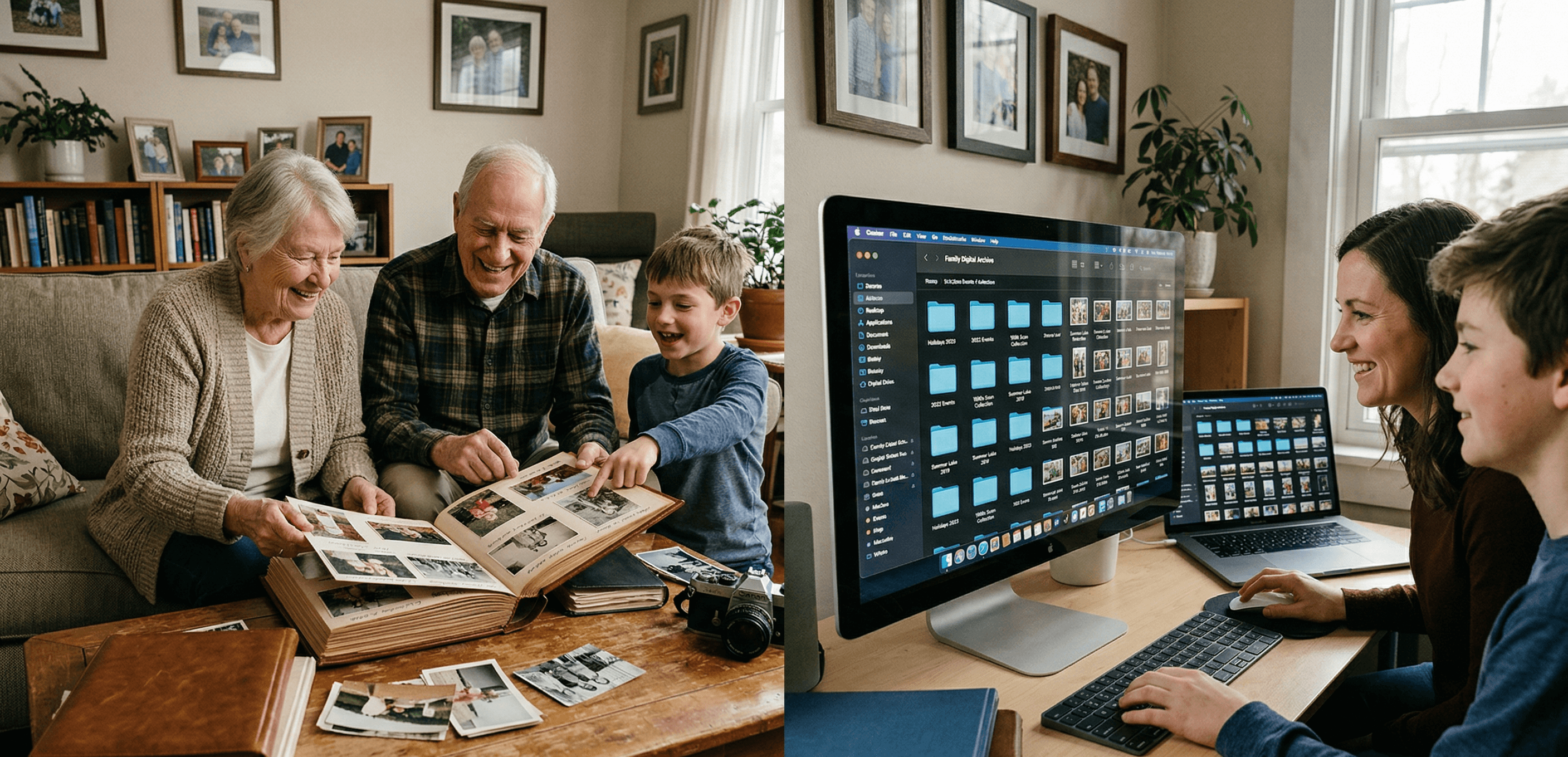
Digital Family Archive vs Photo Albums: Why the Shoebox Under Your Bed Isn't Enough Anymore
Your family photos are fading, your stories are unrecorded, and your kids can't find anything. Here's why a digital family archive does what photo albums never could — and how to build one without losing what makes physical keepsakes special.
Patrick Moore • April 3, 2026
Insights
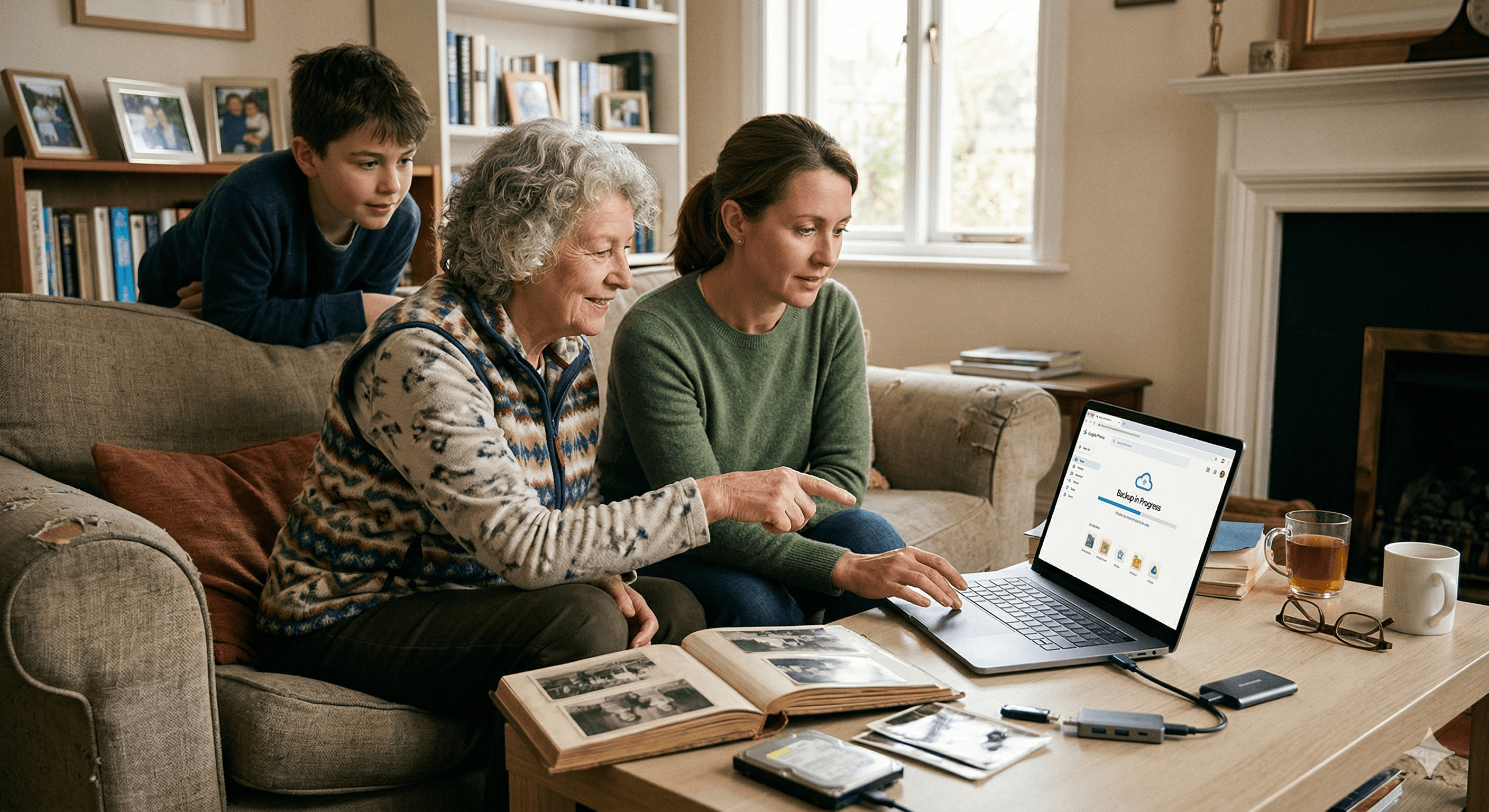
The Family Backup: Why the Most Important Data in Your Life Isn't on Your Phone
You back up your photos, your contacts, your passwords. But the most irreplaceable data in your life — your family's stories — has zero redundancy. Here's how to fix that.
Patrick Moore • March 31, 2026