
The 85-Year Secret to Longevity: What Harvard's Study Found
Harvard's 85-year study links relationships to long-term health. Here's why a family legacy wall can become a daily catalyst for social fitness.
Patrick Moore, Founder • February 4, 2026
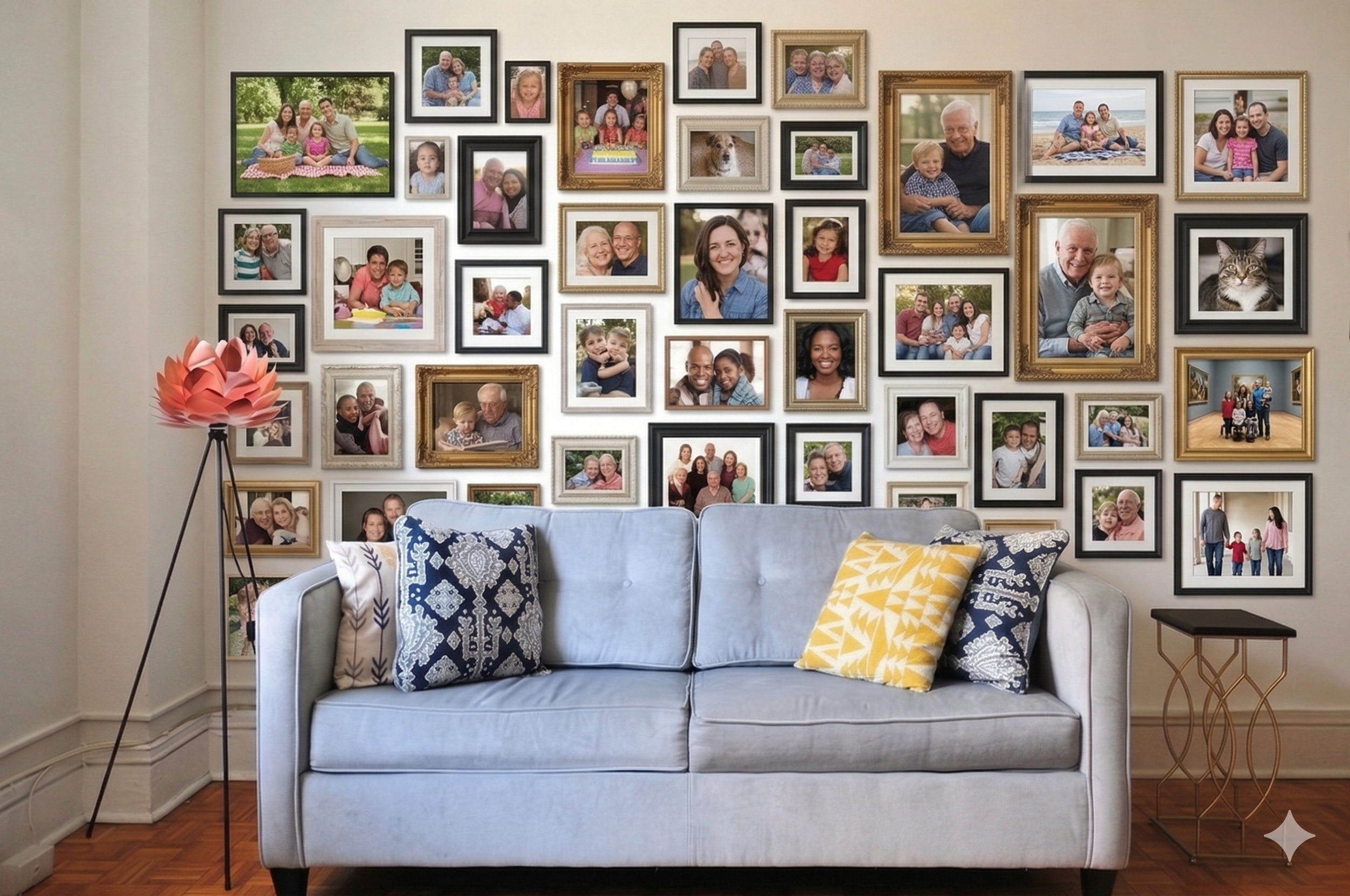
There's a single factor more powerful than diet, exercise, or your bank account that predicts how healthy and happy you'll be decades from now. It's not a supplement. It's not a biohack. It's the quality of your relationships.
The Harvard Study of Adult Development — the longest-running study of human life ever conducted — spent 85 years proving this. And it changes how you should think about that wall in your living room.
85 Years of Data. One Clear Answer.
What actually predicts health and happiness as you age? For decades, people assumed it was physical fitness, financial stability, or career success. Harvard's researchers tracked 724 people from adolescence into old age — their health, careers, relationships, everything — starting in 1938. Their conclusion was surprisingly simple: strong social connections don't just make life better. They make you physically healthier.
85 Years
Study Duration
The longest-running study on human life ever conducted
724
Participants Tracked
Individuals followed since 1938 by Harvard researchers
90+
Participants Still Living
A testament to the study's profound insights into longevity
Dr. Robert Waldinger, the study's current director, puts it bluntly: "Good relationships keep us healthier and happier. Period" (Harvard Health Publishing). And this isn't just about having friends. It's about quality — belonging, active engagement, meaningful connection. Loneliness, on the other hand, is as damaging as smoking or obesity. Socially connected people live longer, experience less pain, and maintain sharper brain function as they age.
The Ripple Effect of Connection
Strong relationships reduce chronic stress, strengthen immune systems, and improve cardiovascular and cognitive health. They're a buffer against the wear and tear of life — physically and psychologically.
Reduced Stress
Stronger Immunity
Sharper Cognition
Social Fitness Needs a Physical Anchor
Knowing that connection matters is one thing. Actually fostering it in a fragmented, screen-first world is another.
Dr. Waldinger is clear: social connections aren't passive. They need to be practiced, like going to the gym. He calls it "social fitness." But here's the problem — most families have their photos and stories scattered across phones, cloud drives, and social feeds that everyone scrolls through alone. All that digital convenience actually gets in the way of the face-to-face moments that relationships need.
If that struggle sounds familiar, it touches on a bigger issue we've written about in The "Digital Orphan" Crisis.
This is where a Memory Mural becomes something more than decoration. It's a physical anchor for social fitness — a catalyst for the kind of conversations that digital albums, by design, can't spark.
A Memory Mural drives three behaviors that matter for family connection:
Shared Attention
Narrative of Belonging
Visual Gratitude
| Feature | Physical | Digital |
|---|---|---|
| Stores photos and videos | ||
| Invites shared attention from multiple generations | ||
| Sparks spontaneous storytelling daily | ||
| Acts as a visual gratitude reminder | ||
| Accessible without a device or password | ||
| Provides narrative context alongside images |
Stores photos and videos
- Physical
- Digital
Invites shared attention from multiple generations
- Physical
- Digital
Sparks spontaneous storytelling daily
- Physical
- Digital
Acts as a visual gratitude reminder
- Physical
- Digital
Accessible without a device or password
- Physical
- Digital
Provides narrative context alongside images
- Physical
- Digital
Your Walls Are Medicine
When you create spaces for connection at home, you're doing more than decorating. You're practicing what researchers call Environmental Wellness. The mural is the medium. The conversation it sparks is the medicine.
For the Elderly: Cognition and Mood
A Memory Mural works like a visual prompt for reminiscence — a therapeutic practice clinically shown to improve mood and cognitive function, especially when shared with others. A meta-analysis on PubMed (Bohlmeijer et al., 2007) found reminiscence therapy effective at reducing depression and improving well-being in older adults. When seniors engage with familiar images and stories, it stimulates recall, fosters purpose, and fights isolation. It's cognitive exercise wrapped in comfort. And this active recall connects directly to how your brain builds your legacy.
For the Young: Fighting the Loneliness Epidemic
Children and young adults face a real loneliness crisis. The U.S. Surgeon General's 2023 advisory called it out explicitly — loneliness isn't just a feeling, it's a public health issue (HHS.gov). A Memory Mural creates the face-to-face interaction and spontaneous storytelling that builds strong family bonds. These interactions give children a secure base, a sense of belonging, and emotional resilience that protects against anxiety and depression. It grounds them in their history and makes them feel seen.
The physical presence of a Memory Mural means your family's history isn't just data in the cloud. It's part of your daily environment. It sparks spontaneous moments of connection — what we call an "enriched home environment." As we explored in The Science of an Enriched Home, your surroundings shape your well-being more than most people realize.
Bridging Digital and Physical
Here's the paradox of our time: we have more photos and videos than ever, but less shared meaning. Memory Murals is built to solve that. The app helps you curate your family's most important moments, add context and narrative, and then bring those memories into the physical world.
That's exactly why Memory Murals includes guided storytelling prompts (Legacy) and Life Threads — so families can turn isolated digital photos into cohesive narratives, then print museum-quality murals. Your family's journey doesn't just get archived. It gets displayed, talked about, lived with. Start your free 7-day trial to see it in action.
Take Action Today
Harvard's message is clear: the relationships you build are the most powerful investment in your long-term health. Don't let your family's most precious asset — its shared history — stay locked in digital silos.
Transform Your Home, Transform Your Health
Bring 85 years of Harvard research into your living room. A visual family legacy sparks daily dialogue, builds resilience in children, and cultivates gratitude. Start your free 7-day trial to begin building your living legacy.
Building Your Social Fitness Routine
Curate Your Story
Select your most meaningful family photos and memories using Memory Murals
Create a Focal Point
Display your mural in a high-traffic area where family naturally gathers
Invite Conversation
Let the mural spark organic storytelling — no formal interviews needed
Make It a Habit
Daily exposure turns occasional reminiscence into a consistent social fitness practice
Can family photos improve mental health?
Yes — especially when they're used to spark conversation, not just scrolled through alone. Clinical studies on reminiscence therapy (PubMed, Bohlmeijer et al., 2007) show that engaging with photos and memories in a social setting reduces depression, anxiety, and loneliness in seniors. For younger generations, seeing family photos displayed builds a stronger sense of identity and belonging, acting as a buffer against mental health challenges. The Emory Family Narratives Lab has done great work on this.
What is the Harvard Study of Adult Development?
It's the longest-running study on human life — 724 people tracked since 1938. The big finding, confirmed over 85 years: good relationships are the single most significant predictor of health, happiness, and longevity. More than wealth, more than traditional health metrics. Dr. Robert Waldinger directs the study today. You can learn more at adultdevelopmentstudy.org.
How do I foster better family connections in a digital world?
Create opportunities for shared attention and storytelling. One practical approach: use your physical environment as a conversation starter. A Memory Mural keeps family history visible every day, inviting spontaneous storytelling and intergenerational bonding without anyone needing to pull out a phone. Unlike photos hidden on devices, a physical display draws people into a shared experience — which is exactly the kind of "social fitness" Harvard's study says we need.
About the author
Patrick Moore, Founder of Memory Murals
Patrick Moore is the founder of Memory Murals. He built it after realizing how much of his own family's history had quietly slipped away — to help families preserve their stories, voices, and photos while they still can.
Related Stories

Pillar Articles
The Grandparenting Buffer: Why Your Legacy is Their Brain's Best Defense
A 2026 APA study links legacy-sharing with grandchildren to slower cognitive decline. Here's why preserving family stories may be the brain's best defense.
Patrick Moore • February 3, 2026

Insights
The "Do You Know" Scale: Why Your Mother's Stories Are Your Child's Secret Superpower
Decades of psychological research show family stories are the foundation of a child's emotional resilience and self-esteem. Here's what the research reveals.
Patrick Moore • January 26, 2026

Pillar Articles
The Biological Glue: How Your Brain Builds Your Legacy
New research shows memory can be stabilized by physical structures in the brain. Here's what functional amyloids reveal about why some moments last a lifetime.
Patrick Moore • February 22, 2026