
Mother's Day With a Mom Who Has Dementia
Practical, gentle ideas for celebrating Mother's Day when your mom has dementia — what works in memory care, what to record while you still can, and what to do when she doesn't recognize you.
The Memory Murals Team • April 30, 2026
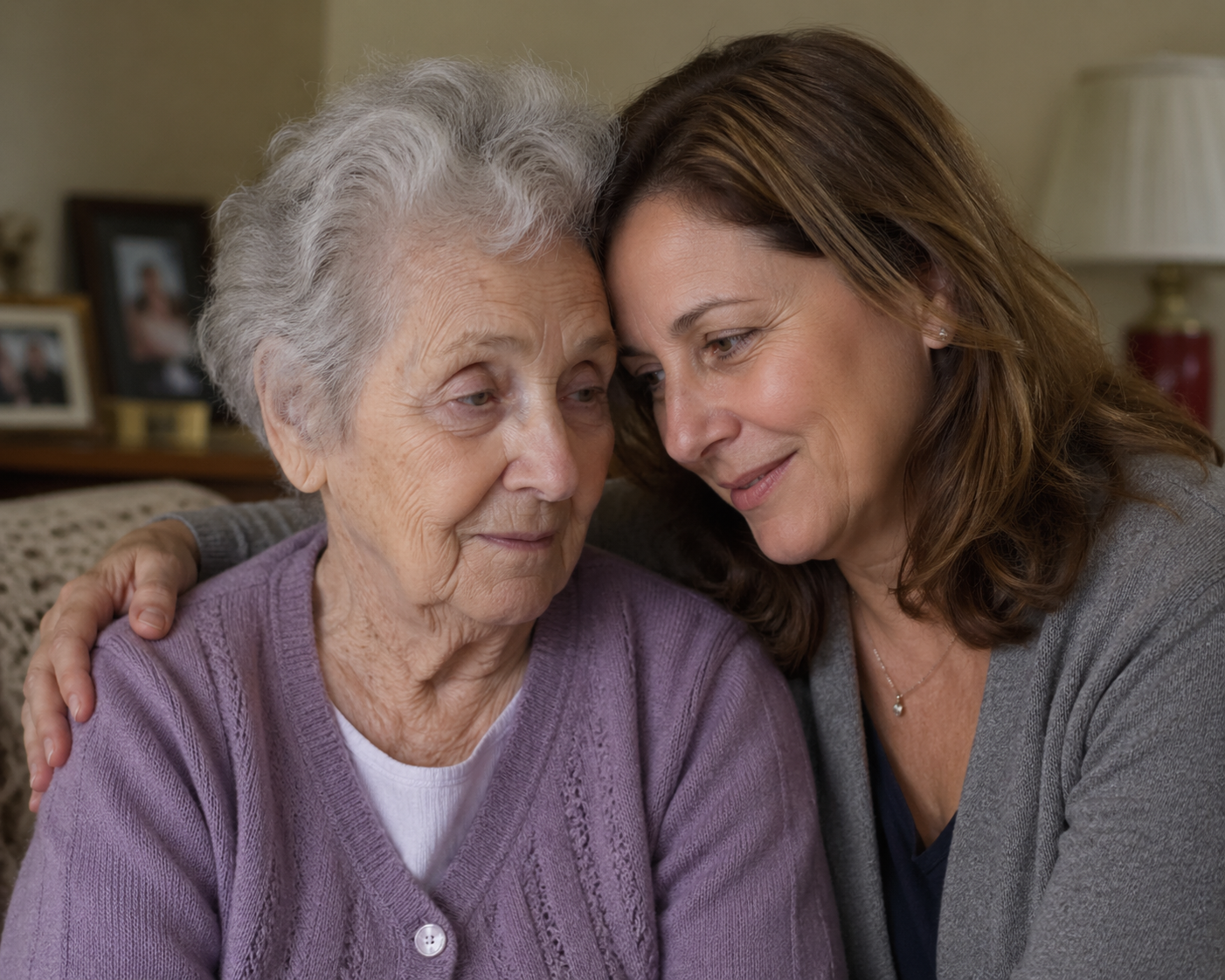
The card aisle is the worst part.
You're standing there in the pink and pastel section of the drugstore on a Tuesday in early May, holding a card that says To the world's best mom, who always knows just what to say, and you're thinking — she doesn't, anymore. She doesn't always know what to say. Last week she called you by your aunt's name, and the week before that she asked you three times in twenty minutes whether the dog had been fed.
You put the card back. You walk out. You drive home and you sit in the car in the driveway for a minute before you go inside, because you don't know how to do this Sunday.
If your mom has dementia and Mother's Day is coming, this post is for you. Not the version of Mother's Day the commercials are selling. The real one — the one where you show up at memory care with a balloon and she's confused about who you are, and you have to make the day matter anyway. There is a way through this. Nine of them, actually. And there's one thing you can do today that you'll be grateful for in five years.
What nobody tells you about Mother's Day with dementia
The grief is doubled. You miss the mom you had and you're losing the mom you have, all on the same day. Caregivers describe it as "ambiguous loss" — grieving someone who's still alive — and Mother's Day amplifies it because the entire world is celebrating the version of her you can't quite reach anymore. Naming what you're feeling is the first thing that helps. It's not just a hard visit. It's a particular kind of grief, and it deserves more gentleness than you're probably giving yourself.
Do this today, before you do anything else
Pick up your phone. Open Voice Memos (iPhone) or your Recorder app (Android). The next time you call her — tonight, tomorrow morning — hit record before you tap the call button. Don't make a thing of it. Just capture five minutes of her saying your name and asking how you are. Save it. Title it with her name and today's date. That five minutes will be worth more to you in five years than any gift you could give her this Sunday.
The Hardest Part Isn't the Visit — It's the After
Most people brace themselves for the visit. They worry about whether she'll recognize them. They worry about whether she'll get agitated. They worry about whether their kids will be scared.
Then the visit happens, and it's actually fine. She's tired but warm. She doesn't quite know who you are but she knows you're someone who loves her, and that's enough for the hour you're there. You leave feeling — relieved, almost. Like maybe this isn't as bad as you'd feared.
And then you get home. And the relief evaporates somewhere between the front door and the kitchen, and you sit down on the couch and you cry for forty minutes, because you finally let yourself feel what you'd been holding back the whole time you were there.
This is normal. The visit is the easy part. The grief comes after, when the performance of being okay is over and you're alone with the math of how much of her is still there. So plan for the after. Don't schedule something demanding for the rest of the day. Don't host a brunch. Give yourself permission to come home and be quiet, or be sad, or call your sister and just say that was hard. The day doesn't end at noon when you leave the facility. It ends whenever you decide it ends.
Meet Her in the Version of Herself She Remembers Today
Here's the most important thing anyone in memory care will ever tell you: don't correct her.
If she thinks you're her sister, be her sister for an hour. If she thinks it's 1978 and she's about to be late for her shift at the hospital, ask her about her shift. If she introduces you to her husband (your dad, who passed in 2019) — just smile and say hello to the empty chair. The point isn't accuracy. The point is presence. She is somewhere right now, and the kindest thing you can do is meet her there instead of dragging her back to a present that confuses and upsets her.
This is called validation therapy, and it's the gold standard for dementia caregiving for a reason. Studies on memory-care residents show that validation reduces agitation, lowers stress hormones, and increases the likelihood of warm, connected moments — which is the entire reason you came. Correction does the opposite. It introduces a small panic into her body every time it happens. Why is this person telling me I'm wrong? She can't reason her way out of the confusion. She can only feel the panic.
So before you walk in: take a breath, drop your need for the visit to look like a "real" Mother's Day, and let her decide what kind of day it is.
9 Gentle Mother's Day Ideas That Work in Memory Care
These are ranked roughly by ease — start at the top, pick two or three. Don't try to do all nine. The goal is presence, not productivity.
1. Bring her a familiar smell
Smell is the most powerful memory trigger we have, and it's one of the senses that stays intact longest in dementia. Bring her a small bottle of the perfume she wore in her thirties. A cinnamon roll from the bakery she used to take you to. A handful of fresh-cut lilacs from her old garden, if it's the right time of year. The recognition you'll see on her face is something you'll carry with you for years.
2. Play her wedding song, or a song from her teenage years
Long-term musical memory persists astonishingly long in dementia — far longer than the memory of breakfast or what year it is. Pick a song she sang to you, or a song from when she was sixteen, and play it on a small speaker. Watch what happens to her face. Don't talk over it. The song is doing the work.
3. Look through one (just one) old photo album together
A whole album is overwhelming. One album, picked specifically for her best decade — usually her thirties — is magic. Sit beside her, not across from her. Let her tell you who's in each photo, even if she gets some of them wrong. Ask softly: "Tell me about this one." Then listen.
4. Bring a little of her old kitchen with you
If she used to make a specific thing — a Sunday roast, a banana bread, a pot of soup — bring her a portion in a covered container. Sit and eat it with her. The taste is the doorway. You don't have to recreate the whole kitchen. One bite of the right thing will do more than a whole meal of the wrong thing.
5. Read her something familiar out loud
A psalm she used to read every morning. A poem she had us memorize as kids. The Sunday comics, even. Reading out loud, slowly, with her hand in yours is one of the most settling things you can do for someone with dementia. She doesn't have to follow the meaning. She has to hear your voice and feel the rhythm.
6. Ask her a single specific question — and record the answer
Not "tell me about your life." That's too big. Try one specific question from this list — like "What was your first job?" or "What was your dad's favorite saying?" Have your phone recording on the table between you. Whatever she gives you — a sentence, a fragment, a hum — is captured forever.
7. Bring grandkids in short bursts (not all day)
Memory care visits with little kids are wonderful for fifteen minutes and exhausting at thirty. Plan for short bursts. Have one grandchild come in alone for a few minutes, then swap. Bring crayons. Let the child draw a picture for her at her bedside. The drawing stays after you leave. So does the moment.
8. Brush her hair, or paint her nails
Touch matters more than words at this stage. Slow, deliberate touch — brushing her hair, holding her hand, painting her nails the color she always wore — is regulating in a way conversation can't be. Twenty minutes of this will leave her calmer than any conversation you could have. It will leave you calmer too.
9. Plant something together (or just water something)
If she has a windowsill plant, bring her a small watering can and let her water it. If she doesn't, bring a tiny pot with a single herb — basil, mint, rosemary — and let her smell it and pat the soil. Planting and watering is one of the deeply embedded procedural memories that stays accessible long after most other tasks fade.
How to Record Her Voice Without Making It Feel Clinical
This is the part most adult children of a dementia mom tell us they regret not doing. Not the photos. Not the visits. The voice.
Five years from now, you will have the photos. You'll have the medical records. You'll have her recipe cards and her wedding ring and the handwritten note she put in your lunchbox in third grade. What you won't have, unless you do something this Sunday, is her voice saying your name. The way she says honey when you call her crying. The little hum she does when she's thinking. The exact pitch of her laugh.
Recording feels weird. We get it. Nobody wants to put a microphone in front of their mom and turn the visit into a performance. So don't. Here's how to do it without making it feel clinical.
Phone face-down on the table, just record
Voice Memos open, phone resting flat between you, screen down so it doesn't blink at her. She'll forget it's there in two minutes — that's exactly when the real recording starts.
Don't set up a tripod or a real microphone
Visible recording gear turns the room into a studio and turns her into a performer. The version of her you want is the one you get when she's not aware she's being captured.
Just talk like you always talk
Same questions you'd ask on any visit. Same warmth. Same pauses. The recording is there to catch the conversation you were going to have anyway — not to script a different one.
Don't ask interview-style questions in a row
"Tell me about your childhood. Now tell me about your wedding. Now tell me about Dad." Stacking questions back-to-back makes her feel cross-examined and shuts her down inside two minutes.
Let her ramble — the rambling is the gold
The tangent off the question, the side-story she remembers halfway through, the "oh, that reminds me…" — those are the parts you'll play back twenty years from now. Don't redirect. Don't course-correct. Just listen.
Don't correct her if she gets a name or year wrong
She might say her sister was 12 when she was actually 14, or that something happened in Cleveland when it was Pittsburgh. Let it stay wrong on the recording. Future-you will recognize her voice on the playback, not the dates.
Frame it as 'saving this for the grandkids'
Most moms love this frame. It moves the recording from "weird thing my kid is doing" to "gift I'm leaving the great-grandkids," and her storytelling voice opens up. The frame is true. Use it freely.
Don't say 'this is going to be saved forever'
That sentence spikes her anxiety even on a good day. Permanence + recording + dementia is a combination her brain will not handle well. Keep the recording quiet, low-stakes, and grandkid-framed.
There's a longer guide to all of this — including which days of the week to record (mid-morning is best for most people with dementia) and how to back the recordings up so they don't disappear with your old phone — in our companion post on how to record your parent's voice before dementia takes it. If you only read one other thing today, read that one.
What to Do When She Doesn't Recognize You
It's going to happen at some point. Maybe not this Sunday. Maybe in six months. But somewhere on the road you're walking, your mom is going to look at you with the polite smile she'd give a stranger, and your name is going to be just out of reach for her. Here is what to do, in order — and the order matters, because each step calms her body before the next one asks anything of her mind.
1. Don't correct her
Don't say "Mom, it's me, it's your daughter." That sentence will cause her a small panic — why is this person telling me I'm wrong? — and the panic is worse than the not-recognizing. Resist the urge, even if you have to bite the inside of your cheek to do it.
2. Sit down beside her
Not across from her. Beside her, the way you'd sit next to a friend on a bench. Side-by-side seating signals safety to a confused brain in a way face-to-face seating doesn't. Keep your shoulders soft. Don't lean in too close.
3. Take her hand if she'll let you
Touch communicates safety to a brain that can't process language as fast anymore. A warm, still hand on top of hers — not gripping, just resting — does more in five seconds than any sentence you could say in five minutes.
4. Say you came to spend time with her
And that you're so glad to see her. Don't introduce yourself. Don't explain who you are. Don't try to remind her. Just be present, the way a kind stranger would be — except you're not a stranger, you're love itself, and on some level she still feels that.
5. Talk about something far back
Her childhood. Her parents. Her schoolteacher. The neighborhood she grew up in. The further back you go, the more reliable her memory will be — long-term memory survives much longer than recent memory in dementia. Old wins. Recent fails.
6. Let it be okay
She is loving the company of a person who feels safe to her, even if she can't name who you are. That is not nothing. That is a daughter taking care of her mother on Mother's Day. The recognition is for you. The presence is for her. Both still count.
What Your Kids Will Need to Hear in 20 Years
Twenty years from now, your kids will be roughly the age you are now. They will have their own kids. They will have lost their grandmother. And on some random Tuesday, your daughter is going to be sitting in her kitchen and she's going to suddenly, desperately, want to hear her grandmother's voice — not just see a photo, but hear her. The pitch of her laugh. The way she said baby when she was being affectionate.
If you record nothing this Sunday, your daughter has nothing.
If you record five minutes, she has five minutes that will mean more to her than anything else you could leave behind. Because the research on this is unambiguous: kids who grow up knowing their family's stories and hearing the voices of older relatives do measurably better on every metric of emotional resilience we know how to measure.
Higher resilience
"Do You Know" Scale
Kids who know their family's stories show stronger emotional regulation, higher self-esteem, and better recovery from setbacks.
Voice > photo
Memory science
Hearing a loved one's voice activates brain regions for connection and identity that photos alone don't reach.
This isn't a sales pitch. This is the actual research. There's a name for it — it's called the Mother's Day memory ritual, and families who do it once a year build something their grandkids will still be playing back in 2070. Twenty minutes a year. That's the entire commitment.
The One Thing Every Adult Child of a Dementia Mom Regrets Not Doing
We talk to a lot of caregivers. Across hundreds of conversations, the regret is always the same:
I should have recorded her voice before it changed.
Not the photos. Not the visits. Not the Mother's Day brunches. The voice. Because dementia changes a voice in a particular way — the cadence flattens, the storytelling muscles atrophy, the laugh gets quieter and then disappears — and the change is so gradual that you don't notice until you stumble on an old voicemail from three years ago and you hear how alive she sounded then, and you sit down on the floor of the kitchen and you sob, because you didn't know that was the last version of her voice that was coming.
There is more about why a loved one's voice matters so much — neurologically, emotionally, generationally — in our piece on the sound of home. But the short version is this: the voice is the part of her that's most singularly her, and it's the part that fades fastest, and it's the part that nobody else in the world can replicate. So please. This Sunday. Hit record on the visit. Hit record on the call before. Hit record on the song she sings while she's eating her cake. Five minutes will outlive everything else you do this Mother's Day.
If you only do one thing this Sunday
Pick up your phone before the visit. Hit record. Leave it on the table, face-down, and just be with her for an hour. Don't perform. Don't interview. Just exist beside her and let the recording catch whatever it catches. Then label the file with her name and today's date and put it somewhere safe. Memory Murals does this for families automatically — voice memos, photos, and stories all transcribed and organized in one private place that you and your family can return to forever. Start free. But even if you never use us — even if you just save the recording to your phone tonight — please do this. Future-you will thank you.
If you're past Mother's Day specifically and looking for the longer playbook, our hub for families inside an active dementia diagnosis gathers the practical guides and FAQs other caregivers have leaned on. The stage-by-stage walkthrough — what to record in early decline, moderate, and late — lives in our pillar on preserving stories after a dementia diagnosis.
Frequently Asked Questions
Q: Should I tell her it's Mother's Day? Only if she asks. Holidays can be disorienting for people with dementia because they're untethered from the rhythm of the year. If she doesn't bring it up, you don't need to. The visit is the gift. The label on the day is for you.
Q: What if she gets agitated when I arrive? Step back. Don't take it personally — agitation in dementia is almost always about an unmet physical need (tired, hot, hungry, in pain) or sensory overload, not about you. Wait fifteen minutes. Try again with a softer voice and an offered hand. If it persists, accept that today isn't the day for a long visit, and ask the staff what window she tends to be calmest in. Come back at that time.
Q: Is it okay to bring my kids if she sometimes doesn't recognize them either? Yes — but in short bursts and with a way out. Brief visits (15–30 minutes max) are easier on everyone, including the kids. Tell your kids beforehand that grandma might mix up names or call them by someone else's name, and that the kindest thing they can do is just smile and say hi. Most kids handle this far better than adults expect.
Q: She's in late-stage dementia and doesn't speak much anymore — is recording still worth it? Absolutely. Hum, breath, the small sounds of contentment when you brush her hair, the way she says one word — all of these are her, and all of them are worth saving. Don't measure the recording by the words. Measure it by her.
Q: How do I deal with the grief of losing someone who's still alive? This kind of grief has a name — anticipatory grief or ambiguous loss — and there are caregivers who have walked exactly this road before you. Look for an Alzheimer's Association support group in your area; the in-person ones are gold. Talk to your therapist about it specifically by name. And forgive yourself for grieving her this Sunday even though she's still here. You're not getting ahead of yourself. You're being honest about what's happening. The grief you're rehearsing now will eventually become real grief on real dates — her birthday, the anniversary, the first holidays — and the work you do now is what makes those days survivable later. If her birthday is coming and you want to start thinking about how to mark it before she's fully gone — or after — our piece on the first birthday without your parent walks through the specific shape of that day.
Related Stories
How-To Guides
How to Record Your Parent's Voice Before Dementia Takes It
After a dementia diagnosis, voice fades in a specific order — vocabulary, then patterns, then the laugh. Here's a 7-step plan to record your parent before that order runs out.
The Memory Murals Team • April 23, 2026
How-To Guides
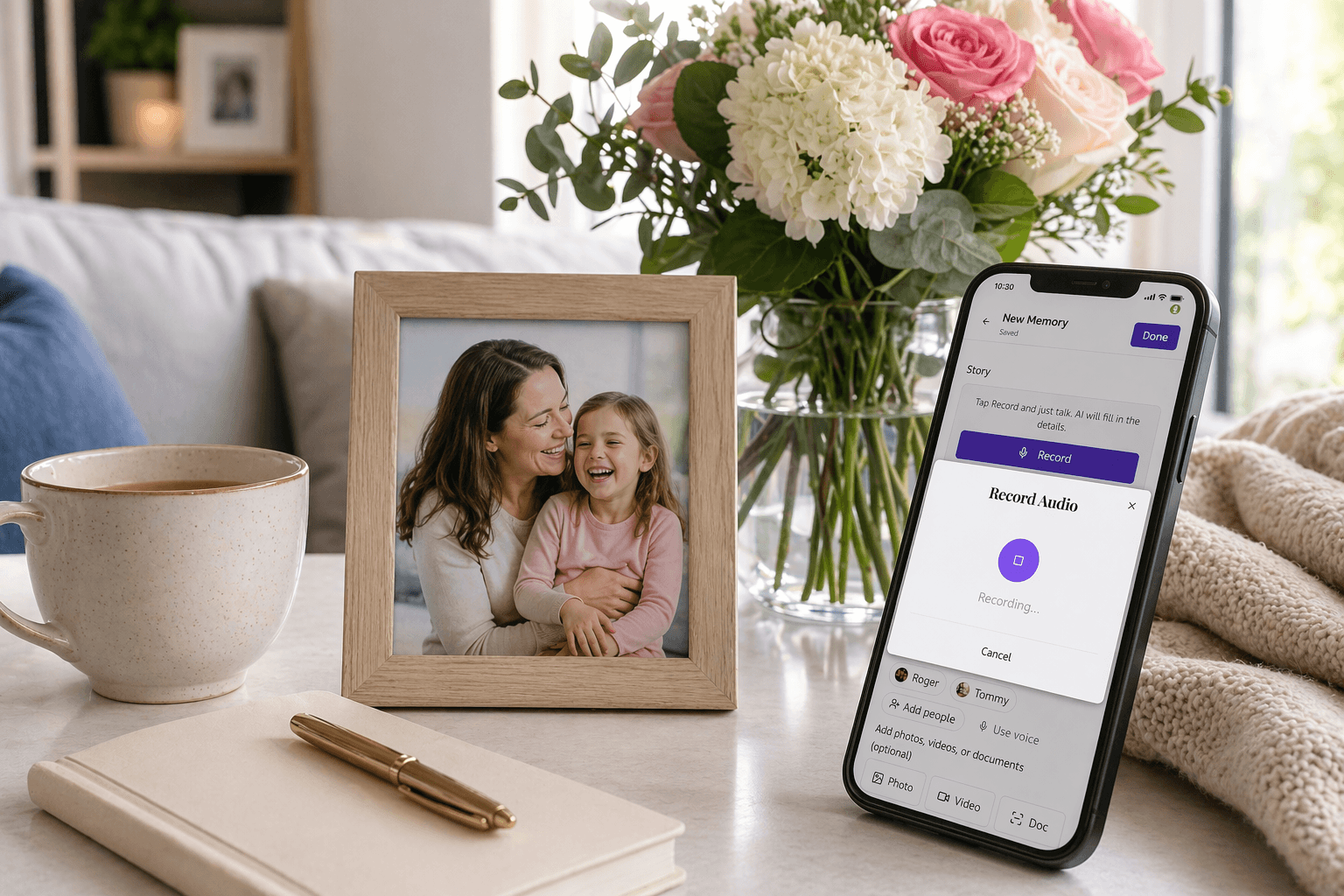
The Mother's Day Memory Ritual: A 30-Minute Annual Tradition That Outlasts Every Other Gift
Flowers wilt by Tuesday. Brunch is forgotten by the next weekend. But a 30-minute recording of your mom's voice, saved every Mother's Day for the rest of her life, becomes the only family heirloom that gets more valuable with time.
Patrick Moore • April 2, 2026

Insights
Your First Mother's Day Without Her: How to Honor Mom's Memory When She's Gone
Nobody tells you about the ads. The pastel-colored avalanche of 'Treat Mom to brunch!' and 'She deserves the world!' that starts hitting your phone in April. Here's what actually helps when Mother's Day arrives and she's not here.
The Memory Murals Team • April 16, 2026