
How to Record Your Parent's Voice Before Dementia Takes It
After a dementia diagnosis, voice fades in a specific order — vocabulary, then patterns, then the laugh. Here's a 7-step plan to record your parent before that order runs out.
The Memory Murals Team • April 23, 2026
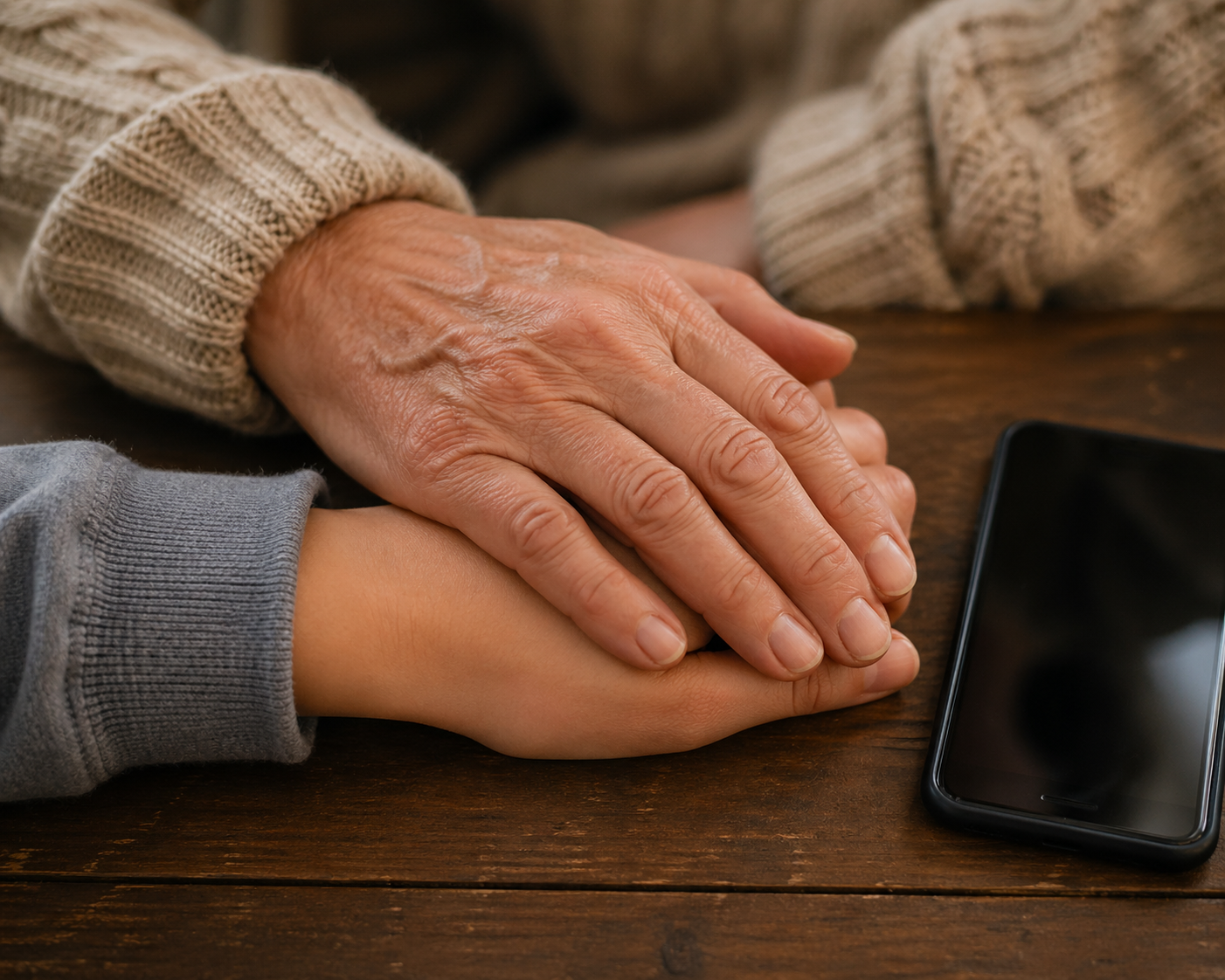
The doctor used the word "moderate" and you nodded like you understood what that meant. You drove your mom home. She asked you twice on the ride whether you'd remembered to turn the oven off at her house, and you'd already locked the front door behind her, and the oven hadn't been on. That's when you understood what moderate meant.
The clock just started. Not the clock for her — that one started a while ago, and nobody can tell you how much is left on it. The clock for you. The window where her voice still sounds like her voice. Where she still says your name the way she's always said it. Where she still laughs at the same dumb thing she's been laughing at for forty years.
That window closes in a specific, predictable order. And the parts that close last — the laugh, the cadence, the way she says "oh honey" when you call her crying — are the parts you'll wish you had thirty years from now. So this post is going to give you seven things to do, ordered by how fast you can do them. The first one takes five minutes and you can do it on the phone in your hand.
If you've never used an AI-assisted memory app, our guide to the best AI memory apps for family stories breaks down which ones handle voice transcription well — that matters here, because mid-stage dementia speech becomes harder for generic transcription tools to follow.
This post is the tactical seven-step. If you want the broader stage-by-stage frame — what to record in early decline vs. moderate vs. late — our companion guide to preserving stories after a dementia diagnosis walks the longer arc. Read them together if you have an hour; if you only have ten minutes tonight, stay here. For the general (non-dementia) version of the recording method, see our complete family interview playbook.
Why this matters more than most people realize
Dementia takes voice in a particular order. Vocabulary fades first — the names of objects, the right word for the thing in the cupboard. Speech patterns fade next — sentence structure, the way she tells a story with a setup and a punchline. The laugh, the cadence, and the unique-to-her sounds fade last. Even mid-stage patients still have those. The window for capturing the most distinctive parts of someone's voice is longer than most families assume — but only if you start now, while vocabulary is still there to anchor it.
Do this in the next hour
Open Voice Memos on your iPhone (or the equivalent on Android — see Step 1 below). Hit the red button on your next phone call with them, or the next time you sit down for coffee. Save it. Title it with their name and today's date. That's it. The remaining six steps go deeper, but if you only do this one before bed tonight, you'll already have something you didn't have this morning.
The 5-minute version, before you do anything else
You don't need a microphone. You don't need an app you have to download. You don't need to wait until you have a "real" sit-down. The phone in your hand right now is enough.
On iPhone: Open the Voice Memos app — it's pre-installed, white icon with a red waveform. Tap the big red circle. It records until you tap it again. The file saves automatically and lives in the app under whatever you name it. To keep it from getting lost: long-press the recording, tap Share, and send it to your own email or save it to Files in iCloud Drive. Now you have two copies.
On Android: Most phones have a Recorder app pre-installed (Pixel calls it Recorder; Samsung calls it Voice Recorder). If yours doesn't, download Google Recorder from the Play Store — it's free, no ads. Hit record. When you're done, share the file to Google Drive or email it to yourself. Same idea: two copies.
The next time you call them — tonight, tomorrow morning, whenever — start the recording before you tap the call button. You can record a phone call from the speaker by putting your phone on speakerphone next to a second device that's recording. It's clunky but it works. Don't overthink the setup. A clunky recording you actually have is infinitely more valuable than the perfect studio recording you're still planning.
Title the file with their full name and the date. Future-you, twenty years from now, will need that label.
A 60-90 minute sit-down session, no fancy gear required
The voice memo from Step 1 catches them being themselves on the phone, which is irreplaceable. But there's a different kind of recording — the structured one, where you sit down across from them with a list of questions and let them tell you the long stories — that captures a different kind of voice. The storytelling voice. The one with rhythm and pauses and "oh, you know what I just remembered."
You don't need a podcast mic. Your phone, set on a table between you, with Voice Memos running, is fine. What matters more than gear is the room — pick the quietest one in the house. Turn off the TV. Close the windows if there's traffic. Put a glass of water within reach, because they'll talk longer than you expect and their voice will get tired.
Pick a time of day when their cognition is best. For most people with dementia, that's mid-morning — after breakfast, before any afternoon "sundowning" sets in. Avoid right after a meal (drowsy) and right before bed (foggy). Aim for somewhere between 10am and noon if you can.
Plan for ninety minutes, but tell them you only need an hour. They'll have more energy than they think once they get going on a story they love. And if they tire out at the forty-five-minute mark, stop — and pick it up next weekend. This isn't one session. It's a series.
Bring photos. A specific old photo on the table between you is the single best memory unlock for someone with dementia. The photo gives them a hook. The hook gives them a story. The story is the thing you came for.
Phone calls, dinner chatter, jokes, and the singing along
Structured interviews catch the long stories. Voice memos catch the moments. But the third bucket — the everyday — is the one most families miss, and it's where the real voice lives.
The way your dad sounds when he's telling the dog to stop barking. The way your mom hums while she's stirring something on the stove. The thing they say every single time the phone rings ("hello, hello!" or "yes, this is she" or whatever it is). The way they laugh at the same line in the same sitcom they've been watching for fifteen years. None of that shows up in a structured interview. All of it shows up in the everyday.
So: the next time you visit, leave your phone recording on the kitchen counter while you make lunch together. The next phone call, hit record. The next time you're in the car driving them to an appointment, prop the phone in the cup holder. You won't use most of it. The bits you do use will be the ones you didn't know to ask for.
A note on legality, because this matters. Recording phone calls is governed by state law. Most US states (38 of them) are "one-party consent," meaning if you're on the call and you know it's being recorded, that's legally fine — even if the other person doesn't know. But twelve states (including California, Florida, Pennsylvania, Illinois, Massachusetts, and Washington) require all parties to consent to the recording. The simple, ethical, legal-everywhere answer: just tell them. "Mom, I want to record this so the grandkids can hear you tell that story someday — is that okay?" In our experience, no parent has ever said no to that sentence.
The highest emotional density per minute of audio
If you only get one focused recording session and you have to choose what to put in it, choose this: songs, prayers, recipes, and the small phrases they say to you that nobody else says.
The reason is purely practical. Stories are wonderful, but stories live partly in the words. Songs and prayers and recipes live in the voice. The melody your mom hums when she's not paying attention. The exact cadence your dad uses when he says grace before a meal. The way your grandmother says "a pinch" of salt with a specific lilt in her voice that you'd recognize across a crowded room.
These are also the recordings that hold up best as dementia progresses. Long-term musical and procedural memory persists significantly longer than episodic memory. Someone who can't remember what they had for breakfast can often still sing the entire chorus of "Amazing Grace" without missing a word. That's not a metaphor. It's how the brain works. Use it.
Specific prompts that tend to land:
- "Sing me happy birthday like you used to sing it to me as a kid."
- "Say grace the way Grandma always said it before Sunday dinner."
- "Tell me how you make the meatloaf — the way you'd tell it to me, not a recipe card."
- "What's the first lullaby you ever sang to me?"
- "Recite the prayer your dad used to say."
- "Tell me a poem you memorized in school."
- "Whistle that song you always whistle when you're working in the garage."
Each one of these is two to three minutes of audio that will outlast almost everything else you record. Get them in the next two weekends if you can.
The clock you don't know is running
Here's the thing most families don't know until it's too late: voicemails left on your phone aren't actually stored on your phone. They live on your carrier's servers, and your carrier has its own retention rules that have nothing to do with your situation.
| Carrier | Default retention | |---|---| | Verizon | ~30 days for saved messages | | AT&T | 14 days for new messages, ~30 days for saved | | T-Mobile | ~21–30 days, varies by plan | | Google Voice | Indefinite, but only as long as the account stays active |
If your parent is in the early or middle stages of dementia, they're still leaving you voicemails. Some of those voicemails — "I just called to see how you were doing, call me back when you get a chance" — are routine right now and irreplaceable in five years. Save them while they're easy to save.
We wrote a full step-by-step guide for how to save a deceased loved one's voicemail — and the same instructions apply for someone who's still here. Read that post for the exact steps on iPhone and Android, then save every voicemail from your parent that's currently in your inbox. Save them to two places: your phone's Files app or Voice Memos, and a cloud location like Google Drive or iCloud. One copy isn't a backup. Two is.
Don't wait until they pass. The window to retrieve a voicemail from a deceased person's account closes fast — most carriers shut down access within days of being notified of a death. Save them now, while you can still log into your own phone.
Why iCloud is not actually an archive
You have voice memos on your phone now. You have voicemails saved. You have the structured interviews from last weekend. The instinct at this point is "I'll just leave it all in iCloud / Google Photos / Dropbox and that's the backup." It isn't. And it's worth being honest about why, because most families learn this lesson the hard way.
Cloud storage from Apple, Google, and Dropbox are device sync services. They keep your devices in sync with a copy in the cloud. They are not designed as long-term archives, and they fail as archives in four specific ways:
- Account suspension. If your Apple ID gets locked — wrong password too many times, payment method expired, security flag — every file on it becomes inaccessible. There is no human at Apple to call. There are documented cases of people losing decades of photos this way.
- Payment failure. If the credit card on file expires and you don't notice the email, your iCloud account drops back to 5GB free, and any file beyond that quota gets queued for deletion in 30 days.
- Accidental deletion. A file deleted from one device deletes from all of them, by design. You have 30 days to recover. After that, it's gone.
- Generational handoff. When the account holder dies, accessing their iCloud requires a court order and Apple's Digital Legacy program, which most families don't know exists until they're trying to use it.
So: back up to a real archive. The minimum-viable version is a labeled USB drive that lives in a desk drawer with all your audio files copied to it, and a second copy on a different cloud service from the one you use day-to-day. The more durable version is a dedicated family memory archive — and yes, this is the part where Memory Murals shows up.
We built Memory Murals because none of the existing options were actually designed for the thirty-year question. It's a private family archive — voice recordings, stories, photos, and the context that explains them, in one place, organized so your kids and grandkids can find a specific recording in 2056. No public feed. No ads. No algorithm. Voice-first by design, because we kept watching families lose the voices first. We're not the only option, and you should pick the tool that fits — see our roundup of voice recording books and tools for grandparents for an honest comparison across price points.
Phone voice memos: zero friction, infinite speed
Already on every phone. No download, no signup, no learning curve. The fastest possible way to capture audio in the moment. Recordings save locally, can be shared anywhere, and are completely free.
Phone voice memos: works for the panicked reader
The advantage of a tool you already own is that you can use it before you've finished reading this sentence. For Step 1, nothing beats it — and Step 1 is the one that matters most.
Phone voice memos: not an archive
Voice Memos are tied to one device and one Apple/Google account. They don't get organized, tagged, or linked to a family member. If your phone breaks or your iCloud locks, the recordings can vanish. They're a great capture layer; they're a poor preservation layer.
Phone voice memos: nobody else can find them
Even if the files survive, nobody but you knows they exist. Your kids in 2050 are not going to log into your old iCloud account and scroll through 4,000 voice memos labeled "Recording 47." A dedicated archive solves the discovery problem; phone memos do not.
You can't be everywhere — and you don't have to be
Here's the part most adult children miss: you are not the only person who can record your parent. Your siblings can. The grandkids can. The spouse can. Your aunt who calls them every Sunday afternoon can. Your dad's college friend who still emails birthday wishes can.
Some of the most valuable recordings will be of conversations you weren't there for. Your mom telling her sister a story she'd never tell you. Your dad on the phone with his old buddy from the Navy. Those moments are not recoverable by you — but they are recordable by them, if you ask.
So ask. Send a group text to your siblings tonight: "Mom got the diagnosis last week. I'm trying to record as much of her voice as I can while she's still herself. If you have a phone call with her, hit record on Voice Memos and send me the file. I'll put it all in one place." Most families don't do this. The ones that do end up with twice the recordings, from twice the angles, with five times the emotional range — because mom is different on the phone with her sister than she is with you.
Divide and conquer the prompts from Step 4 too. Maybe you take the recipe interview. Your sister takes the family-history interview. Your brother — the one who's terrible at sentimental things but great at making mom laugh — takes the "tell me a funny story from your twenties" interview. Each person brings out a different voice.
Twelve prompts that work — even mid-stage
The questions below are designed to surface voice, not biography. Anyone can read a Wikipedia article. Only your mom can tell you the specific way she said hello to the dog every morning.
- Sing me a song you used to sing to me when I was little.
- Tell me how you and Dad met — but tell it the way you'd tell a friend, not the official version.
- What's something you say all the time that I'd recognize anywhere?
- Say my name.
- Recite a prayer or a poem you memorized as a child.
- What did your own mother always say to you when you were upset?
- Tell me your favorite joke — the one you've been telling for years.
- What's the recipe you make from memory? Walk me through it like you're teaching me.
- Hum the first song that comes to mind right now.
- What did Sunday mornings sound like in your house when you were ten?
- Tell me about the day I was born — the part you remember most.
- What's something you want me to remember you saying, fifty years from now?
That fourth one — "say my name" — is intentional. It looks small. It is not small. There is a reason families save voicemails just to hear their parent say their own name. Get it on tape while you can. You will be glad you did.
Four mistakes worth naming
Don't wait for the right time. There is no right time. There is only sooner and later, and in this specific case, sooner is dramatically better than later. Whatever recording you'd make today is more valuable than the better recording you're still planning for "when things calm down." Things will not calm down.
Don't transcribe to text and delete the audio. Text is a useful supplement. It is not a substitute. The voice carries information that words on a page cannot — pace, breath, hesitation, laughter, the specific way she says "oh honey." Transcribe if it helps you find things later. Never delete the audio.
Don't save to one device only. A single phone is a single point of failure. A single iCloud account is a single point of failure. Two copies in two different places is the minimum. Three is better.
Don't tell yourself you'll remember. You won't. That's not a moral failing — it's how memory works. Even the parts of your parent's voice that feel impossible to forget right now will fade in your head over time, especially after they're gone. The recording is what holds it. Trust the recording.
If you only do one thing this week
Pick up your phone. Open Voice Memos. Call your parent. Hit record before you say hello. Ask them to tell you the story of how they met your other parent — the long version, the way they'd tell a friend. Ten minutes. Save the file. Email a copy to yourself. Done. Anything else in this post is a bonus on top of that one ten-minute recording. But the ten-minute recording is the thing.
Frequently asked questions
Is it too late to record someone with mid-stage dementia?
No. This is the single most common worry we hear, and the answer is almost always no. Dementia degrades cognition unevenly. Vocabulary and short-term memory go first; speech patterns, emotional tone, the laugh, songs, prayers, and procedural memory persist much longer. Even patients who can't remember what year it is can often still sing a hymn from their childhood with perfect cadence, recite a poem they memorized in third grade, or say their child's name with the same warmth they always have. If your parent is still talking — even if the conversations are repetitive or confused — there is voice worth capturing. Don't let "they wouldn't remember" stop you. The recording isn't for them. It's for you, and your kids, and your grandkids.
Will recording stress out a person with dementia?
It can, if it's done clinically. It usually doesn't, if it's done conversationally. The trick is not to make it feel like a test. Don't put a microphone in their face. Don't ask them rapid-fire questions about dates and names — the things they're most likely to feel embarrassed about not remembering. Just have a conversation. Put the phone on the table between you, hit record, and ask the kinds of questions that draw on the parts of memory that are still intact: songs, recipes, the long stories they've told for forty years. If they get tired, stop. If they get frustrated, stop. The session can always continue next weekend.
What's the best app for recording a parent with dementia?
For raw capture, your phone's built-in voice recorder is enough — Voice Memos on iPhone, Recorder on Android. They're free, instant, and good enough quality for almost any use. For organizing and preserving recordings long-term — labeling them, tagging the family member, making them findable in twenty years — you need something more than the phone's default app. Memory Murals is built specifically for this; alternatives include StoryWorth and Heirloom voice-recording books across various price points (see Step 6 above for a fuller comparison). Honest answer: capture in whatever's fastest, archive in whatever's most durable. Those are usually two different tools.
How long do voicemails stay before the carrier deletes them?
It depends on the carrier and the plan, but the typical window is 14 to 30 days for new voicemails and around 30 days for messages you've manually saved. After that, the message is gone from the carrier's servers, and "cached" copies on your phone can vanish during the next sync. Step 5 above has the carrier-by-carrier walkthrough — the same process works for someone who's still alive, and you should run it now rather than later.
Should I tell my parent why I'm recording?
Yes. Frame it as legacy, not loss. "I want the grandkids to be able to hear your voice telling this story someday" lands very differently from "I'm worried I'm going to lose you and I want a recording before that happens." Both are true. Only one is helpful to say out loud. Most parents — once they understand it's about preserving their stories for the family, not documenting their decline — are touched by the request and more open than you'd expect. If they push back, don't force it. Try again in a few weeks, with a different framing, or with a sibling instead of you.
What if I'm reading this and it's already too late?
If your parent has already passed, the path forward is different but not closed. We've written guides on how to memorialize a parent in ways that actually last and thoughtful sympathy gift ideas for the loss of a parent — both written for people in exactly that moment. Voicemails, home videos, old answering-machine tapes, and recorded family events from the past are still recoverable in ways most families don't realize. You have less to work with, but not nothing.
The closing beat
The diagnosis you got last week didn't actually start the clock. The clock has been running the whole time — for everyone, for every parent, for every voice. The diagnosis just told you to look at the clock.
So look at it. Then pick up the phone, open Voice Memos, and call your mom. Ask her to tell you the story you've heard a hundred times — the one about the snowstorm, or the dog, or the trip to the lake when you were six. Hit record before she answers. Save the file. Email it to yourself.
That's it. That's Step 1. The other six steps are real and worth doing in the order we laid out. But Step 1 is the one that has to happen tonight, because tomorrow it's a tiny bit harder than it is right now, and the day after that a tiny bit harder still.
The voice fades in a specific order. So does the chance to capture it. Start at the top.
If you want a single place to land with the rest of this season's reading — companion guides, FAQs, and the curated reading list other caregivers have used — our hub for families inside an active dementia diagnosis gathers it all.
Ready to give every voice in your family a place that will last? Try Memory Murals free → — a private family archive built voice-first, designed for the thirty-year question. Capture today; preserve for the people who don't even exist yet.
Related Stories
How-To Guides
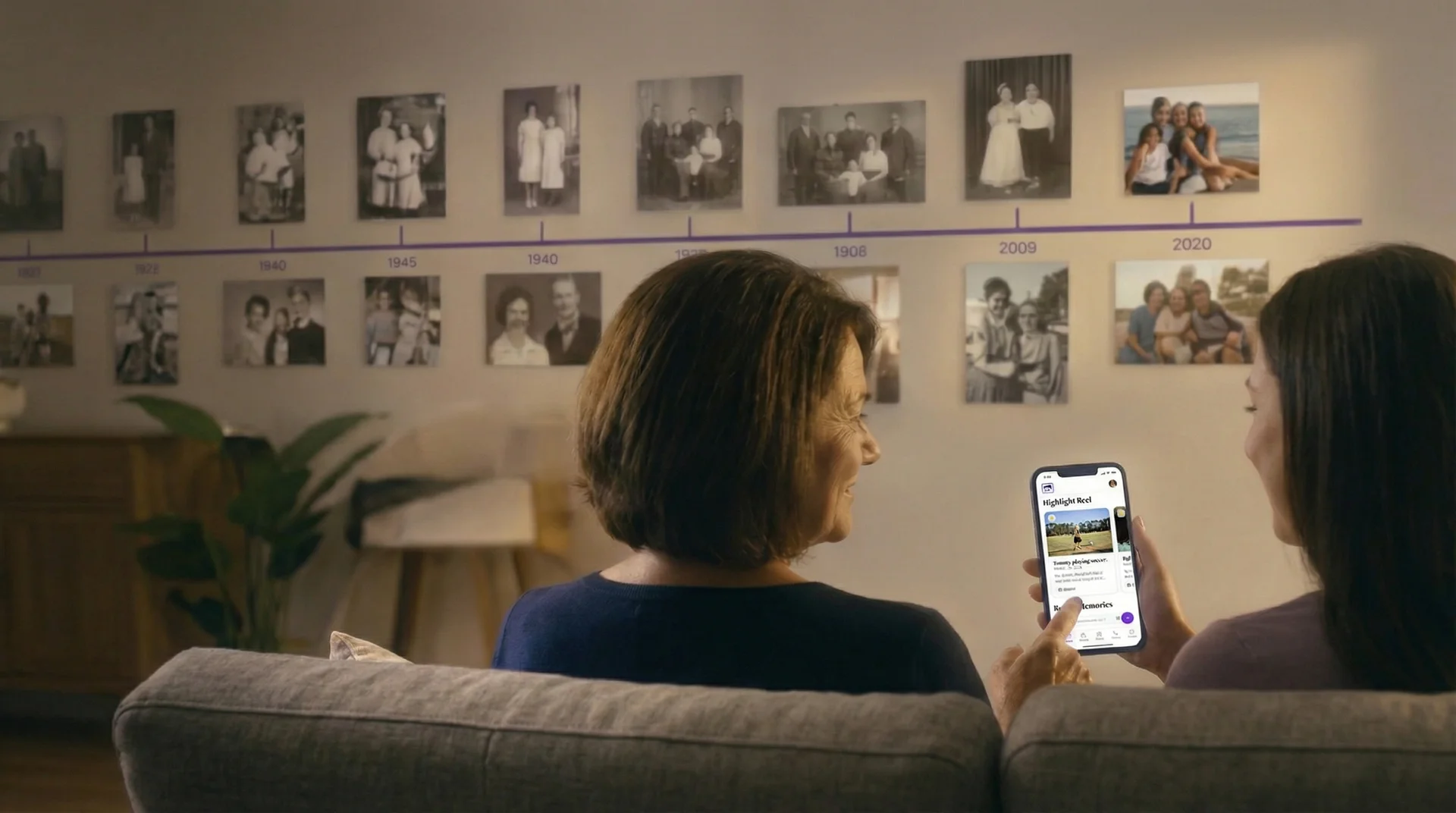
How to Save a Deceased Loved One's Voicemail Before It's Gone Forever
Your phone carrier is counting down to the day your loved one's last voicemail disappears forever. Most families don't know this until it's too late. Here's exactly how to save it — on iPhone and Android — before the clock runs out.
The Memory Murals Team • April 19, 2026

Comparisons
Save Your Dad's Stories Before He Forgets: 7 AI Memory Apps Tested
The third time he told the hitchhiking-to-Halifax story, you realized you had zero recordings of it. Here are the seven AI memory apps actually built to capture a parent or grandparent's voice — tested without the vendor spin.
Patrick Moore • April 27, 2026
Comparisons
Voice Recording Books for Grandparents: What Actually Works (and What Feels Gimmicky)
A voice recording book can turn a grandparent's storytelling into something your kids will actually hear someday. But there's a wide gap between the gimmicky ones and the ones that really work. Here's what to look for.
Patrick Moore • April 14, 2026