
How to Memorialize a Parent: 7 Ways That Last
Seven specific, lasting ways to memorialize a parent — from saving their voicemails before the carrier deletes them to planting something that outlives the grief. Pick one. Start this week.
The Memory Murals Team • April 26, 2026

It's the second Father's Day. Last year you bought flowers and they died on the dresser before you'd even decided what to do with them.
There's a voicemail you keep meaning to save.
There's a watch in a drawer that you take out about once a month, hold for a minute, and put back. You're not sure what you're supposed to do with the love that has nowhere to go.
This post is for that. Seven specific things — not vague advice, not "let yourself feel your feelings," not a candle and a Pinterest quote — that families actually do to memorialize a parent and that hold up over years, not weekends.
Where to start
The seven ways below take anywhere from twenty minutes to twenty years. Only one has a clock on it — saving their voice. Voicemails auto-delete on a rolling 14–30 day window depending on the carrier, and the older relatives who can still tell you who's who in the photos are not getting younger. Start there if you start anywhere this week. Everything else is yours, in whatever order makes sense for who they were and who you are without them.
A few honest things about doing this
Grief isn't linear. You may feel ready to do something concrete this week and then go six months without touching any of it. Both are normal.
There's no "right way" to memorialize a parent. The internet will try to sell you one — usually involving a candle and a journal — and that's fine if it fits. But the seven ways below are practical, not prescriptive. Some of them take an afternoon. Some take a decade. A couple of them you'll start now and your kids will keep going long after you're done.
If a section in this post doesn't feel right for who they were or who you are, skip it. The watch on the dresser doesn't need to become a tree. The annual phone call to their best friend doesn't need to become a scholarship.
One thing I'd push back on, though: the urge to wait until you "feel ready." Some of these — especially Way 1 — have a clock on them. The voicemails get deleted. The aunt with the family stories gets older. The siblings of the parent you lost will not always be available to record. Ready is a luxury. Started is what counts.
The one with a clock on it
If you do exactly one thing this month, do this one. Voicemails do not last forever.
Most carriers auto-delete saved messages on a rolling window. AT&T's basic voicemail holds messages for 14 days; visual voicemail for 30. T-Mobile auto-saves between 14 and 30 days depending on the plan, and even messages you've explicitly "saved" eventually fall off. Verizon's behavior has shifted over the years — some users report messages held indefinitely, others have lost them without warning. The honest summary: don't trust the carrier.
What to actually do, today, in the next twenty minutes:
- Open your voicemail right now and forward every saved message from your parent to your email. Most phones let you do this directly from the visual voicemail screen. If yours doesn't, there's a separate guide for saving a deceased loved one's voicemail with the exact steps for iPhone, Android, and the carrier-specific quirks.
- Pull every old voicemail off other family members' phones too. Your sibling. Your other parent. The aunt who got sentimental at Christmas. There may be voicemails of your parent on their phones that you don't know about. Ask.
- Save the audio in two places. Email is one. A folder on a hard drive is two. Cloud-only is one place that will eventually fail.
If your parent is still alive — read this paragraph twice — record them now. There's a separate piece on how to record your grandparents' stories that applies just as well to parents. The single best Saturday-afternoon project you will ever do is two hours with a phone set to record audio and a list of questions you actually care about. The voice is the part you'll wish you had.
A place where the voice, photos, and stories live together
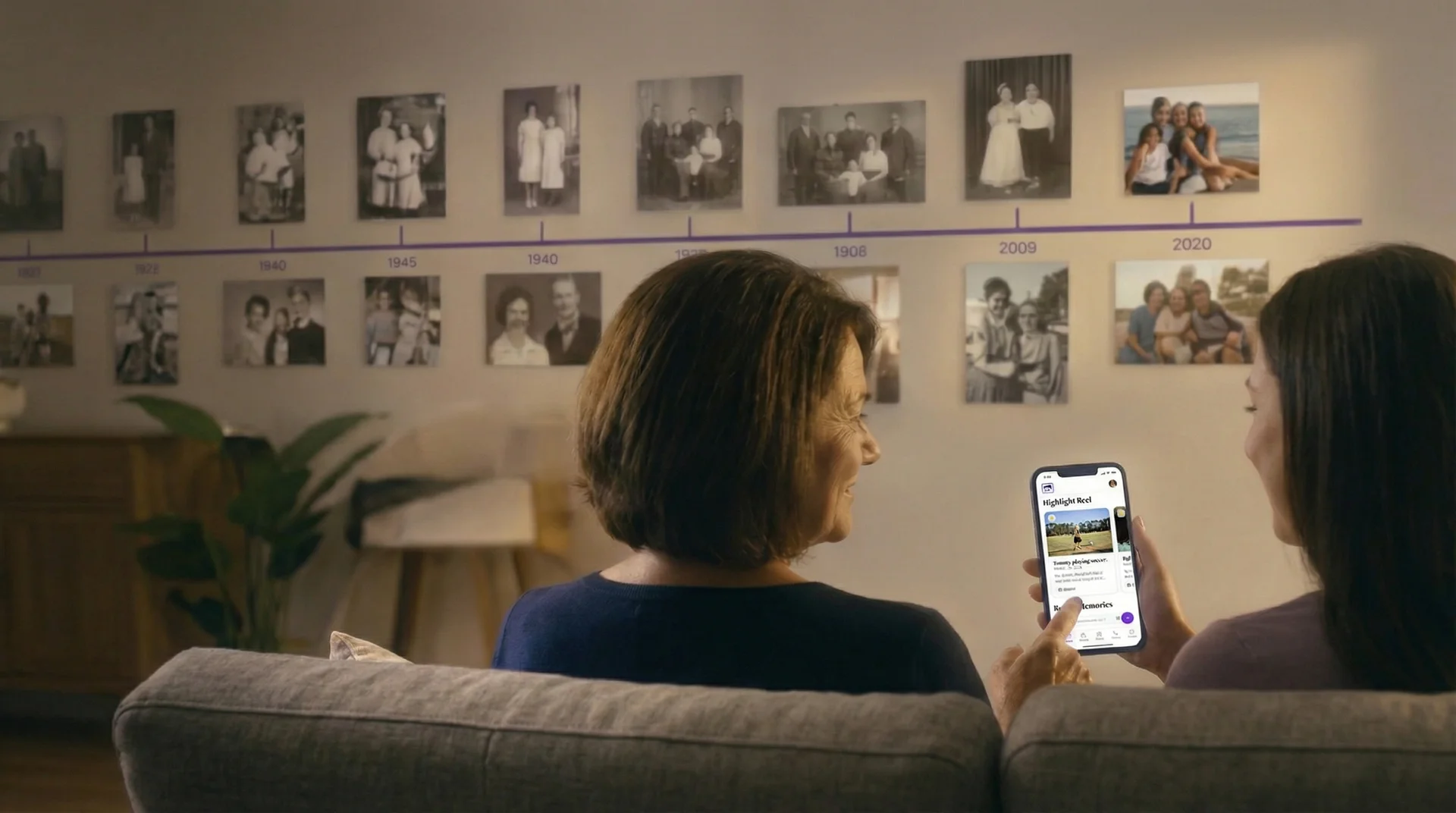
Most families' memories are scattered. Voicemails on the phone. Photos in iCloud. A box of prints in the closet. A folder on a dead laptop. Stories in nobody's head except the cousin who can't remember which year the Florida trip was.
The second way to memorialize a parent is to gather it. Not all at once. Over months. Into one place where, in twenty years, your kid can search "Grandpa Joe" and actually find something.
What "an archive" can be:
A shared Google Drive
Folders by year, person, and event. Free, ugly, works.
Anyone in the family can drop a photo or a story into the right folder. The limit: there's no real way to attach voice or context to a specific image. It's a filing cabinet, not a story.
A printed photo book
A service like Mixbook or Artifact Uprising. Beautiful, finite, expensive.
Add captions and short stories to each image, then ship a hardcover. Best for one-shot "year of remembering" projects, not ongoing capture.
A dedicated family archive
A product like Memory Murals — opinionated, ongoing, voice-first.
Voice + stories + photos + the context that explains them, all in one place. Built for the case where the voice is the part you'll wish you had.
Honest tradeoff: an archive is not a printed gift box. It's not finished in three weeks and wrapped under a tree. It's a thing you build over time, the way some families build a photo album one summer at a time. If you want a one-shot project with a clear endpoint, jump ahead to Way 6 (heirloom with story).
If you want the version where the voice is the center of the thing — every photo can have an audio note recorded by you or someone who knew them, every story has the voice that told it — that's what we built Memory Murals to be. It's free to start. We also wrote a related post on what to do when there's a pile of unlabeled photos and the only person who knew the names is gone — same problem, slightly different angle.
A quick honest note on photo-animation tools like MyHeritage's LiveMemory, which a lot of grieving families try first: they're cosmetic. A 5-second animation can be a nice postcard, but it's not the archive. We wrote a longer piece comparing the current options — animate the photo if you want, then build the archive that holds the voice.
A tree, a perennial, a small wild place that's theirs
There's a specific category of grief that wants to plant something. It shows up about a year after the loss for most people, sometimes earlier. Listen to it.
The practical version of "plant a memorial tree" is more involved than it sounds, so here's what to actually think about:
- Pick something native to your zone. A magnolia in Vermont is sad. An oak in Phoenix is sadder. Your local extension office or a decent nursery will tell you what'll thrive without you having to fight it for ten years.
- Pick something they'd have chosen. A father who fished the same lake every summer probably wants a willow near water, not a perfectly manicured ornamental cherry that blooms for nine days. A mother who loved her garden probably wants something that flowers — lilac, dogwood, magnolia in the right zone.
- Pick somewhere you'll actually visit. A tree in your own yard is a daily reminder. A tree at their old house, after you sold the house, is heartbreak waiting to happen. Be honest about where you'll be in ten years.
- Slow vs reliable. A white oak grows slowly but stands for centuries. A river birch grows fast and offers shade in five years. There's no wrong answer — but if you're forty and grieving a parent, consider what version of you, at sixty, walks past this tree.
If you don't have land — most people don't — there are good options:
Arbor Day Foundation
The cheapest meaningful option — starts around $5 a tree.
The commemorative program plants in vetted forests of need, registers the dedication, and sends a certificate.
U.S. Forest Service
Fund reforestation in a specific national forest in your parent's name.
The Plant-A-Tree program includes an optional memorial certificate. Trees aren't individually marked, but the donation goes to real ground.
State + national park groves
Many parks have memorial groves with a named bench or tree.
Call the park's foundation directly — the website almost never lists it, but most have a small giving program for this exact thing.
The thing a planted tree gives you that nothing else does: it grows. The grief, mostly, doesn't. Watching something gain mass and shade and birds while you're slowly figuring out how to live without your parent is — in a way that's hard to explain in a blog post — exactly the right shape for that work.
A small repeated thing that holds the year together
Pick a date. The birthday is the most common — death anniversaries are heavier and a lot of families avoid them deliberately. Mother's Day or Father's Day works. So does Christmas Eve, or the first day of trout season, or whatever specific day was theirs.
What the ritual actually is matters less than the fact that you do it again next year, and the year after that.
A short list of rituals families actually keep:
- Cook one of their recipes — exactly the way they made it, on the same day, every year.
- Drive the route they used to drive. Stop where they stopped. Get the same gas station coffee.
- Watch the movie they always quoted. The Princess Bride. Caddyshack. It's a Wonderful Life.
- Call the person who knew them best — their oldest friend, a sibling, the neighbor — and just talk about them for twenty minutes.
- Write them a letter you don't send. Keep all the letters in one box. In ten years it's a more honest record of your grief than any therapist's note.
- Visit the spot. Bring something seasonal — a leaf, a flower, a stupid little rock from the place you went last weekend that they'd have laughed at.
Permission, in case you need it: the ritual can be small. It can take fifteen minutes. It does not need a Pinterest aesthetic, an Instagram post, or other people's participation. The point is the repetition, not the production. We wrote a separate piece on building an annual Mother's Day memory ritual that goes deeper on this if it's the path that fits.
Beyond the funeral-week donation
When someone dies, people make one-time donations in their name. That's lovely. It's also temporary. Way 5 is about ongoing giving — the multi-year version that actually moves something.
Concrete shapes this takes:
- A scholarship at their high school or college — many smaller schools will take a few thousand dollars a year and award it as a named scholarship. Their alumni office knows how this works. Your kids can keep funding it after you're gone.
- A named bench, brick, or paver at a place that mattered — the library where they read, the park they walked, the hospital that took care of them at the end. Most institutions have a giving program; nobody on the website tells you about it because it's small-dollar.
- A monthly recurring donation to the cause they actually cared about — not the one you wish they'd cared about. If your dad cared about veterans, pick a veterans' org, not the climate nonprofit you donate to. The point is to honor them.
- Sponsor a section — books in a library wing, a tree in a park, a square foot of restoration work — these tend to be the cheapest "named" gifts and the most lasting.
A note on tax-deductibility: ongoing giving in their name, at most 501(c)(3) organizations in the U.S., is deductible the same way any other charitable giving is. Keep the receipt. Talk to your accountant if you're doing more than a few hundred a year.
This is not a "send-flowers" replacement. Flowers are for the funeral; flowers are also fine. Way 5 is the multi-year version — a ten-year choice, sometimes a generational one. If you're not sure which cause, ask the person who knew them best what your parent talked about when nobody was listening. That's usually the answer.
The object means little without the why
There's a watch. There's a recipe card with handwriting. There's a record collection. A set of dishes from the wedding. A toolbox in the garage. A leather journal somebody wrote in for two months in 1974 and then abandoned. A ring.
The standard advice is "pass it down." That's incomplete. The object without the story is just a thing. The object with the story is an inheritance.
Here's the simplest practice that turns objects into heirlooms:
For each meaningful object, record a 60-second voice memo — your phone, free voice memo app — that answers three questions:
What is this?
Name the object out loud. Specific. The future listener doesn't know yet.
"The watch. Grandpa's watch. The Hamilton he wore on his wedding day in 1958."
Where did it come from?
The provenance, briefly. Where, when, by whom.
"Bought at the jeweler in downtown Pittsburgh. Reset by the same shop in 1979. Wound every Sunday morning."
Why did it matter?
The story that turns the object into an heirloom.
"He'd take it off every night and your grandmother would wind it for him while he was in the bathroom — she did this for fifty-two years."
That's it. Sixty seconds per object. Save the audio with the photo of the object in the same folder. When the object passes to the next generation, the audio passes too. They get the watch and the why.
If you have a pile of objects and no idea what's what, start with the ones the older generation can still tell you about. We wrote a separate piece on what to do with a parent's photo collection — same instinct: capture the context while there's still someone alive who knows it.
For grandparents specifically — who tend to be the keepers of more objects with longer stories — there are also voice-recording memory books that pair an object or photo with a recorded story in a single bound volume. Different format, same idea.
The only one that doesn't need a thing
Way 7 is the one with no object, no garden, no donation. It's an inheritance of practice.
What this looks like in real families:
- A child named after them. (The most ancient version of this. Still the most common.)
- A recipe they perfected, made by you, made by your kids — and then taught to your kids, the same way they taught it to you, hands on hands.
- A tradition they started — the Christmas-morning waffles, the day-after-Thanksgiving leaf-raking, the Sunday phone call — that you keep going because they did.
- An art form they practiced — woodworking, knitting, gardening, the way they fixed every broken thing in the house — that you take up, even badly, even just to keep the practice alive.
- The way they greeted people. The exact joke they always told. The phrase they used when you were upset. (One of the strangest, most powerful inheritances: at some point, you'll catch yourself saying their thing, in their voice, to your own kid, and you'll have to sit down for a minute.)
Way 7 is the only one of the seven that requires nothing physical. Nothing planted, nothing recorded, nothing donated. It happens when a thing they made or named or did becomes a thing you do — without thinking about it — until your kids do it without thinking about it.
This is also the way that, statistically, lasts the longest. The watch wears out. The tree falls. The scholarship runs out of funding in a recession. The recipe, made every Christmas for three generations, doesn't.
What memorialization is, and isn't, for
There's a quieter thing to say here, and it's the truest one in the post.
The seven ways above are not a fix. None of them will give you back the person. The grief — at least the specific texture of this grief, of having been parented by someone who is no longer here to parent you — does not actually go away. People who've lost a parent ten, twenty, thirty years ago will tell you. It softens. It changes shape. But it's permanent.
What memorialization is actually for: giving the love a place to live so it doesn't slowly disappear by accident, because life got busy and you got older and the specifics started to fade. The love doesn't go anywhere. But without somewhere for it to land — a tree, a recording, a recipe, a ritual, a name — it can become unfocused. The grief becomes a kind of background noise instead of a thing you can sit with on purpose.
The seven ways are structures. They give the love a target. The voicemail folder. The Saturday afternoon. The first lilac in May. The dish you only make once a year. The kid named after them.
Your job here is not to "process" the grief into something neat. It's to build small, true containers that hold the love when you're not actively thinking about it — so that when you do think about it, on the bad days, you have somewhere to go.
That's it. That's the whole project.
If you do nothing else
Pick one. Start this week. The hardest part is starting, not finishing. Way 1 (saving the voice) has a clock on it and is the most reversible if you skip it — the voicemails get deleted, the aging relatives stop being available. Start there. Everything else can wait.
Frequently asked questions
What's the most meaningful way to memorialize a parent who recently died? The most meaningful way is almost always the one that's most specific to who they were — not what's most meaningful in the abstract. If they loved their garden, plant something. If they were the family storyteller, save every recording you can find. If they had a recipe everyone loved, learn it and make it every year. Generic memorials feel hollow because they could apply to anyone. Pick the one of the seven that fits this parent, not "a parent."
How do I memorialize a parent on the anniversary of their death? Anniversaries are heavy, and many families intentionally avoid making them the day. If you'd rather pick a different date — birthday, holiday, the season they loved most — that's completely valid. If you do want to mark the actual anniversary, a small ritual works better than a big one: a walk where they walked, a meal they made, a phone call to someone else who misses them. Small and repeatable beats grand and one-off, every time. For the specific shape of the first one — what to expect, what to avoid, and why the run-up is often worse than the day itself — we wrote a separate piece on the first anniversary of a parent's death that goes deeper on this exact question.
How do you memorialize a parent without a grave? A surprising number of families don't have a grave to visit — cremation with scattered ashes, a memorial reef, a body donated to science, a death far from home. Without a grave, the memorial becomes whatever you decide it is: a tree somewhere meaningful, a bench in a park they loved, an annual ritual on a date that matters, a digital archive their grandkids can actually find. In some ways, the absence of a grave forces a more honest answer to the question "where do I go to feel close to them?" The answer might be a kitchen, a hiking trail, or a folder of voice recordings — and those tend to last longer than a stone in a cemetery your kids may never visit.
How long after a parent dies should you memorialize them? There's no right window. Some families plant a tree the first month; others can't bring themselves to touch any of this for two or three years. Both are normal. The only thing with an actual timeline is saving voicemails — those have a clock measured in days or weeks depending on the carrier. Everything else can wait until you're ready, and "ready" is allowed to take years.
What can I do with my parent's voicemails before they get deleted? Forward them to your email immediately — most phones let you do this from the visual voicemail screen. Save the audio file in at least two places (email plus a hard drive or cloud folder). If your phone won't let you forward, the step-by-step carrier guide linked in Way 1 above has the iPhone, Android, and carrier-specific instructions. Don't wait — AT&T basic voicemails delete in 14 days, T-Mobile in 14-30, and Verizon's behavior is inconsistent enough that you should not trust it.
There is no version of this where you do everything right. There's no version where the grief gets smaller because you planted a tree or saved a voicemail or named a kid after them. That's not what these are for.
What they are for: making sure that, twenty years from now, the love you had for your parent has somewhere to go. So your kid can hear their voice. So someone is still cooking the recipe. So a tree, somewhere, is taller than you are. So when somebody asks what they were like, you have something more than a fading description in your head — you have a folder, an archive, a story you wrote down, a name your child carries.
For the rest of the practical first-year work — voicemail-saving guides, the grief-cluster reading list, FAQs other families have asked at week three and week thirty — our hub for grieving families gathers it in one place.
If you're cross-shopping memorial-platform options specifically, Memory Murals vs Chptr covers the multi-contributor tribute-page side of the category, and Memory Murals vs ForeverMissed covers the established public-tribute model. Both walk through where a memorial-page tool fits versus where a private family archive fits.
If the graveside itself is part of the picture — QR-coded medallions for the gravestone are a small physical object that opens a digital memorial page when a visitor scans it. The honest explainer covers how they work, what they cost, the durability questions nobody puts on the marketing page, and whether your family actually needs one.
If a celebration of life is upcoming and you want a private memory wall the whole family can contribute to — voice messages, photos, and stories from everyone who knew them — the celebration-of-life memory wall guide walks through how to set one up before the service.
Pick one. Start this week.
Related Stories
How-To Guides
How to Save a Deceased Loved One's Voicemail Before It's Gone Forever
Your phone carrier is counting down to the day your loved one's last voicemail disappears forever. Most families don't know this until it's too late. Here's exactly how to save it — on iPhone and Android — before the clock runs out.
The Memory Murals Team • April 19, 2026

How-To Guides
The Mother's Day Memory Ritual: A 30-Minute Annual Tradition That Outlasts Every Other Gift
Flowers wilt by Tuesday. Brunch is forgotten by the next weekend. But a 30-minute recording of your mom's voice, saved every Mother's Day for the rest of her life, becomes the only family heirloom that gets more valuable with time.
Patrick Moore • April 2, 2026

How-To Guides
What to Do With All the Old Family Photos Nobody Labeled
There's a shoebox on a closet shelf with hundreds of photos of people nobody alive can fully name. Your mom knows who most of them are. She won't, forever. Here's how to fix it this month — before the only memory that still knows goes quiet.
Patrick Moore • April 22, 2026