
Ask Dad About His Dad This Father's Day
Most Father's Day posts ask you to record your dad. This one asks something different: spend Sunday asking him about his father. He is, for most of us, the last living person who really knew the man your kids will only ever see in a frame. When he goes, the only stories left of your grandfather go with him.
The Memory Murals Team • May 15, 2026
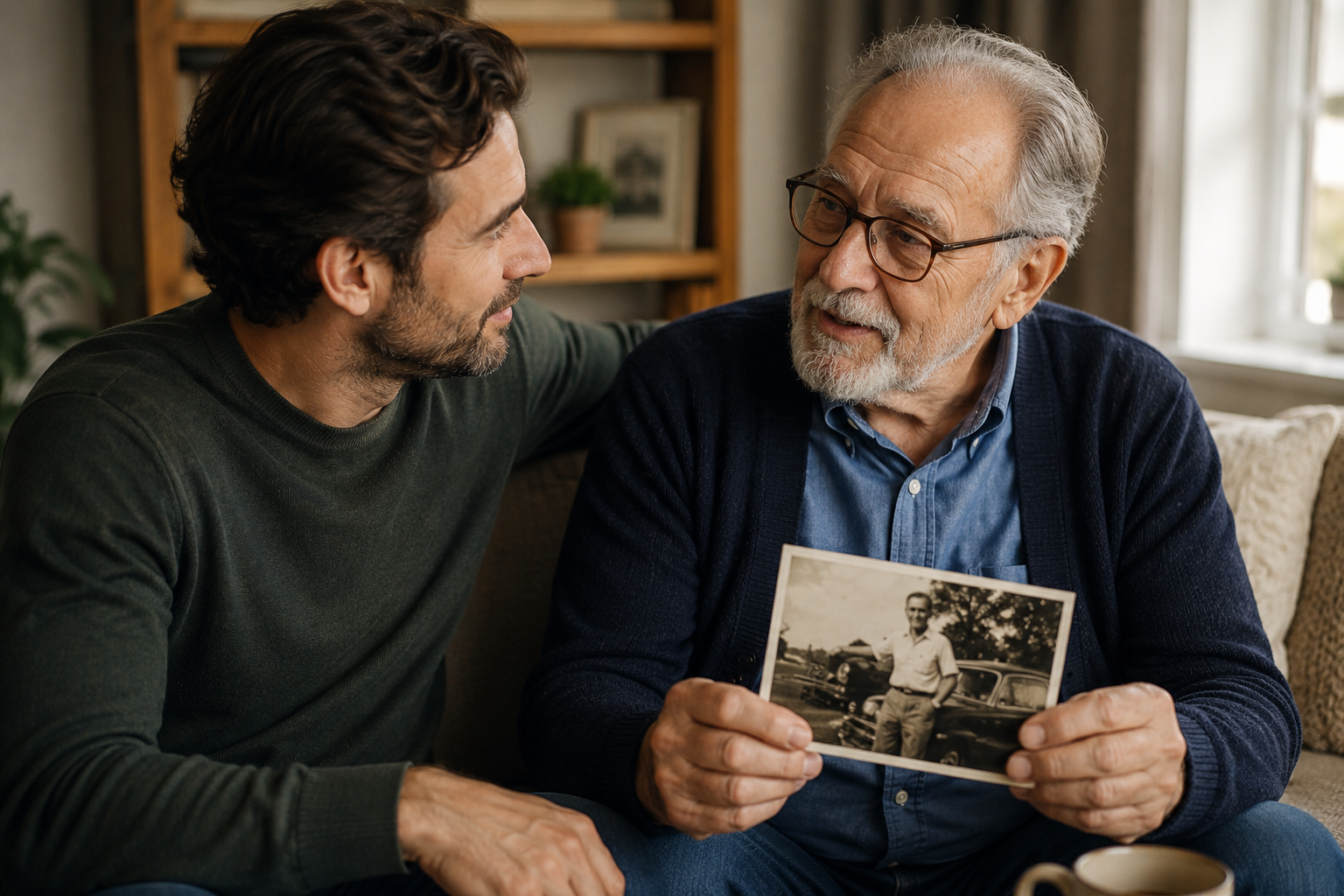
A few years ago, on a hunch, I asked my dad what his own father used to whistle.
He looked at me like I'd asked him to recite a phone number from 1972. "Whistle?" he said. Then he stopped. He set down the beer. He stared at the window for what felt like a full minute. And then, with no warning, he started whistling — four bars of a tune I'd never heard, in the breathy off-key way of a man whose mouth was remembering something his brain had forgotten he knew.
"That," he said. "He did that every morning, shaving. I haven't thought about it in forty years."
That whistle is on a recording now. Seventeen seconds long. It is the only audio anywhere on Earth of the man my children call "Great-Grandpa" in the framed photo on the bookshelf — a man who died in 1989, before I was old enough to remember his face.
This is the quiet truth about Father's Day nobody talks about: there is a stranger, more important gift you can give your dad this Sunday than anything wrapped in paper. You can spend thirty minutes asking your father about his father. Because he is, for almost all of us, the last living person who actually knew him. When your dad is gone, your grandfather dies a second time — and that one is permanent.
The whole post in one line
This Sunday, ask your dad about his dad. Eight questions, recorder on, thirty minutes. You'll capture the only autobiography your grandfather will ever leave behind — and you'll give your dad something he almost never gets: to be a son again, out loud, in front of someone who's actually listening.
The camera turned one generation back
There are already plenty of guides on how to interview your dad — including our list of 50 questions to ask your dad before it's too late and the broader list of questions to ask your grandparents directly. They're all built around the same idea: your dad (or your grandfather) is the subject. Get him on tape. Save his voice while you can.
This post is asking you to do something different on Sunday. Not record your dad as the subject — record your dad as the keeper. The subject is your grandfather.
The frame is one generation back, and the urgency is sharper than people realize. Statistically, more than two-thirds of the people reading this no longer have a living grandfather on their father's side. The rest will be there within a decade. After that, the only person on Earth who can answer "what did Grandpa's hands look like when you were eight" is the man sitting across the brunch table on Sunday. When he's gone, that answer is gone with him — and there is no archive on the planet that can recover it.
80%
Lost in 3 generations
of personal family detail vanishes within three generations if no one records it
1 in 4
Never asked
adults have never had a meaningful conversation with their father about their grandfather
17 sec
Worth a lifetime
is all it took to capture my grandfather's morning whistle — forty years after the fact
The 1-in-4 number is the one that lands hardest. We tend to assume family memory transmits itself — passed down through stories at holidays, the way salt gets passed down a table. But the data is clearer than the feeling. Most families lose their grandfather's actual voice, gait, handshake, and rhythms within a single generation of his death. Not because anyone failed to love him. Because nobody thought to ask the one person who still had him on the inside.
There's a piece of research from Emory University that quietly proves the point: kids who know their family's intergenerational story — who their grandfather was, what he survived, what he loved — show measurably better emotional resilience than kids who don't. The strength comes from being part of something older than yourself. And the only way your kids get that story is if your dad tells it to you first.
Eight questions to ask Dad about his dad this Sunday
These are the eight I'd give you if you only had thirty minutes. Don't try to do all of them. Pick three or four. Let him drift between them. The good stuff is always in the drift.
1. "What did your dad's voice sound like?"
Why it matters: Most people can describe a parent's face from memory. Almost nobody can summon a voice. Asking your dad to describe his father's voice — the pitch, the cadence, whether it got softer or louder when he was angry — forces him back into a body that hasn't existed in decades. Whatever comes out of his mouth in the next ten seconds is the closest your kids will ever get to hearing their great-grandfather speak.
2. "What did his hands look like?"
Why it matters: A father's hands are the first thing a son notices and the last thing he forgets. Were Grandpa's hands rough or smooth? Stained with motor oil, paint, ink, nicotine? Did he have a wedding band that wore a permanent groove? A scar from a job site? Your dad's answer is, in the most literal way, how your grandfather worked — and how he held your dad when he was small enough to be held.
3. "What did he do when he came home from work?"
Why it matters: This is the question that captures who your grandfather was when he stopped performing. Did he change clothes immediately? Pour a drink? Sit on the porch in silence for ten minutes before saying a word? Read the paper at the kitchen table while everyone tiptoed around him? The first ninety seconds of a man's evening tell you more about his inner life than a hundred polished anecdotes ever will.
4. "What's one thing he said constantly that drove you crazy as a kid?"
Why it matters: Every father has a catchphrase — the rhythmic line he used a thousand times that the kids rolled their eyes at. "Turn the lights off when you leave a room." "Money doesn't grow on trees." "Did you check the oil?" Capturing your grandfather's catchphrase is the audio version of a fingerprint. It's also the thing your dad is most likely to laugh about — and his laugh telling you about it is half the gift.
5. "What did he love that you only found out about later?"
Why it matters: Most fathers, especially of your grandfather's generation, kept the things they actually loved quiet. The poetry. The jazz records. The garden he secretly babied. The Saturday morning radio show he'd never miss. Asking your dad what his dad loved in private is asking him to introduce you to a man you were never allowed to meet — usually because that man wasn't allowed to meet himself out loud either.
6. "What did the two of you fight about?"
Why it matters: Conflict reveals values. Saints don't make for good biographies — real people do. What your grandfather fought with your dad about is what your grandfather believed mattered enough to die on a hill for. The length of his hair? The college he picked? A job he didn't respect? A girlfriend he couldn't stand? Whatever it was, you'll learn more about who your grandfather actually was from one fight than from a hundred sanitized stories at his funeral.
7. "What did he look like the last time you saw him?"
Why it matters: This is the hardest question on the list, and it is the most important. The last visual is the one that haunts every son, and almost nobody talks about it. Whether your grandfather died in a hospital bed or at the wheel of his truck or in his sleep on a Tuesday, your dad carries the image of his final face. Recording the description of that face — even as your dad's voice cracks, especially as it cracks — is the most honoring thing you will ever do for either of them.
8. "What would he want his great-grandkids to know about him?"
Why it matters: This is the question that turns the recording into an inheritance. Your dad isn't answering for himself anymore — he's answering as his own father. For thirty seconds, your grandfather gets to address children he never met. There is no other way to give your kids that voice. There is no other technology that does this. There is only your dad, on Sunday, with the recorder on.
The 30-minute setup
Most people who read a post like this nod, close the tab, and remember it on Monday. Dads are especially easy to lose to "I'll do it next time." Here's how to make it harder to forget.
Bring a photo of Grandpa
The single best thing you can do is print or pull up a photo of your grandfather before you start. Anything — his wedding day, a snapshot in a uniform, a Polaroid from a backyard barbecue, a bad work ID from 1974. Faces unlock memories nothing else can. Your dad will look at the photo, and the moment his eyes land on a specific feature — Grandpa's eyebrows, the watch he always wore, the way his collar sat — the answers start. Without the photo, dads in particular tend to stay at the surface. With it, you usually can't keep up with what comes out.
Pick three questions, not eight
The list above is a menu, not a worksheet. Pick the three you'd most regret never knowing the answer to and stop there. The conversation will spill into the others on its own — your dad will start with the voice and end up at a story about a Sunday morning in 1973 that has nothing to do with voices at all. That's the recording you actually want. Forty minutes of drift beats two hours of interview every time. The full interview-your-dad guide for the strong-silent type goes deeper on how to set up the room so he forgets it's an interview.
Hit record at the start, not 'when something good comes up'
Most people wait until they hear the first profound thing before turning on the recorder. By then it's too late. Hit record before you ask question one. The first ninety seconds are always awkward, and you can trim them later. After that, your dad forgets the phone is on, and you'll get the version of him that doesn't perform. That's the version your grandkids will need.
Voice memos work fine if — and this is a real if — you commit to moving the file out of your phone the same day. Either way, save it twice. A file on one device isn't preserved; it's waiting to be lost the next time the carrier purges old data.
What if your grandfather is still alive — or your dad is gone?
If your grandfather is still here, record both of them — separately, then together. The crossover stories are the gold. If your dad has already passed, the questions still work, you just ask them of your uncles, your dad's oldest friend, his cousins, his sister. Don't wait. If you're spending this Father's Day grieving him, even the smallest detail someone else can offer about him or his father is worth chasing down this week. Every year of delay halves the answers.
Why this is also a gift to him
There's a thing nobody warns you about: most dads, after a certain age, almost never get asked about their own fathers. Their friends knew the man, so they don't ask. Their kids never met him, so it doesn't come up. Their grandkids only know him as a name on a wall. So your father is the only one carrying this entire person around inside him, and most weeks of the year, nobody opens that door.
When you ask him these questions on Sunday, you're not just gathering facts. You're letting him be a son again, out loud, in front of someone who is actually paying attention. For thirty minutes he gets to live in his own father's house with company. That is, by itself, a Father's Day gift — and it's the kind dads almost never get. Most of them have been quietly waiting decades for someone to ask. The gift you can give a dad who already has everything usually isn't a thing — it's a question.
The recording is the bonus.
If your father is showing any signs of memory changes — the names slipping, the same story twice in one visit — don't wait until next Sunday. Capturing his voice before any cognitive decline accelerates is the difference between a complete archive and a half-finished one.
This Sunday, sit with him. Bring the photo. Hit record. Ask three questions. The tie will be in a drawer by Tuesday. The barbecue will be forgotten by next weekend. The seventeen seconds where he says "every morning, shaving, he whistled that same tune" will outlive everyone in the room.
This Father's Day, give him the gift of being a son again
You don't need to buy anything. You don't need to plan anything elaborate. You just need to sit down beside him, place a photo on the table, and ask one question he hasn't been asked in forty years.
The tie will be wrinkled by Tuesday. The barbecue plate will be in the dishwasher. But the story he tells you on Sunday — the one about the whistle, or the hands, or the last face — that's the gift that lasts.
Not for him. For everyone who comes after.
Start preserving your grandfather's story today. Try Memory Murals free →
Related Stories

50 Questions to Ask Your Dad Before It's Too Late (And Why Each One Matters)
He taught you to ride a bike and pretended the burnt pancakes were fine. But do you know what scared him? What he almost did differently? What he wishes he'd said? These 50 questions unlock the man behind 'Dad.'
The Memory Murals Team • April 18, 2026
40 Questions to Ask Your Grandparents Before It's Too Late (And Why Each One Matters)
Your grandparents are the last living link to a world nobody else around you ever saw — your parent as a kid, the country you came from, the century before yours. These 40 questions unlock the stories that disappear when they do.
The Memory Murals Team • May 2, 2026

How to Interview Your Dad (Even If He's Not a Talker): A Gentle Guide to Recording His Stories
Most dads don't open up across a kitchen table. They talk sideways — in the truck, in the garage, walking the dog. Here's how to record him anyway: why he deflects, why audio is the medium that finally works, and 30 questions ranked from 'first car' to 'your father.'
The Memory Murals Team • May 5, 2026