
40 Questions to Ask a Veteran in Your Family Before It's Too Late
WWII veterans are passing at roughly 130 a day. Vietnam vets are now in their 70s and 80s. These 40 questions are the ones their families will wish they'd asked — with the gentle framing that gets them answered.
The Memory Murals Team • May 17, 2026
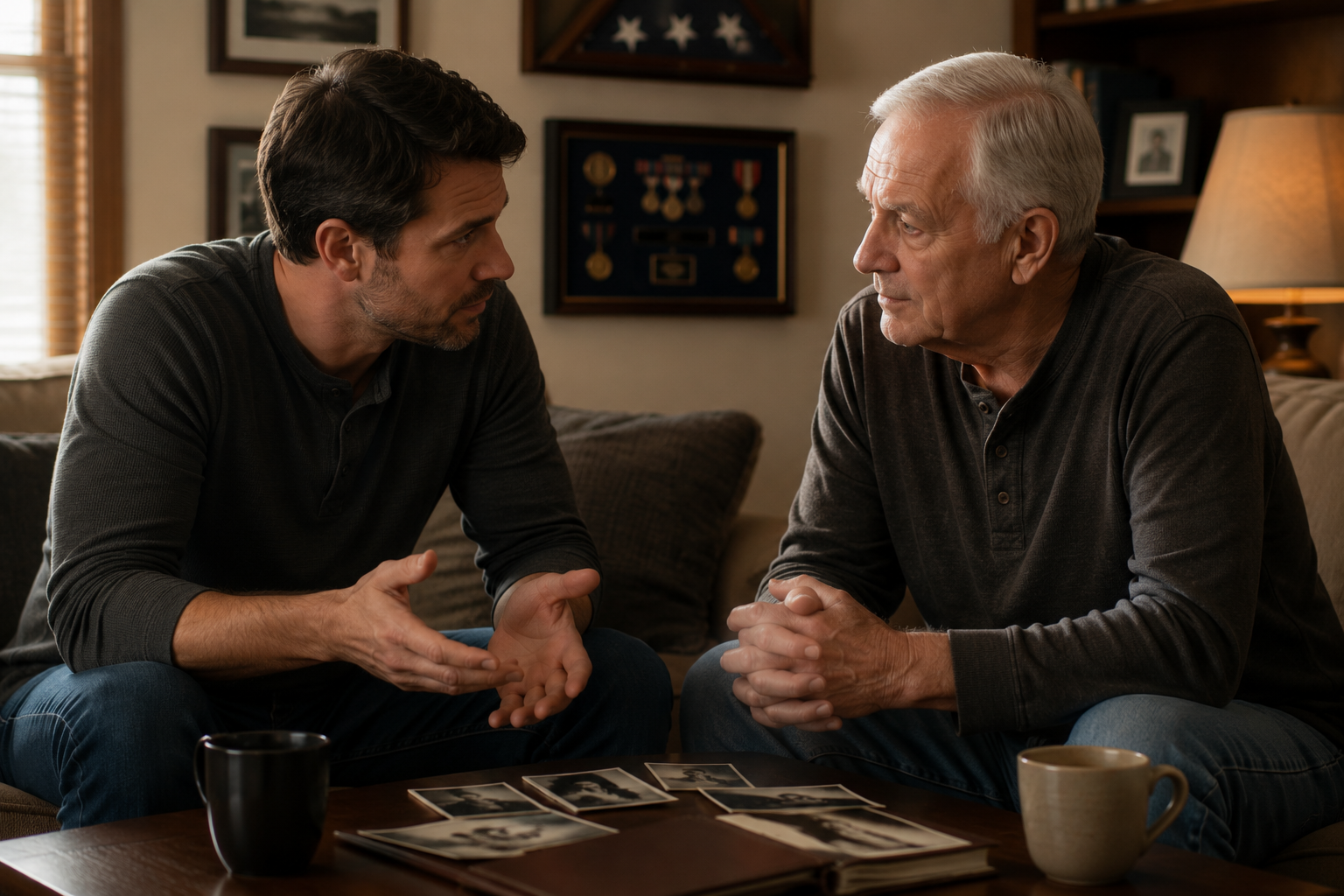
If there's a veteran in your family, you already know the rule: don't ask about the war.
Maybe your grandfather went quiet whenever anyone brought up his time in the Pacific. Maybe your dad rolled his eyes at Vietnam movies and changed the channel. Maybe your uncle, the one who came home from Iraq, told a few stories at Thanksgiving and never repeated them.
There was always a reason to wait. There was always next year. And next year, there was always something else.
Memorial Day is the week the math catches up with you. According to VA and National WWII Museum tracking, roughly 45,000 WWII veterans are still alive in the United States — under half a percent of the 16.4 million Americans who served. The youngest are in their late 90s, and the cohort is losing 130 to 230 veterans every day. Vietnam-era veterans are now in their 70s and 80s (average age 72 to 78) and make up roughly 28% of all living U.S. veterans — the largest war-era cohort still here. Of the 6.1 million Vietnam-era servicemembers still alive, only about 850,000 deployed to the combat zone in Southeast Asia, and that combat subset is aging into the same window WWII vets were in fifteen years ago. Even Gulf War vets are in their 50s, and the ones with combat injuries are aging faster than the rest of us.
These 40 questions are the ones their families will wish they'd asked. They're sequenced from easiest to hardest, and each comes with why it matters — because veterans almost never tell stories without a reason. Give them the reason.
This list is the veteran-specific entry into our complete guide on recording your family's life stories — the master guide that covers every relationship, the recording technique, and what to do with the audio after the conversation.
Before you ask
Don't sit him down at a kitchen table with a recorder and call it an interview. That framing shuts most veterans down. Ask one question at a time, in motion — in the truck, on a walk, at the workbench. Let the silence after the question do the work. If he doesn't answer, don't fill it. The answer almost always comes in the second pause, not the first.
The questions about how it started
1. "How old were you when you signed up?"
Why it matters: This is the safest question on the list and the door to every other one. It anchors him in a specific year, a specific age, a specific version of himself. The answer is almost always followed by "I was just a kid" — which is the doorway to everything that came next.
2. "Did you enlist, or were you drafted?"
Why it matters: Enlistment and the draft were two completely different decisions, and the difference shaped how he felt about every day after. Volunteers and conscripts came home as different men. He'll tell you which one he was, and from there, why.
3. "What did your parents say when you told them?"
Why it matters: This question reaches the people who aren't there anymore. His mother, his father, the kitchen they were standing in. Watch what happens in his face when he answers. The grief he never showed for them often comes out here.
4. "Where did you do basic training, and what was the first day like?"
Why it matters: Every veteran remembers the first day of boot camp the way you remember your first day of high school — only sharper, because it was designed to break him on purpose. The drill instructor's name. The shock of the haircut. The smell of the barracks. Specific. Sensory. Easy to talk about.
5. "Who was your bunkmate, and where did he end up?"
Why it matters: Bonds formed in basic training were forged in 72-hour exhaustion and 4:30 a.m. cold. Most veterans can still name their bunkmate fifty years later. Some of those names lead to stories that have never left him.
6. "What did you think the war would be like before you got there?"
Why it matters: Every soldier carries two memories of the war — the one he imagined and the one he lived. The gap between them is where most of the stories live. The question gives him permission to talk about the boy who didn't know yet.
7. "What was your specialty? What did the military train you to do?"
Why it matters: MOS. Rating. Job code. Every veteran has one, and most never get asked about it by family. Mechanic, radioman, medic, gunner — the answer tells you what his days actually looked like. Most people imagine combat. Most veterans were doing something else.
8. "What did you carry in your pack that wasn't issued?"
Why it matters: A letter from his mother. A photograph. A pocketknife from his father. Soldiers always carried something unauthorized, and the something usually mattered more than anything that was authorized. This question opens a door no autobiography ever asks about.
The questions about the places he can't forget
9. "Where were you stationed, and how did you get there?"
Why it matters: The journey was usually the longest of his life — a troop ship across the Pacific, a transport plane to Da Nang, a flight to Kuwait. Most veterans remember the first sight of the place better than they remember the last. Ask him what the air felt like when the door opened.
10. "What did your unit do — what was your day-to-day job?"
Why it matters: Movies show combat. Reality was usually waiting, maintaining equipment, filling sandbags, peeling potatoes, writing letters, and short bursts of something else. The day-to-day is what he actually lived. Ask about the boring parts. The stories hide there.
11. "What was the food like?"
Why it matters: Every veteran has opinions about C-rations, K-rations, MREs, or whatever else he was fed. This is a safe, low-stakes story prompt that nearly always opens into something else — the time the cooks ran out, the trade he made for a candy bar, the meal he couldn't eat after a bad day.
12. "Did you have a nickname over there?"
Why it matters: Almost every soldier did. The nickname tells you who he was to his unit — the funny one, the religious one, the one who could fix anything. Knowing the nickname unlocks an entire identity you've never met. Ask who gave it to him.
13. "What did your bunk or your quarters look like?"
Why it matters: A photograph taped to a metal locker. A name carved into a beam. A radio that played one station. The physical space he lived in for months or years is something he can still see when he closes his eyes. Asking him to describe it is asking him to put you in the room.
14. "Did you keep a journal or write letters home?"
Why it matters: Many did. Some of those letters are in a box your grandmother kept. Some of them are gone. Either way, the question opens up what he was thinking — and who he was writing to. Ask if you can read them. Ask if you can scan them.
15. "What did you see that you wish you hadn't?"
Why it matters: This is the first question that requires permission to ask. Don't ask it first. Don't ask it at a dinner table. Ask it in the truck, on the third or fourth conversation, when he's already trusted you with smaller things. Then don't react. Just listen.
16. "What did you see that you're glad you did?"
Why it matters: This is the question that surprises most families. Veterans saw beautiful things too — a sunrise over a jungle, a stranger's kindness, a city no tourist will ever visit. The trauma narrative leaves no room for these. Make room for them.
The questions that take the most courage to ask
17. "Did you lose anyone close to you over there?"
Why it matters: If the answer is yes, every other answer in the interview is shaped by it. Ask only when you've earned the right to ask, and don't push for details. Just ask the name. Write it down. Saying the name out loud, in his hearing, may be the first time anyone has in decades.
18. "Were you ever wounded?"
Why it matters: Many were. Some never told their families. Purple Hearts sit in drawers, unmentioned. This question gives him permission to acknowledge what happened to his body — visible or invisible. The answer may surprise you, and may explain things about him you never understood.
19. "What's the worst day you remember?"
Why it matters: He may not answer. That's fine. Ask once, and let it sit. If he answers, listen without interrupting. Don't say "I can't imagine." Just say "Tell me more." The worst day is usually a day he's been carrying alone since it happened. Carrying it with him for a few minutes is a gift.
20. "Was there a moment you thought you wouldn't make it home?"
Why it matters: Almost every combat veteran has one. The moment he was sure. The moment he made peace with it. The moment he didn't. He may have told this story before, but rarely to family, and rarely with the specifics. Ask for the specifics.
21. "Did you ever have to make a decision you still think about?"
Why it matters: Combat puts 19-year-olds in positions where their decisions kill people. Many veterans carry one specific decision for the rest of their lives. They've never told anyone. They probably won't tell you the first time you ask. Ask anyway. Ask gently. Ask again later.
22. "What was your unit's biggest loss?"
Why it matters: Some battles, some patrols, some convoys — they have names inside the unit even if they have no names in the history books. Asking about the unit's loss instead of his personal loss gives him a wider frame to use. Often the personal comes out anyway, but with the unit holding it.
23. "What did the chaplain or the corpsman do for you?"
Why it matters: The people who held units together in the worst moments are almost never family. They were strangers in uniform — chaplains, medics, corpsmen, doctors. He may have one specific person he's been grateful to for fifty years. Ask the name. Find out if that person is still alive.
24. "Did you ever pray, even if you didn't believe?"
Why it matters: This question doesn't require him to be religious. It asks what he reached for when there was nothing else. Most veterans have an answer. The answer is rarely about God and almost always about something he was trying to hold onto — a face, a name, a voice from home.
The questions about the people he served with
25. "Who was your best friend in your unit?"
Why it matters: This is one of the most reliably story-rich questions on the list. Almost every veteran had one. Sometimes the friend came home. Sometimes he didn't. Either way, ask his name. Then ask what he was like, what made him laugh, what he ate for breakfast. The details matter.
26. "Are you still in touch with anyone from those days?"
Why it matters: If the answer is yes, ask if he'll show you. Photos, letters, reunions, phone calls. If the answer is no, ask why — distance, drift, death, all three. Veterans often carry a sense of having lost the only people who really knew them. Acknowledging that is its own gift.
27. "Who was the toughest person in your unit?"
Why it matters: Veterans love this question. It's an excuse to talk about someone they admired, and admiration is one of the few emotions that comes out easily. The story he tells will reveal what he values — what counted as tough, why it counted, what he wished he'd had more of.
28. "Who was the funniest?"
Why it matters: Every unit had one. The class clown of the platoon. The man who kept everyone alive with a joke at the worst possible moment. This question almost always pulls a laugh out of a veteran who hasn't talked about that part of his service in years.
29. "Was there a leader who shaped you?"
Why it matters: A sergeant. A captain. A corpsman. Someone who decided, in a moment, who he was going to become. Most veterans have one. Ask the name. Ask the moment. Ask whether the man is still alive — and if so, whether he's still in touch.
30. "Was there a leader who failed you?"
Why it matters: Equally common, rarely discussed at home. The lieutenant who got people killed. The officer who covered something up. The institution that didn't keep its promises. The honest answer here often explains a lifetime of his attitudes toward authority.
31. "Did you ever save someone's life, or have your life saved?"
Why it matters: Some veterans answer yes. Some say no but mean yes. The story behind either answer is usually one he's never offered without being asked. Don't ask twice if the first answer is short. Let it land. Come back to it a week later.
32. "Is there anyone from those days you wish you could still find?"
Why it matters: A nurse. A radio operator. A kid from a different unit who shared a foxhole one night. Veterans often have one person they've been thinking about for fifty years and never tried to find. Sometimes finding them is the gift you can give him. Many veteran reunion organizations exist for exactly this reason.
The questions about what happened next
33. "What was the first thing you did when you got home?"
Why it matters: Some came home to parades. Most didn't. The first meal, the first shower, the first time he hugged his mother — these are concrete details that are easy to talk about and almost never asked. Start here before going deeper.
34. "Did people understand what you'd been through?"
Why it matters: Most veterans say no. Some say a few people did. The question opens a wound that's also a relief to admit — that they came home to a country that didn't know how to receive them. Vietnam veterans, especially, have been waiting their whole lives for someone to ask.
35. "Did your service change how you saw America?"
Why it matters: Some veterans came home more patriotic than they left. Some came home angrier than they ever expected to be. Most came home conflicted. This question gives him permission to articulate something he's probably never tried to put into words at home.
36. "How did your service shape who you became?"
Why it matters: Career, marriage, parenting, religion, politics — every part of his life downstream from his service was touched by it. Ask him what he sees when he looks back. Don't expect a tidy answer. The answer is usually a list, not a sentence.
37. "What do you wish civilians understood about being a veteran?"
Why it matters: This is the question that often gets the longest answer. He's been thinking about this for decades and almost never been asked. Whatever he says — write it down. Record it. This is the line you'll want to play for your kids someday.
38. "Are there parts of your service you've never told anyone?"
Why it matters: Yes, almost always. He may not be ready to tell you, and that's fine. But the question itself is a permission slip — it says I know there are things you've been carrying, and I am willing to carry some of them with you when you're ready. That permission can take years to ripen. Plant it.
39. "What do you want your grandkids to know about that time?"
Why it matters: This reframes the entire conversation. He's not telling you about the past — he's recording it for his great-grandchildren. Many veterans who refuse to talk about themselves will talk for the kids. The framing changes what's possible. Use it.
40. "If you could go back and talk to the kid who enlisted, what would you tell him?"
Why it matters: This is the final question, and it's the master key. It folds the whole interview into one answer. Some veterans cry here. Some laugh. Some say nothing for a long time. Whatever comes next is the line that belongs at the end of the recording — the line his great-grandchildren will hear when they ask who he was.
The Library of Congress wants his story too
The Veterans History Project at the Library of Congress accepts oral history submissions from any U.S. veteran of any era. If you record the interview, you can donate a copy to be permanently archived alongside the stories of millions of other veterans. It's free. The kit they send tells you exactly how. This isn't a substitute for keeping the recording for your own family — it's the second copy, the one that outlives all of us.
~45,000
WWII veterans still alive
VA / National WWII Museum tracking — the cohort is losing 130–230 veterans every day
~850,000
Vietnam combat-zone veterans
Of 6.1M living Vietnam-era servicemembers, ~2.7M deployed to Vietnam — fewer than 850K of that combat cohort survive. Average age 72–78.
Don't just ask — record
These conversations don't repeat themselves. The veteran in your family will tell some of these stories once, on a Sunday afternoon, in a way he's never told them before — and if you're not recording, you'll remember the feeling and lose the words.
The exact words are the part that matters. The cadence. The pause before the answer. The thing he almost didn't say but then did. The first time he says his bunkmate's name out loud in fifty years.
Save his voice while you can
Memory Murals lets you record conversations, transcribe them automatically, and save them alongside photos on a private family timeline. Tap, talk, done. His voice, his exact words, preserved for your kids and their kids. Free to try, no credit card required. Start here →
If you only have time for one conversation this Memorial Day, sit beside him — not across from him — and ask question 5: "Who was your bunkmate, and where did he end up?" Then let the silence do the rest. The rest of the list will keep for another Sunday. The bunkmate's name might not.
If the veteran in your family is your dad, the same logic applies to his father — your grandfather, the one whose stories your dad is the last person alive to remember. We wrote a separate guide on asking your dad about his dad for that exact conversation.
That's not a memory. That's a name being said again, sixty years later, in a kitchen he never thought he'd be sitting in. That's a legacy.
Related Stories

50 Questions to Ask Your Dad Before It's Too Late (And Why Each One Matters)
He taught you to ride a bike and pretended the burnt pancakes were fine. But do you know what scared him? What he almost did differently? What he wishes he'd said? These 50 questions unlock the man behind 'Dad.'
The Memory Murals Team • April 18, 2026
Your Dad Is the Last Person Who Remembers Your Grandfather. Ask Him This Sunday.
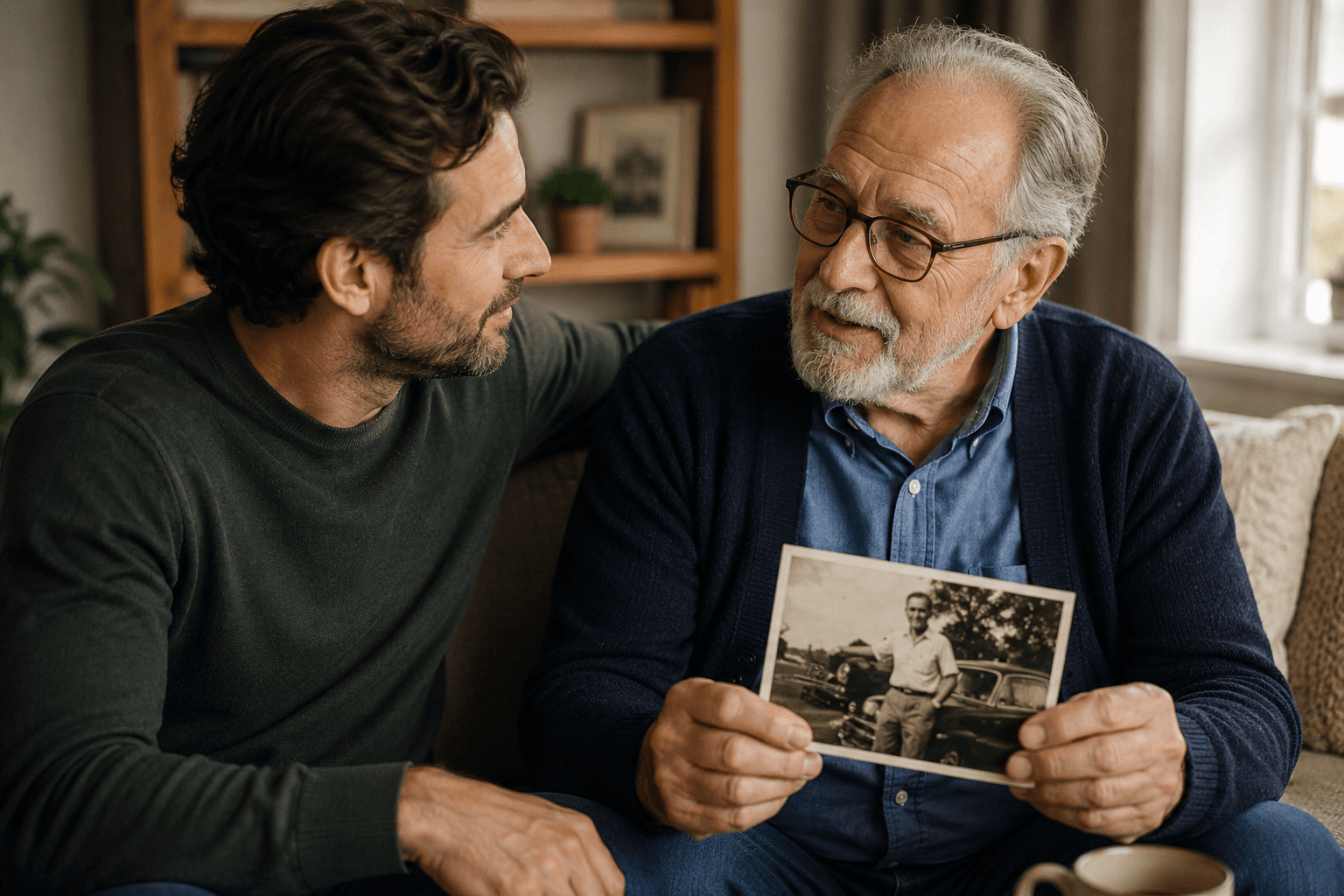
Most Father's Day posts ask you to record your dad. This one asks something different: spend Sunday asking him about his father. He is, for most of us, the last living person who really knew the man your kids will only ever see in a frame. When he goes, the only stories left of your grandfather go with him.
The Memory Murals Team • May 15, 2026

How to Interview Your Dad (Even If He's Not a Talker): A Gentle Guide to Recording His Stories
Most dads don't open up across a kitchen table. They talk sideways — in the truck, in the garage, walking the dog. Here's how to record him anyway: why he deflects, why audio is the medium that finally works, and 30 questions ranked from 'first car' to 'your father.'
The Memory Murals Team • May 5, 2026