
Biblical Baby Names With Meaning
Beyond Noah and Sarah, the Bible holds dozens of beautiful, mostly forgotten names with stunning meanings. Here are the strong ones, the quiet ones, and the ones almost nobody is using yet — with the meaning, the verse, and the why.
The Memory Murals Team • May 17, 2026
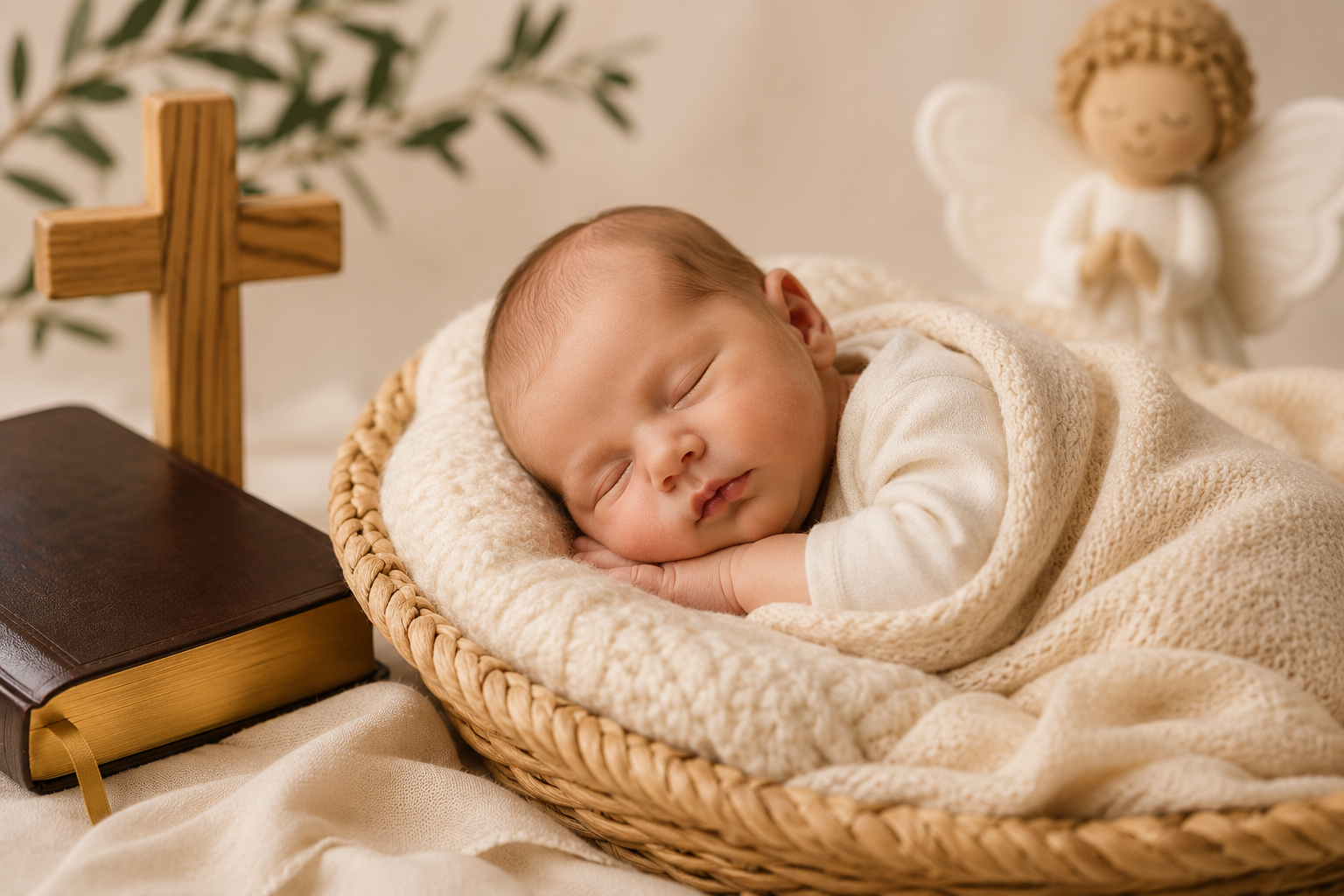
Most lists of biblical baby names give you the same fifteen names you already know. Noah. Mary. Joseph. Sarah. Daniel. The names so popular they've stopped sounding biblical at all and just sound like names.
That's not this list.
The Bible has more than three thousand named people in it. Most of them have meanings — beautiful, specific, sometimes startling meanings — that have been quietly waiting in the index of a Bible nobody has opened in a while. Some of these names are strong. Some are quiet. Some have been forgotten for so long they feel brand new on a 2026 baby.
This is a curated list of the biblical names worth knowing about right now: what each one means, where it appears, and the kind of family it tends to fit. Organized by feel rather than alphabet, because picking a baby name is more about feel than spelling.
If you want a fast tool while you read, our Baby Name Generator lets you filter biblical names by gender, origin, and meaning — useful for finding the less obvious ones once you know what kind of meaning you're after. And if your interest in a biblical name is partly that it carries a memorial weight, our companion piece on baby names that mean memory, legacy, and remembrance covers the deeper version of that conversation.
The short answer
Biblical baby names with strong, beautiful meanings include Asher ("blessed, happy"), Tabitha ("gazelle"), Ezra ("help"), Selah ("pause, reflect"), Caleb ("whole-hearted"), Junia ("youthful"), Reuben ("behold, a son"), and Lior ("my light"). Most are out of the top 200 and carry their meaning right in the name — a name that quietly does some of the work.
What makes a biblical name different from any other old name
Almost every biblical name has a meaning baked into it that goes deeper than the name itself.
A Hebrew name is usually a sentence. Nathaniel doesn't just mean "gift of God" — it's literally the words "gift" and "God" jammed together. Bethel means "house of God." Elijah means "my God is Yahweh." These are statements that the family was making, often about the moment the baby arrived. The name carried theology, history, and a small act of family witness at once.
That's part of why biblical names age so well. The meaning isn't decorative. It's structural.
They tell a story in one word
A Hebrew name is usually a compressed sentence. The story is in the name itself, available for the child to unpack when they're old enough to ask.
They've been used continuously for thousands of years
A name continuously in use for three millennia tends to age better than a name continuously in use for thirty years. Biblical names are tested. They've passed.
They cross borders cleanly
The same name has variants in Hebrew, Greek, Latin, English, Spanish, Russian, Arabic, and more. You can pick the variant that fits your family's voice without losing the original.
The downside, if you can call it that, is that some biblical names carry weight a child may have to grow into. Solomon is a beautiful name with a long heritage and a serious meaning, and a four-year-old Solomon is going to spend a few years being asked if he is wise. That's not always bad. It just means biblical naming asks for a small amount of thought about what you're handing forward.
Strong biblical boy names — beyond the top 20
These are the names with weight, history, and a meaning that a child can grow into. Many were huge in 1880 and have been on the bench since. Most are now climbing again, often slowly enough that you can still pick one without it sounding like a top-10 chart placement.
Asher (Hebrew, "blessed, happy") — The eighth son of Jacob, whose name became a blessing in Jewish liturgy. Currently in the top 30 in the US and still rising — the rare biblical name that carries pure joy as its meaning. Ash is the warm nickname.
Ezra (Hebrew, "help") — The scribe and priest who led the second wave of return from exile. The name itself is a quiet declaration: we needed help, and we got it. Currently in the top 25 and one of the most-chosen names for thoughtful parents in 2026.
Caleb (Hebrew, "whole-hearted" or "faithful, brave") — One of only two spies in the Hebrew scriptures who came back from Canaan with a positive report. The name has carried courage as its meaning for three thousand years. Currently in the top 50.
Reuben / Ruben (Hebrew, "behold, a son") — The firstborn of Jacob. The name itself is the cry of a mother at a birth. Rising in 2026 after several decades on the bench. The nickname Rube is warm and short.
Boaz (Hebrew, "swift" or "in strength") — The kind-hearted landowner in the book of Ruth who marries her and ultimately becomes great-grandfather of King David. Still rare on a 2026 baby; climbing slowly.
Gideon (Hebrew, "great warrior" or "feller of trees") — A judge of Israel who led a famous small-force victory. Long out of fashion in English-speaking countries; back in steady use among writer and faith-rooted families.
Silas (Latin/Greek, "of the forest" — also a New Testament traveling companion of Paul) — Often classified as biblical even though the root is Latin; widely used in both Christian and secular families. Currently top 100, climbing fast.
Tobias / Toby (Hebrew, "God is good") — A figure from the deuterocanonical book of Tobit. The full form Tobias has a Germanic-Yiddish warmth; the nickname Toby is one of the cheerful boy names of the decade.
Levi (Hebrew, "joined, attached") — The third son of Jacob and the ancestor of the priestly tribe. Currently in the top 20 in the US — the meaning, joined, is a quiet metaphor for what a child does to a family.
Eli / Elias / Elijah (Hebrew, "my God") — The short and long forms of one of the most important names in Hebrew scripture. Elijah is in the top 5; Eli is in the top 50; Elias is climbing. All carry the same root meaning of personal devotion.
Phineas (Hebrew, "oracle" or "mouth of brass") — One of the deeper biblical vintages. Still rare. The Dickens character helps a little; the nickname Phinn keeps it light. Worth knowing about even if you don't use it.
Zebulun / Zebedee (Hebrew, "dwelling, exaltation") — A son of Jacob and a father of two apostles. Almost no one uses these on a 2026 baby. Zeb would be the modern nickname.
Malachi (Hebrew, "my messenger") — The last prophet of the Hebrew scriptures and one of the most beautifully named. Currently in the top 200 and climbing. Mal or Kai both work as nicknames.
Job (Hebrew, "persecuted" or "the patient one") — Heavy meaning, but the name itself has been used quietly in Christian and Jewish families for centuries. Almost nobody uses it on a 2026 baby. Could be one of the breakout choices of the next decade.
Amos (Hebrew, "carried by God" or "burdened") — A prophet known for fierce social-justice oratory. Three letters; perfect 2026 sound. Climbing for ten years now and not slowing down.
Hosea / Hoseah (Hebrew, "salvation") — A prophet whose name shares a root with both Joshua and Jesus. Still very rare; the deeper-vintage version of Joshua.
Strong biblical girl names — beyond Mary and Sarah
The Bible has fewer named women than named men, but the ones it has tend to carry striking meanings. These are the strong ones — names with weight and a story underneath.
| Feature | Physical | Digital |
|---|---|---|
| Tabitha | Aramaic, "gazelle" | Disciple in the book of Acts; raised by Peter (Acts 9) |
| Junia | Latin, "youthful" | Romans 16:7 — described as "outstanding among the apostles" |
| Priscilla | Latin, "ancient" or "venerable" | Co-leader of an early church alongside her husband Aquila |
| Damaris | Greek, "calf" or "gentle" | Convert and follower of Paul mentioned in Acts 17:34 |
| Lydia | Greek, "from Lydia" (a region) | The first European convert; a merchant of purple cloth (Acts 16) |
| Phoebe | Greek, "radiant" | Romans 16 — "a deaconess of the church at Cenchreae" |
| Abigail | Hebrew, "father's joy" | One of the wives of David; known for her wisdom and diplomacy |
| Esther | Persian/Hebrew, "star" or "hidden" | The Persian queen whose courage saved her people (book of Esther) |
| Deborah | Hebrew, "bee" | A prophetess and the only female judge of Israel (Judges 4–5) |
| Naomi | Hebrew, "pleasant" | The mother-in-law in the book of Ruth; a portrait of grief and return |
| Rhoda | Greek, "rose" | Servant girl who recognizes Peter at the gate in Acts 12:13 |
| Salome | Hebrew, "peace" | Follower of Jesus; sometimes identified as a sister of Mary |
Tabitha
- PhysicalAramaic, "gazelle"
- DigitalDisciple in the book of Acts; raised by Peter (Acts 9)
Junia
- PhysicalLatin, "youthful"
- DigitalRomans 16:7 — described as "outstanding among the apostles"
Priscilla
- PhysicalLatin, "ancient" or "venerable"
- DigitalCo-leader of an early church alongside her husband Aquila
Damaris
- PhysicalGreek, "calf" or "gentle"
- DigitalConvert and follower of Paul mentioned in Acts 17:34
Lydia
- PhysicalGreek, "from Lydia" (a region)
- DigitalThe first European convert; a merchant of purple cloth (Acts 16)
Phoebe
- PhysicalGreek, "radiant"
- DigitalRomans 16 — "a deaconess of the church at Cenchreae"
Abigail
- PhysicalHebrew, "father's joy"
- DigitalOne of the wives of David; known for her wisdom and diplomacy
Esther
- PhysicalPersian/Hebrew, "star" or "hidden"
- DigitalThe Persian queen whose courage saved her people (book of Esther)
Deborah
- PhysicalHebrew, "bee"
- DigitalA prophetess and the only female judge of Israel (Judges 4–5)
Naomi
- PhysicalHebrew, "pleasant"
- DigitalThe mother-in-law in the book of Ruth; a portrait of grief and return
Rhoda
- PhysicalGreek, "rose"
- DigitalServant girl who recognizes Peter at the gate in Acts 12:13
Salome
- PhysicalHebrew, "peace"
- DigitalFollower of Jesus; sometimes identified as a sister of Mary
A few extras worth knowing about in the strong-girl category:
Mara (Hebrew, "bitter") — The name Naomi calls herself after her loss in the book of Ruth ("Call me Mara, for the Almighty has dealt bitterly with me"). Heavy meaning, beautiful sound, sometimes chosen by parents who have known grief and want to name a child arriving on its other side.
Selah (Hebrew, "pause, reflect") — Technically a musical/liturgical instruction in the Psalms rather than a person, but used as a girl's name for the last twenty years. Carries a meaning almost no other name can match: stop, listen, be still.
Anna / Hannah (Hebrew, "grace, favor") — One name in two forms. Anna is in the top 30; Hannah is in the top 40. Both carry the same root meaning, both name the woman who recognized the infant Jesus in the temple, and both age beautifully through a whole life.
Susanna / Susannah (Hebrew, "lily") — A name with stunning history — appears in the books of Daniel and Luke — and currently rising on a slow line. The shortened Susie is having a quiet revival.
Tirzah (Hebrew, "delight") — One of the deepest cuts on the list. A daughter of Zelophehad whose name became a city. Almost nobody uses it on a 2026 baby. Beautiful sound, immediate warmth.
Quiet biblical names — soft, short, easy to wear
These are the names with biblical history but a notably soft, gentle sound — names that work well on a tiny baby and grow into adult names without any awkwardness. Most are short. Most are out of the top 200 right now.
Eve
Hebrew, "life" or "living one." Three letters, one syllable, the most ancient woman's name in the Western tradition. Climbing in 2026 after decades on the bench.
Mira / Miriam
Hebrew, "beloved" or "wished-for child." Miriam is the original; Mira is the soft modern form. Both work; both quietly carry the meaning of a long-awaited daughter.
Ari / Ariel
Hebrew, "lion of God." Ari works for any gender; Ariel works for either. Both carry strength without sounding heavy.
Eden
Hebrew, "delight" or "place of pleasure." A garden, a beginning, a name that is gentle on the ear and weighty in meaning. Rising on both sides of the gender line.
Jonah
Hebrew, "dove." The reluctant prophet of the whale story, but the name itself just means dove. Currently top 150 and steady.
Susie / Susanna
Hebrew, "lily." See above. The full form is rich; the nickname is gentle. Many parents in 2026 are choosing names with this kind of long-form-nickname structure.
Lior / Liora
Hebrew, "my light" or "I have a light." Often given in remembrance of someone the family wants to keep bright. Soft, two-syllable, increasingly used.
Talia
Hebrew, "dew from God." A name that sounds entirely contemporary while carrying a 3000-year-old root. Climbing fast.
Nava
Hebrew, "beautiful." Two syllables, soft, easy to wear at any age. Rare on a 2026 baby, but the kind of name early-adopter parents are starting to use.
Avi / Avigail
Hebrew, "my father" / "father's joy." Avi works as a standalone boy's name (Hebrew Avi, "my father"), or as a nickname for Avigail (Abigail) on the girls' side.
More quiet biblical picks worth knowing:
Sela (Hebrew, "rock") — Short, soft, immediately easy to say. Carries the meaning of that which endures — fitting for any baby a family wants to grow into something steady.
Tovah / Tova (Hebrew, "good") — Two syllables, simple, deep. Mostly used in Jewish families but works in any tradition that values plain-spoken meaning.
Iliana (Hebrew/Greek, "the Lord answered me") — A long-form name with a built-in story. Climbing in Latin American naming and starting to cross over.
Shai (Hebrew, "gift") — Unisex, one syllable, easy on the ear, profound in meaning. Used widely in Israeli naming and starting to appear elsewhere.
Yael / Jael (Hebrew, "mountain goat" — but in name meaning, "to ascend") — A book-of-Judges figure who literally drove a tent peg through an enemy general's head. The strongest woman's name in the Bible, possibly. Soft sound, hard history.
The forgotten ones — biblical names almost nobody is using yet
This is the deepest part of the index. These are names that appear in the Bible, often only once, with meanings that have been quietly waiting in the footnotes for centuries. On a 2026 baby, most of these would be the only one in a kindergarten — which is, for some families, exactly the point.
Tirzah (Hebrew, "delight" — Numbers 26:33) — Already mentioned above; included again because it is genuinely one of the best forgotten ones.
Keren / Karen (Hebrew, "ray of light" or "horn of plenty" — Job 42:14) — One of Job's three daughters, born after his suffering had ended. The Karen-as-meme moment has unfairly buried a name with stunning meaning. Karen the Hebrew name is unrelated to Karen the internet caricature — it just shares the spelling.
Jemima (Hebrew, "dove" — Job 42:14) — Another of Job's daughters. The pancake-syrup association still hovers; the name itself is one of the most beautiful in the Hebrew Bible. Recovering slowly.
Keziah (Hebrew, "cassia" — Job 42:14) — The third of Job's daughters, all three of whom are described in the text as the most beautiful women in the land. Used quietly for centuries; almost nobody on a 2026 baby.
Ada / Adah (Hebrew, "ornament, adornment" — Genesis 4:19) — Two of the earliest named women in the Bible (one is Lamech's wife, the other is Esau's wife). Ada is currently rising; the spelling Adah is rarer.
Bezalel (Hebrew, "in the shadow of God" — Exodus 31:2) — The craftsman who built the tabernacle. One of the most beautiful name meanings on earth, attached to a name almost nobody knows. Boy's name; deep cut.
Othniel (Hebrew, "lion of God" — Judges 3:9) — The first judge of Israel. Long out of use, ripe for revival.
Tamar (Hebrew, "date palm" — Genesis 38) — Appears multiple times in the Bible. The associated stories are weighty (Tamar is the wronged daughter-in-law in Genesis, and there is a second Tamar in 2 Samuel). The name itself, date palm, carries the meaning of upright endurance.
Bilhah / Zilpah (Hebrew, mothers of four of Jacob's sons) — Genuinely forgotten. Bilhah means "troubled" or "modest"; Zilpah, "frailty" or "drop." Not in widespread use on a 2026 baby and unlikely to be — but worth knowing they exist.
Onesimus (Greek, "useful") — A figure in the book of Philemon. Almost no one uses this name. Carries a complex history (Onesimus was a runaway slave whose freedom Paul argued for in the letter that bears Philemon's name) that some families specifically want to honor.
Drusilla (Latin, "strong" — Acts 24) — Sometimes appears in Christian naming traditions; almost never on a baby today.
Mahlah / Milcah / Hoglah (daughters of Zelophehad, Numbers 27) — Five sisters who successfully petitioned Moses for the right to inherit their father's property — one of the earliest recorded legal victories for women in Western literature. Mahlah means "weakness" but is read in the broader story as the name of a quietly powerful daughter. Milcah means "queen."
Asenath (Hebrew, "belonging to her father" — Genesis 41) — The Egyptian wife of Joseph. Stunning sound, rich history. Possibly one of the great unused names in the Hebrew Bible.
On reviving a forgotten biblical name
If you choose one of these names, your kid will be a small-scale ambassador for it. People will mispronounce it. Teachers will ask you to spell it. The kid will, at some point, decide whether to embrace the name's biblical roots or quietly translate it to a nickname for daily use. None of that is bad. The name was always going to come back into circulation through some family; it might as well be yours. Some of the most loved names on the planet today (Hazel, Ezra, Asher) were exactly in this same position twenty-five years ago. Vintage names need someone to use them first.
Biblical names grouped by meaning
If you know what kind of meaning you want — a name that means light, a name that means help, a name that means life — here's the index by category.
| Feature | Physical | Digital |
|---|---|---|
| "Light" | Lior, Liora, Nahor, Uriel, Phoebe (radiant), Aurelia (Latin-Christian) | |
| "Joy" or "happy" | Asher, Abigail (father's joy), Beatrice (Latin-Christian), Felix (Latin-Christian) | |
| "Help" or "salvation" | Ezra, Hosea, Joshua, Jesus (Yeshua), Azarel | |
| "Gift" or "given" | Nathan, Nathaniel, Matthew, Theodore (Greek-Christian), Shai | |
| "Grace" or "favor" | Hannah, Anna, John (Yochanan), Hanan, Yochanan | |
| "Life" | Eve (Chava), Zoe (Greek-Christian), Vita (Latin-Christian) | |
| "Beauty" or "delight" | Tirzah, Naomi (pleasant), Eden (delight), Nava (beautiful) | |
| "Strength" or "courage" | Caleb, Boaz, Gideon, Othniel, Yael | |
| "Wisdom" | Solomon (peaceful, by implication wise), Hannah (one of the wise women) | |
| "Memory" or "remembered" | Zachary, Zechariah, Yadid, Yadira (see the companion piece) | |
| "Peace" | Solomon, Salome, Selah (pause, peace), Shalom (in Sephardic naming) |
"Light"
- Physical
- DigitalLior, Liora, Nahor, Uriel, Phoebe (radiant), Aurelia (Latin-Christian)
"Joy" or "happy"
- Physical
- DigitalAsher, Abigail (father's joy), Beatrice (Latin-Christian), Felix (Latin-Christian)
"Help" or "salvation"
- Physical
- DigitalEzra, Hosea, Joshua, Jesus (Yeshua), Azarel
"Gift" or "given"
- Physical
- DigitalNathan, Nathaniel, Matthew, Theodore (Greek-Christian), Shai
"Grace" or "favor"
- Physical
- DigitalHannah, Anna, John (Yochanan), Hanan, Yochanan
"Life"
- Physical
- DigitalEve (Chava), Zoe (Greek-Christian), Vita (Latin-Christian)
"Beauty" or "delight"
- Physical
- DigitalTirzah, Naomi (pleasant), Eden (delight), Nava (beautiful)
"Strength" or "courage"
- Physical
- DigitalCaleb, Boaz, Gideon, Othniel, Yael
"Wisdom"
- Physical
- DigitalSolomon (peaceful, by implication wise), Hannah (one of the wise women)
"Memory" or "remembered"
- Physical
- DigitalZachary, Zechariah, Yadid, Yadira (see the companion piece)
"Peace"
- Physical
- DigitalSolomon, Salome, Selah (pause, peace), Shalom (in Sephardic naming)
For the memory and remembered category specifically, many of the strongest names are biblical (Zachary, Yadira, Lior) but several come from Sanskrit, Latin, and other traditions worth knowing about side by side — see the companion piece linked in the opening of this post for the deeper version of that conversation.
The same name in different traditions
One of the most useful things about biblical names is that almost every one has variants across languages. If the Hebrew or English form doesn't feel right, the Spanish or Greek or Russian version might. The meaning stays the same.
| Feature | Physical | Digital |
|---|---|---|
| Yochanan (grace) | John | Juan / Greek Ioannis / Russian Ivan |
| Yeshua (salvation) | Joshua / Jesus | Jesús (Sp.) / Greek Iesous |
| Yaakov (heel-grasper) | Jacob / James | Diego (Sp.) / Greek Iakovos |
| Miryam (beloved) | Mary / Miriam | María (Sp.) / Greek Maria / Marisol |
| Eliyahu (my God) | Elijah / Elias | Elías (Sp.) / Greek Ilias |
| Mosheh (drawn out) | Moses | Moisés (Sp.) / Greek Moses |
| Sarah (princess) | Sarah / Sara | Sara (Sp.) / Greek Sara / Sarai |
| Channah (grace) | Hannah / Anna | Ana (Sp.) / Greek Anna / Russian Anya |
| Tabita (gazelle) | Tabitha | Dorcas (Greek, same meaning) |
| Avraham (father of nations) | Abraham | Abraham (Sp.) / Arabic Ibrahim |
Yochanan (grace)
- PhysicalJohn
- DigitalJuan / Greek Ioannis / Russian Ivan
Yeshua (salvation)
- PhysicalJoshua / Jesus
- DigitalJesús (Sp.) / Greek Iesous
Yaakov (heel-grasper)
- PhysicalJacob / James
- DigitalDiego (Sp.) / Greek Iakovos
Miryam (beloved)
- PhysicalMary / Miriam
- DigitalMaría (Sp.) / Greek Maria / Marisol
Eliyahu (my God)
- PhysicalElijah / Elias
- DigitalElías (Sp.) / Greek Ilias
Mosheh (drawn out)
- PhysicalMoses
- DigitalMoisés (Sp.) / Greek Moses
Sarah (princess)
- PhysicalSarah / Sara
- DigitalSara (Sp.) / Greek Sara / Sarai
Channah (grace)
- PhysicalHannah / Anna
- DigitalAna (Sp.) / Greek Anna / Russian Anya
Tabita (gazelle)
- PhysicalTabitha
- DigitalDorcas (Greek, same meaning)
Avraham (father of nations)
- PhysicalAbraham
- DigitalAbraham (Sp.) / Arabic Ibrahim
The fact that you can choose, for instance, Anna over Hannah without losing the meaning — or that you can choose Ana, Anya, or Annette and stay in the same name family — is one of the underused gifts of biblical naming. The name family is large. The meaning is fixed. The form is yours.
How to pick a biblical name well
Biblical naming is not just spiritual; it's a practical decision about what your kid is going to be carrying through their whole life. Here's the working sequence that families who land good biblical names tend to follow.
How to choose a biblical name your kid will be glad you chose
Read the actual story
Don't just pick a name. Read the chapter the name appears in. A name lands differently when you know what kind of person carried it — Tamar in Genesis is not the same Tamar as in 2 Samuel; Mara is a chosen renaming of Naomi after grief. The story shapes the name. Some stories are darker than the name suggests. A few minutes of reading saves a lifetime of awkward explaining.
Check the meaning, not just the sound
Some biblical names sound beautiful and mean something heavy. Mara, for instance, is "bitter." That's a name that some families specifically choose because the bitterness was followed by a kind of return, but it's worth knowing what the name says about the child every time someone learns its meaning.
Pick the language form that fits your family's voice
Most biblical names have an English form, a Spanish form, a Hebrew form, and often a Greek or Russian or Arabic one. They mean the same thing. The form that fits the family is the one that fits. There's no rule that says English is the default.
Run the daily-use test
Imagine the name on a coffee cup. On a school sign-in. Being yelled across a yard. Being introduced at a job interview. Biblical names with built-in nicknames (Tobias → Toby; Susanna → Susie; Tabitha → Tabby) tend to age better than names where there's no childhood-friendly short form.
Tell the story to a five-year-old in your head
Practice the explanation. "Your name is Asher, which means joy. We named you that because…" If the sentence is true and easy to finish, the name is doing what biblical names are supposed to do. If you can't easily finish the sentence, either keep researching or look for a different name in the same family.
Write the name story down before you forget it
The name is the front door of a story. The story behind it is what makes the name an heirloom rather than a fashion choice. Record yourself saying why you chose it, even just a one-minute voice note, before you lose the freshness of the answer.
On naming biblically without being from a faith tradition
Plenty of families use biblical names without being practicing Jews or Christians. There's no rule against it. The names have been part of Western naming for fifteen hundred years and have long since crossed the line from religious-only to broader cultural use.
What's worth doing, if you're outside the faith tradition the name comes from, is being honest with yourself about why you're drawn to it. Three good reasons, in order of how often we hear them.
Good reasons
-
The meaning resonates with the kind of person you hope your child grows into. Asher (joy), Caleb (whole-hearted), Hannah (grace) are picked by many secular families precisely for the meaning. The meaning carries.
-
The sound is genuinely beautiful and the historical depth gives it weight. Lydia, Phoebe, Eli all read as elegant and aged-well regardless of whether the family is religious.
-
A family member you loved had the name, and the original biblical association is incidental. This is a real category — many families honor a grandmother named Ruth or a grandfather named Isaac without thinking of it as a "biblical" choice at all.
Worth thinking through
-
If you're picking a biblical name to add gravitas you don't otherwise feel, the kid eventually notices. Names that are chosen as a kind of borrowed identity tend to feel borrowed.
-
If you're picking the name from a religion that isn't yours, learn at least the basic story. Owning the name means owning a small piece of its history.
-
Some biblical names have been heavily associated with specific religious traditions — Solomon and Esther are deeply Jewish; Mary and Joseph are deeply Christian. Using these names from outside those traditions is not wrong, but it does mean the kid may field assumptions throughout their life. Worth knowing in advance.
The short version: biblical names are open to everyone who genuinely loves them. The honoring is in the knowing.
The short answer
The biblical baby names with the richest meaning aren't always the most popular ones. Asher (joy), Tabitha (gazelle), Ezra (help), Selah (pause), Caleb (whole-hearted), Junia (youthful), Lior (my light), Tirzah (delight) all carry beautiful meanings that the child can grow into and unpack across a lifetime. Pick a name whose story you can finish in one sentence. Read the chapter it comes from. Write down why you chose it before the baby gets old enough to ask. The name itself is just the door. The story is what makes it an inheritance.
The name is the front door, the story is the whole house
A biblical name has one advantage almost no other name has: a multi-thousand-year head start on meaning. The day you write Asher or Hannah or Caleb on a birth certificate, you're attaching your child to a meaning that has been actively used and unpacked by other families for three millennia.
The catch is that the meaning isn't automatic. It only becomes part of the kid's life if someone — usually you — tells them what their name means, where it comes from, and why you chose it.
Most adults named from the Bible can tell you the meaning of their name on request. It's the kind of fact that gets passed down at age four and remembered for life. The parents who do this well don't sit the child down for a formal explanation; they say the meaning casually, often, over years. Your name means light, you know. Your grandmother loved that. The name becomes a small daily reminder of the meaning, the story, and the person who picked it.
That's the part of biblical naming most lists skip: the name isn't a magic word that does the work for you. It's a beautiful starting place. The work is in the telling.
If you'd like help preserving that telling — the voice saying why you chose the name, the photo of the relative the name honors, the chapter you read that finally convinced you — that's exactly what Memory Murals was built for. A private family archive where a name story can live alongside the voice that should be telling it. Free to start, no public feed, no algorithm.
If you're after a related angle, our companion piece on the small baby milestones you'll forget if you don't write them down covers the same instinct from a different direction — the moments that matter most are almost always the ones nobody writes down, until it's a year later and you can't remember what you were going to say.
The name is the front door. Make sure the story behind it gets preserved alongside.
Related Stories

Baby Names That Mean Memory, Legacy, or Remembrance
Names that literally mean memory, remembrance, or legacy — drawn from Hebrew, Latin, Greek, Sanskrit, and more. For babies born into a story that started long before they arrived.
The Memory Murals Team • May 15, 2026

Baby Milestones You'll Forget If You Don't Write Them Down
You'll remember the first steps. You won't remember the exact day they figured out how to clap. Here's why the small milestones matter most — and how to make sure they don't disappear.
The Memory Murals Team • April 17, 2026

Baby Names That Honor a Grandparent (Without Using Their Exact Name)
You want to honor a grandparent in your baby's name — but you don't want a tiny Mildred or a junior. Here are the gentle, modern ways families do it well.
The Memory Murals Team • May 14, 2026